
# Can Dogs Have Yogurt? A Vet-Backed Look at Whether Yogurt Actually Helps Your Dog’s Gut
Author: PurePalsLab Research Team
Fact-checked by: Veterinary review panel
Published: August 12, 2026
Reading time: 8 minutes
—
Walk into a pet forum and you’ll read the same advice a hundred times: “Give your dog a spoonful of plain yogurt — it’s a natural probiotic.” It’s one of those tips that feels safe and obvious. Yogurt is good for human gut health, the logic goes, so it must help dogs too.
But here’s the question most well-meaning advice skips: why are you giving your dog yogurt in the first place?
If the answer is “to support digestion,” then the honest conversation isn’t really about yogurt at all. It’s about whether yogurt can actually deliver what a dog’s gut needs — and on that front, the evidence tells a more complicated story than the forums do.
Let’s walk through what the research says, where yogurt genuinely fits (and where it doesn’t), and what a more effective approach to canine gut health actually looks like.
—
The Short Answer
Yes, most healthy adult dogs can have plain, unsweetened yogurt in small amounts — it is not toxic, and it won’t harm a dog that tolerates dairy. But “can have” is not the same as “should get their probiotics from.” When you look at what yogurt actually delivers to a dog’s digestive system, it turns out to be a surprisingly inefficient way to support gut health.
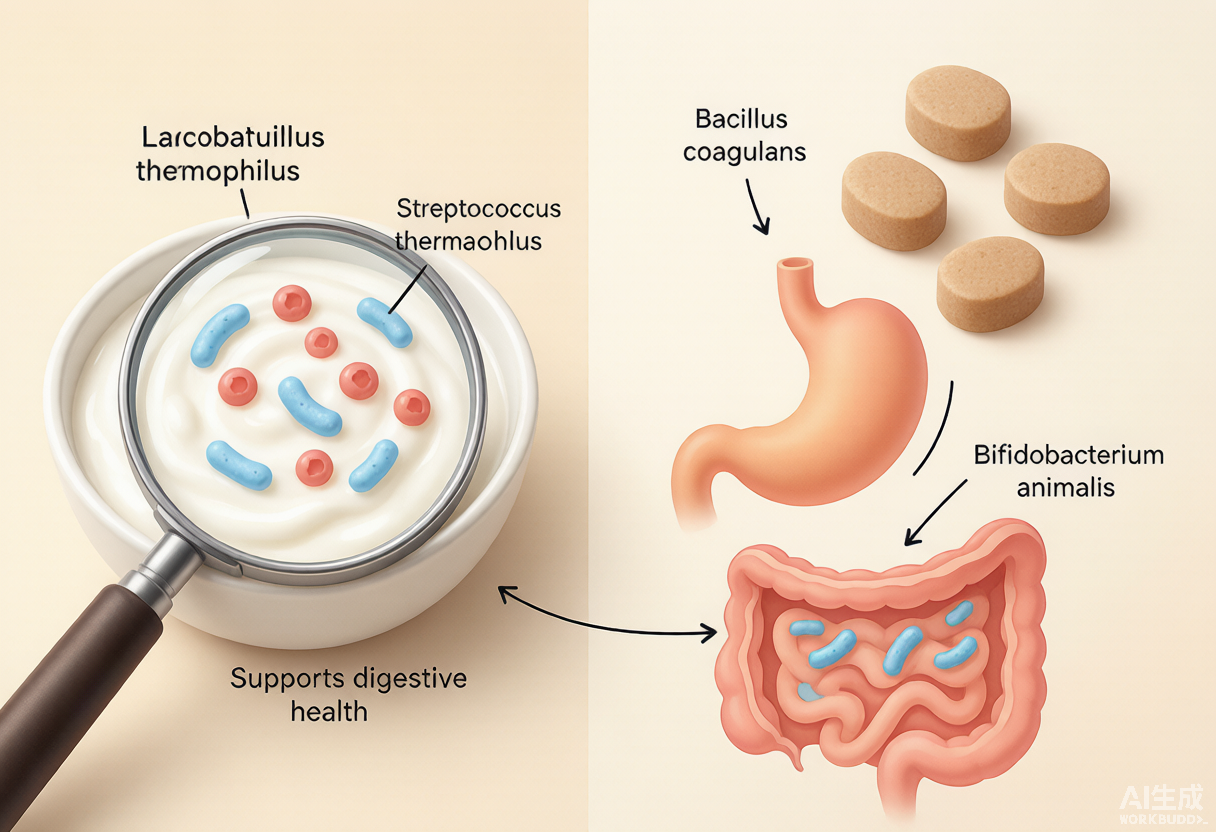
The reason comes down to three things that rarely get mentioned in “can dogs have yogurt” articles: what happens to yogurt’s live cultures in a dog’s stomach, what the strains in yogurt are actually designed to do, and whether the bacteria survive long enough to matter.
—
Why Most Owners Reach for Yogurt (and What They're Really After)
Almost nobody gives their dog yogurt because they’re curious about dairy. They give it because they want to help with something specific — soft stools, intermittent diarrhea, gas, a “sensitive stomach,” or recovery after a course of antibiotics.
That’s a legitimate goal. A healthy gut microbiome — the community of bacteria living in the large intestine — supports digestion, nutrient absorption, and immune function in dogs. When that community gets disrupted, symptoms follow.
The question is whether a bowl of yogurt is a reliable tool for that job. To answer it, you have to look at what actually makes a probiotic effective in a dog’s body.
—
The Hard Question: Do Yogurt's Cultures Survive the Journey?
Here’s the central problem, and it’s a biological one.
For a probiotic to do anything useful, its bacteria have to survive a gauntlet: the highly acidic stomach, the bile salts of the small intestine, and the digestive enzymes along the way — then arrive alive in the colon, where they can influence the microbial community.
Yogurt is made with two starter cultures: Lactobacillus bulgaricus and Streptococcus thermophilus. These strains are excellent at fermenting milk — that’s their job. But they were never selected to survive a dog’s digestive tract. They evolved to thrive in dairy, not to withstand gastric acid.
Research on probiotic survival consistently shows that many bacterial strains don’t make it through the stomach intact. Acid-resistant, bile-resistant strains do. The starter cultures in yogurt are not, in general, among the hardiest survivors.
The result: a significant portion of the “live cultures” your dog swallows in yogurt never reach the colon in a state where they can help. You’re not getting nothing — but you’re getting far less than the label on the tub might suggest.
—
The Strain Problem: Yogurt Bacteria Aren't Dog Bacteria
Even when yogurt cultures survive, there’s a second issue: most yogurt strains aren’t the ones with the strongest evidence in dogs.
Canine-specific probiotic supplements are formulated with strains that have been studied in dogs. The research-backed examples include:
- **Bacillus coagulans** — a spore-forming strain with a natural protective shell that helps it survive stomach acid. Multiple studies report it shortens the duration of diarrhea and improves stool consistency in dogs.
- **Bifidobacterium animalis** — well-studied for gut barrier support. A 2022 study in *Frontiers in Veterinary Science* found supplementation improved fecal scores and reduced inflammatory markers in dogs with chronic enteropathy.
- **Lactobacillus acidophilus** — among the most-researched *Lactobacillus* species in dogs, with evidence supporting its use for antibiotic-associated diarrhea.
These are strains chosen specifically for canine biology — acid resistance, bile resistance, and documented effects on dog stool quality. Yogurt’s starter cultures were chosen for a different purpose entirely: making yogurt.
—
The Label Problem: CFUs You Can Actually Trust
There’s one more practical difference worth knowing about.
A quality canine probiotic supplement lists a colony-forming unit (CFU) count on the label — a measurable number of viable bacteria per serving, backed by batch testing. You know what you’re getting, and you can hold the manufacturer to it.
Yogurt doesn’t work that way. The “live and active cultures” claim on a yogurt container tells you cultures were added, but it doesn’t tell you:
- How many viable CFUs remain at the time you buy it
- How much the count has dropped during shipping and shelf storage
- Whether the specific strain mix survived the trip from the factory to your fridge
The live bacteria count in yogurt degrades over time and with temperature changes. So even “high-culture” yogurt is a moving target — you genuinely don’t know how many viable organisms your dog is actually ingesting.
—
The Lactose Factor Most Owners Never Consider
Here’s a fact that surprises most dog owners: the majority of adult dogs are lactose intolerant to some degree.
Puppies produce plenty of lactase — the enzyme that breaks down lactose — because they’re built to digest their mother’s milk. But lactase production drops sharply after weaning. By adulthood, many dogs produce only a fraction of the lactase they had as puppies.
When an adult dog eats yogurt, the undigested lactose passes into the large intestine, where gut bacteria ferment it. The result: gas, bloating, loose stools, and abdominal discomfort — the very symptoms you might be trying to fix with the yogurt in the first place.
A 2019 study in the Journal of Animal Physiology and Animal Nutrition found that approximately 60% of adult dogs showed measurable signs of lactose maldigestion when fed dairy products. That’s not a small minority — it’s the majority.
And here’s the irony: if you’re reaching for yogurt to settle your dog’s stomach, for a lactose-intolerant dog, you may be doing the opposite of what you intended.
—
How a Healthy Gut Microbiome Actually Works in Dogs
Before deciding what to feed your dog, it helps to understand what you’re trying to support in the first place.
A dog’s large intestine hosts a dense, diverse community of microorganisms — mostly bacteria, plus some yeasts and other organisms. This community, the gut microbiome, does far more than process leftover food. It:
- **Ferments indigestible fiber** into short-chain fatty acids like butyrate, which feed the cells lining the colon and help maintain a healthy gut barrier.
- **Competes with pathogens** for space and nutrients, making it harder for harmful bacteria like *Clostridium* and *Salmonella* to take hold.
- **Trains the immune system.** A large share of a dog’s immune tissue sits along the digestive tract, and the microbiome plays a central role in keeping that response balanced.
- **Synthesizes certain vitamins** and supports nutrient absorption.
When this community is diverse and balanced, digestion runs smoothly. When it’s disrupted — by a poor diet, stress, antibiotics, or illness — the balance tips, and symptoms like loose stools, gas, and abdominal discomfort follow.
The goal of any gut-health intervention, whether yogurt or a probiotic supplement, is to help restore or maintain that balance. And that’s exactly why the delivery method matters so much: it’s not enough for bacteria to be in the food. They have to reach the colon alive, in meaningful numbers, to actually shift the community.
—
The Three Tests a Real Canine Probiotic Passes (and Yogurt Often Doesn't)
If you want to evaluate any gut-health product — yogurt included — run it through three tests. These are the criteria veterinary researchers use when assessing whether a probiotic is likely to work.
Test 1: Does the strain survive gastric acid and bile?
This is the survival test. The most reliable way to guarantee gastric survival is a spore-forming strain like Bacillus coagulans, which has a natural protective shell. Non-spore-forming strains can still work, but they need to be delivered in high numbers and often with protection. Yogurt’s starter cultures generally don’t fare well here.
Test 2: Does the strain have documented effects in dogs?
Many probiotics work in humans but haven’t been studied in dogs — canine gut biology differs. The strains with the strongest canine evidence base are the ones to look for. Yogurt’s cultures were selected for dairy fermentation, not for canine outcomes.
Test 3: Is the dose known and verifiable?
A real probiotic gives you a stated CFU count, per serving, backed by batch testing. This lets you (and your vet) reason about whether the dose is meaningful. Yogurt doesn’t offer this — you can’t know how many viable organisms you’re actually delivering.
Run yogurt through those three tests and it’s clear why it’s an unreliable tool for gut support. Run a quality canine probiotic through them and each box is checked.
—
So When Is Yogurt Actually Okay?
None of this means yogurt is forbidden. If your dog tolerates dairy well and you want to give it as an occasional treat, here’s how to do it as safely as possible:
- **Choose plain, unsweetened** yogurt. Flavored yogurts add sugar, and some “light” or “sugar-free” versions contain xylitol — which is **extremely toxic to dogs**, even in small amounts.
- **Read the full ingredient list**, not just the nutrition panel. Look for xylitol, birch sugar, wood sugar, or any ingredient ending in “-itol.” This is non-negotiable.
- **Start with a teaspoon** and watch for gas, loose stools, or discomfort over the next 24 hours. If you see any, your dog doesn’t tolerate it well.
- **Keep portions small** — a few teaspoons for a large dog, less for a small one. Yogurt should be a treat, not a meal or a daily staple.
- **Avoid it for dogs with known digestive issues** until you’ve talked to your vet.
If you follow those rules, a little plain yogurt now and then is fine for many dogs. But if your goal is actual gut-health support, there’s a more reliable tool for the job.
—
What to Reach For Instead: A Canine-Specific Probiotic
If you’re considering yogurt because your dog has digestive concerns, a canine-specific probiotic supplement addresses the root goal far more effectively. Here’s how the two compare:
| Plain Yogurt | Quality Canine Probiotic | |
|---|---|---|
| **Strains** | Starter cultures (not dog-specific) | Strains selected for canine digestion |
| **Acid/bile survival** | Variable, often low | Formulated for gastric survival |
| **CFU count** | Not verifiable | Stated and batch-tested |
| **Lactose** | Present | Lactose-free |
| **Research in dogs** | Limited | Documented in dogs |
A multi-strain canine probiotic combines several research-backed organisms — spore-forming Bacillus strains for reliable gastric survival, Bifidobacterium for colon health, and Lactobacillus for general digestive support — alongside prebiotics and digestive enzymes.
PurePalsLab’s 12 Billion CFU Multi-Strain Probiotic uses this exact approach: eight strains selected for canine digestion, four prebiotics to feed the good bacteria, and five digestive enzymes — in a lactose-free soft chew. It’s a targeted tool for gut support, rather than a human food repurposed as a supplement.
—
Situations Where a Dedicated Probiotic Makes Sense
There are specific moments in a dog’s life when the gut microbiome is most vulnerable — and when a reliable probiotic matters most. These are the situations where reaching for a dedicated supplement (rather than yogurt) is worth considering:
After a course of antibiotics. Antibiotics are lifesaving, but they don’t discriminate — they kill beneficial bacteria along with harmful ones. Supporting the microbiome during and after antibiotic treatment is one of the best-documented uses for probiotics.
During or after a bout of diarrhea. Whether from dietary indiscretion, stress, or a mild infection, diarrhea often follows a disrupted microbiome. Rebuilding that community can help shorten recovery and firm up stools.
When switching to a new food. Diet changes temporarily stress the digestive system. A probiotic can smooth the transition, though a gradual food switch (over 7-10 days) is still the first step.
For dogs prone to “sensitive stomachs.” Some dogs simply have more reactive digestive systems. A daily probiotic helps maintain a stable baseline, especially when combined with a consistent diet.
During stressful transitions. Moving, boarding, travel, or adding a new pet can trigger stress-related digestive upset. Supporting the gut during these windows can help.
In all of these scenarios, what you want is reliable, measurable support — which points back to a canine-specific probiotic over a human food.
—
The Real Question: Why Are You Reaching for Yogurt?
Before you spoon another dollop into your dog’s bowl, it’s worth asking the question that gets skipped: what are you actually trying to achieve?
If it’s a treat — sure, a little plain yogurt is fine for a dog that tolerates dairy.
If it’s gut-health support — then the honest answer is that a canine-specific probiotic is the more reliable, more measurable, and more effective way to get there. It’s the difference between hoping a food has the right bacteria, and giving your dog a supplement designed around the bacteria that actually work in a dog.
Your dog’s digestive health deserves the version backed by evidence, not the version that happens to be in your fridge.
—

Frequently Asked Questions
How much yogurt can a dog have?
For a dog that tolerates dairy, keep it to a few teaspoons at most — roughly a teaspoon for a small dog and up to a tablespoon for a large dog. Any more risks triggering gas, bloating, or diarrhea in lactose-intolerant dogs, and the probiotic benefit is minimal either way. Always choose plain, unsweetened yogurt and check the ingredient list for xylitol.
Is yogurt an effective probiotic for dogs?
Not a very efficient one. Yogurt’s starter cultures — Lactobacillus bulgaricus and Streptococcus thermophilus — aren’t selected to survive a dog’s stomach acid, aren’t dog-specific, and don’t have a verifiable CFU count. A canine-specific probiotic uses strains chosen for gastric survival and documented in dogs, which makes it a far more reliable gut-health tool.
Which probiotic strains actually work for dogs?
The strains with the strongest canine research include Bacillus coagulans (reduces diarrhea duration), Bifidobacterium animalis (improves stool quality and gut barrier function), and Lactobacillus acidophilus (supports antibiotic-associated diarrhea recovery). Look for a supplement that combines several of these, ideally with prebiotics and digestive enzymes.
Can yogurt cause diarrhea in dogs?
Yes, it can. The majority of adult dogs are lactose intolerant to some degree, and the undigested lactose in yogurt gets fermented by gut bacteria, causing gas, bloating, and loose stools. If you give yogurt and see digestive upset, your dog likely doesn’t tolerate dairy well — stop and consider a lactose-free canine probiotic instead.
References
1. Cornell University, Riney Canine Health Center — The Power of Probiotics. Read
2. Bacillus coagulans as a probiotic strain for dogs — overview of clinical applications. ScienceDirect
3. Microbiota and probiotics in canine and feline welfare. ScienceDirect
4. Bifidobacterium animalis — overview of probiotic applications. ScienceDirect
—
Disclaimer: This article is for educational purposes and is not a substitute for professional veterinary advice. Always consult your veterinarian before adding any supplement — including probiotics — to your dog’s routine, especially if your dog has an existing health condition or is on medication. PurePalsLab supplements are not intended to diagnose, treat, cure, or prevent any disease.