
# Can Dogs Eat Blueberries? The Superfood Label, Weighed Against What Studies Actually Fed
Blueberries have had a remarkable decade. They appear on every superfood list ever written, get blamed and credited for things far beyond their reach, and have made their way into dog treats, kibble toppers, and boutique dog foods with premium pricing. Somewhere between the hype and the skepticism sits a real question: when you toss your dog a few blueberries, are you doing something meaningful, or just sharing a snack?
The safety half of this question is blessedly simple, and it will be settled in the first section below. The interesting half is the health-claims half, because blueberries are one of the few people foods where dog-specific research actually exists, not just rodent studies and extrapolation. That research has real findings, and it also has a dose problem that almost nobody mentions, a gap between what studies fed dogs and what falls off the breakfast table.
This guide covers the safety basics, what the blueberry research in dogs really showed, the sugar math every owner should know, how to feed them, a berry-family warning that every dog owner should read once, and where blueberries fit, and do not fit, in a senior dog’s nutrition plan.
—
The Short Answer
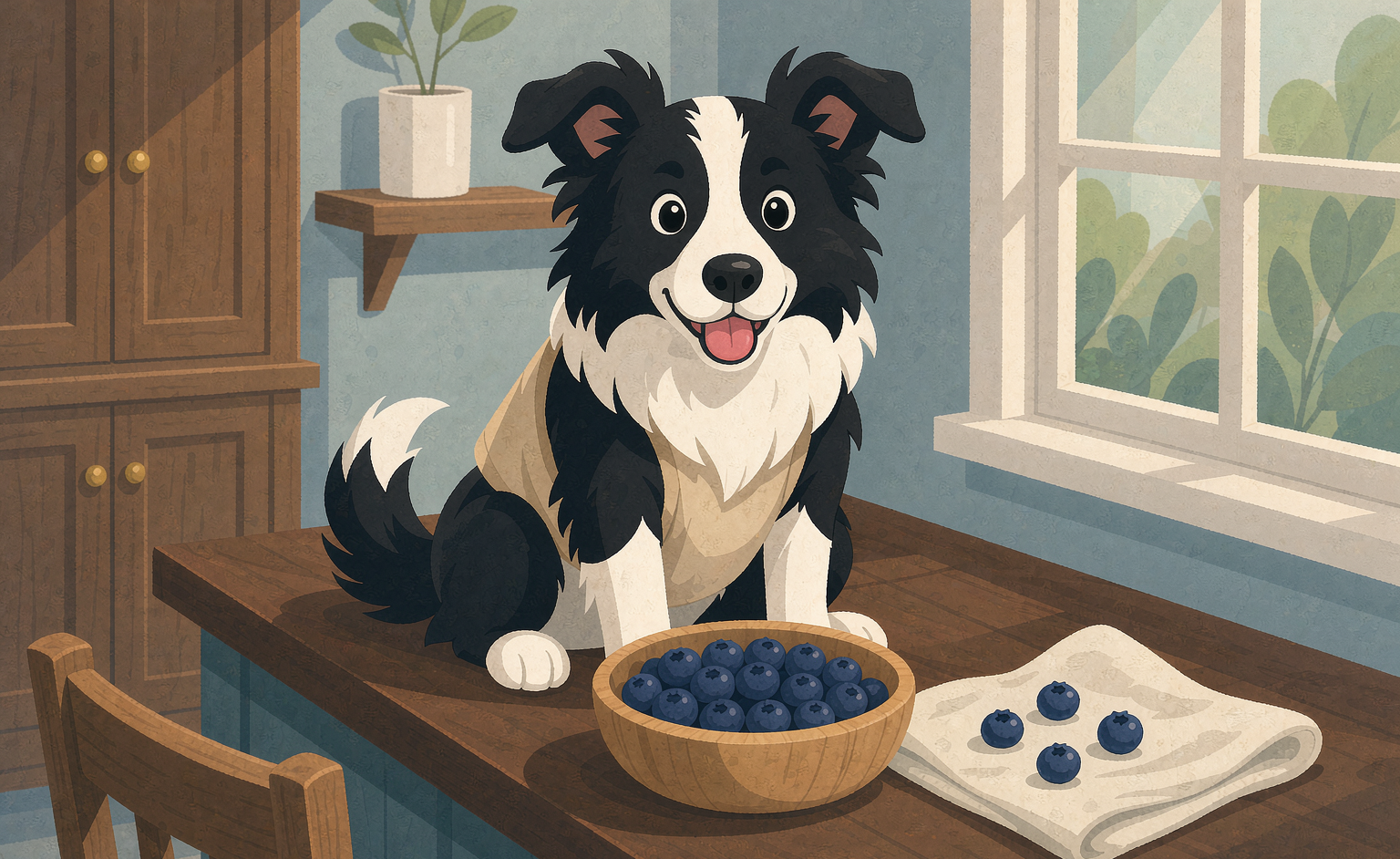
Yes, dogs can eat blueberries. They are nontoxic, low in calories, and small enough that most dogs can eat them whole. The much-hyped antioxidants, anthocyanins that give blueberries their color, are real, and dog studies suggest benefits especially for older dogs’ cognitive function. The honest caveat is dose: those studies used carefully measured daily portions, not a berry or two off the counter, so treat blueberries as a healthy, reasonable snack rather than medicine. Keep portions to roughly a teaspoon of berries per 10 pounds of dog, a few blueberries for a small dog, a small handful for a large one. Skip them if your dog is diabetic without asking your vet, never feed grapes or raisins, which are from a different branch of the fruit world and are severely toxic to dogs, and read ingredient labels on blueberry-flavored products, since flavor and fruit are different things. The senior-dog angle, including how food antioxidants compare with omega-3s from fish oil, is covered below.
—
The Safety Part, Settled
Blueberries are safe for dogs. Not “safe in moderation with caveats” safe, but genuinely nontoxic, with no seeds, pits, or compounds that require processing to become edible. A dog that eats a fallen handful is fine. The practical cautions are mechanical and behavioral: very small dogs can choke on a whole berry, so halve or mash them for toy breeds, and blueberries are round, sweet, and exactly the right size to be inhaled by an enthusiastic eater, which is a reason to offer them one at a time rather than as a bowl to be vacuumed.
That said, one warning belongs at the top of every berry discussion, because it is the one mistake with real consequences: grapes and raisins are toxic to dogs, capable of causing acute kidney failure in amounts as small as a few fruits for some dogs, and they sit on a different branch of the plant family than blueberries despite being sold side by side. Blueberries are safe fruit. Grapes are a veterinary emergency. If your dog ever eats grapes or raisins, call a vet or a pet poison line immediately, even if the dog seems fine, because the window for protective care is the first hours.
What Blueberries Are, Nutritionally
A cup of blueberries is roughly 85 calories, most of it sugar, about 15 grams, plus fiber, vitamin C, vitamin K, and manganese. For the quantities a dog will ever eat, the vitamin content is a footnote: a dog eating a balanced diet gets its vitamin C and K needs met many times over, and dogs synthesize their own vitamin C besides.
The entire case for blueberries, in dogs as in the marketing copy, is a class of pigments called anthocyanins, the compounds that make the berries blue. Anthocyanins are antioxidants, a word worth defining properly because it gets used loosely. Normal metabolism and inflammation produce reactive molecules that damage cells, and antioxidants neutralize them before that damage lands. Oxidative damage accumulates with age and drives some of the chronic problems of aging, which is why antioxidant research in dogs concentrates heavily on senior dogs, whose internal antioxidant defenses have declined. That framing, aging bodies, accumulating oxidative damage, declining defenses, is the honest backdrop for everything that follows.
What the Dog Studies Actually Found
Here is where blueberries earn more respect than most superfoods, and simultaneously less than their marketing implies.
Studies in dogs have looked at blueberries and blueberry-containing antioxidant blends, mostly in senior dogs, and the findings cluster around cognitive aging: older dogs fed antioxidant-enriched diets, blueberry among the ingredients, have shown better performance on learning and memory tasks, and slower cognitive decline than control groups, in work that came out of the same research programs that established how canine cognition changes with age. Aged dogs on antioxidant support in some studies also showed measurable changes in biomarkers of oxidative stress.
Now the dose problem. The dogs in the research did not eat four berries on Sunday. They ate measured daily portions of antioxidant-fortified food, every day, for months, in diets designed so the total antioxidant intake was consistent and meaningful. That is a different object from “I gave him some blueberries because they are good for him.” Four berries a few times a week is a pleasant, healthy treat, with a real but small anthocyanin contribution. It is not the intervention the studies tested.
This is not a reason to skip blueberries. It is a reason to hold the claims at the right size: good snack, genuinely healthful ingredients, plausible small contributions to antioxidant intake, especially for seniors, and a demonstration effect that the produce aisle contains things worth sharing. If the goal is a research-scale antioxidant and anti-inflammatory strategy for an aging dog, that is built on a different foundation, one this article will connect to shortly.
The Sugar Math, and Who Should Skip Berries
Fifteen grams of sugar per cup sounds like a lot until you notice the whole cup is only 85 calories. For a 60 pound dog eating 1,400 calories a day, a small handful of blueberries is a rounding error. The dogs for whom the math matters are three groups.
Diabetic dogs should not get between-meal sugary snacks without the treating vet weighing in, because even small sugar loads complicate glucose management in some diabetics. Overweight dogs can have blueberries as easily as any treat, and they are among the better choices, but they still count against the daily calorie budget, and berries are not exempt from the 10 percent treat guideline most vets suggest. And dogs with a sensitive gut that reacts to new foods may find that a pile of berries, like any sudden dietary addition, produces looser stool, so introduce them the way you would any new food, small amounts first.
The practical portion guide most sources agree on runs to about a teaspoon of berries per 10 pounds of body weight as a treat serving. A Chihuahua gets two or three berries. A Labrador gets a small handful, up to perhaps ten. Daily is not necessary, and “most days as a small topper” is plenty for any realistic benefit.
How to Serve Them
Fresh is the default, rinsed. Frozen is equally good and arguably better for one specific reason: anthocyanins are fairly stable through commercial freezing, and frozen blueberries keep for months, so a bag in the freezer means berry toppers in February. Many dogs enjoy the crunch of a frozen berry. Mashed or halved for small dogs solves the choking geometry and probably helps a little with digestibility, since berry skins are the part a quick eater processes least. Plain in every form, meaning no blueberry yogurt, no blueberry pie, no muffins, since those are sugar, dairy, and in the case of some baked goods, xylitol or other hazards wearing a berry costume.
The treat-dispensing trick worth knowing: drop a few berries into a puzzle feeder or scatter them on grass, and a snack becomes five minutes of nose work, which for a lot of dogs is worth more enrichment than the berries themselves.
Berries in Context: Food Antioxidants and Omega-3s Do Different Jobs
The antioxidant story has a natural partner, and the pairing explains how thoughtful senior dog nutrition actually gets built.
Anthocyanins and food antioxidants work on one side of the aging problem, mopping up reactive molecules in a general way. Omega-3 fatty acids, EPA and DHA from marine sources, work differently: they are structural and signaling molecules, built into cell membranes, and they are the anti-inflammatory backbone of any serious aging-support plan, the ones our fish oil guide covers in detail. A senior dog’s cognitive and joint support plan leans on omega-3s first, because that is where the strongest canine evidence sits, and food antioxidants like blueberries contribute alongside.
That layering, food first for pleasure and general support, omega-3s for the essential fatty acids a dog cannot make, is the same logic behind our wild-caught fish oil: EPA and DHA in a form designed for daily feeding, 200 Chews in a bottle, built to be the reliable layer under the enjoyable ones.
Clarity on limits, as always: blueberries are a snack, and fish oil is not a treatment for disease, and neither reverses cognitive decline or arthritis. They are the nutritional layer of an approach whose other layers, exercise, weight control, and veterinary care, do the heavier work.

Frequently Asked Questions
How many blueberries can my dog eat?
A practical guide is about a teaspoon of berries per 10 pounds of body weight as a serving, so two to three berries for a very small dog, up to around ten for a large breed. A few times a week is plenty, and daily berry toppers are fine for healthy dogs but not necessary. For overweight dogs, count berries within the treat budget; for diabetic dogs, check with your vet first.
Can dogs eat frozen blueberries?
Yes, and frozen is nearly as nutritious as fresh, since anthocyanins hold up well to freezing. Many dogs like the texture, and the freezer means you can keep a bag for months. The one caution is for very small dogs, since a hard frozen berry is a choking shape, so halve or thaw them for toy breeds.
Are blueberries actually good for senior dogs?
They are a reasonable choice, and this is where the strongest dog research sits: studies of antioxidant-enriched diets including blueberry have shown slower cognitive decline in older dogs. The honest caveat is that those studies fed measured daily portions in complete diets, so a few berries as a treat is a small contribution rather than the intervention tested. For senior support, omega-3s from fish oil carry the strongest evidence, which our senior dog supplements guide explains.
Can dogs eat strawberries and blackberries too?
Yes, strawberries, blackberries, and raspberries are all safe for dogs in small amounts, with the same sugar math and portion sense as blueberries. Strawberries carry more sugar per berry and raspberries are high in fiber, so portions stay small. The one hard rule in the berry aisle is grapes and raisins, which are severely toxic to dogs despite being fruits, and any grape ingestion is an immediate call to the vet.
Can diabetic dogs eat blueberries?
Only with your veterinarian’s input. Blueberries are low calorie but still contain sugar, and even small between-meal sugar loads can complicate glucose control in some diabetic dogs. Some vets allow a berry or two timed with meals; others prefer to avoid fruit entirely. Ask before feeding, rather than testing on your own.
Disclaimer
This article is for general education only and is not veterinary advice. Dogs with diabetes, kidney disease, or other chronic conditions should have dietary additions cleared by their veterinarian. If your dog eats grapes or raisins, or any food containing xylitol, contact a veterinarian or pet poison hotline immediately. Product references describe nutritional supplements and are not intended to diagnose, treat, cure, or prevent any disease.
References
- American Kennel Club. “Can Dogs Eat Blueberries?”
- Cummings School of Veterinary Medicine at Tufts University. “Antioxidants and Aging in Dogs.”
- Journal of the American Veterinary Medical Association. “Antioxidant-Fortified Diets and Cognitive Function in Aged Dogs.”
- ASPCA Animal Poison Control. “Grape and Raisin Toxicity in Dogs.”
- Veterinary Clinics of North America: Small Animal Practice. “Nutritional Management of the Senior Dog.”