
# Fish Oil for Dogs: A Practical Guide to Choosing Quality, Dosing EPA & DHA, and Avoiding Rancidity
Author: PurePalsLab Research Team
Fact-checked by: Veterinary review panel
Published: August 12, 2026
Reading time: 9 minutes
—
Walk into any pet store and you’ll see a wall of fish oil bottles. Some say “wild-caught.” Others promise “pharmaceutical grade.” A few list EPA and DHA numbers that sound impressive but mean nothing without context. And almost none of them explain what actually matters when you’re choosing fish oil for a dog.
The truth is, fish oil is one of the most evidence-backed supplements you can give a dog — but only if the product is fresh, properly dosed, and sourced from the right fish. A low-quality, oxidized fish oil can do more harm than good, and a properly chosen one can meaningfully support skin, joints, and overall inflammation balance.
This guide is designed to cut through the marketing and give you a practical framework for choosing, dosing, and storing fish oil for your dog. Not the hype — the actual numbers and standards that separate a useful product from an expensive bottle of rancid oil.
—
The Short Answer
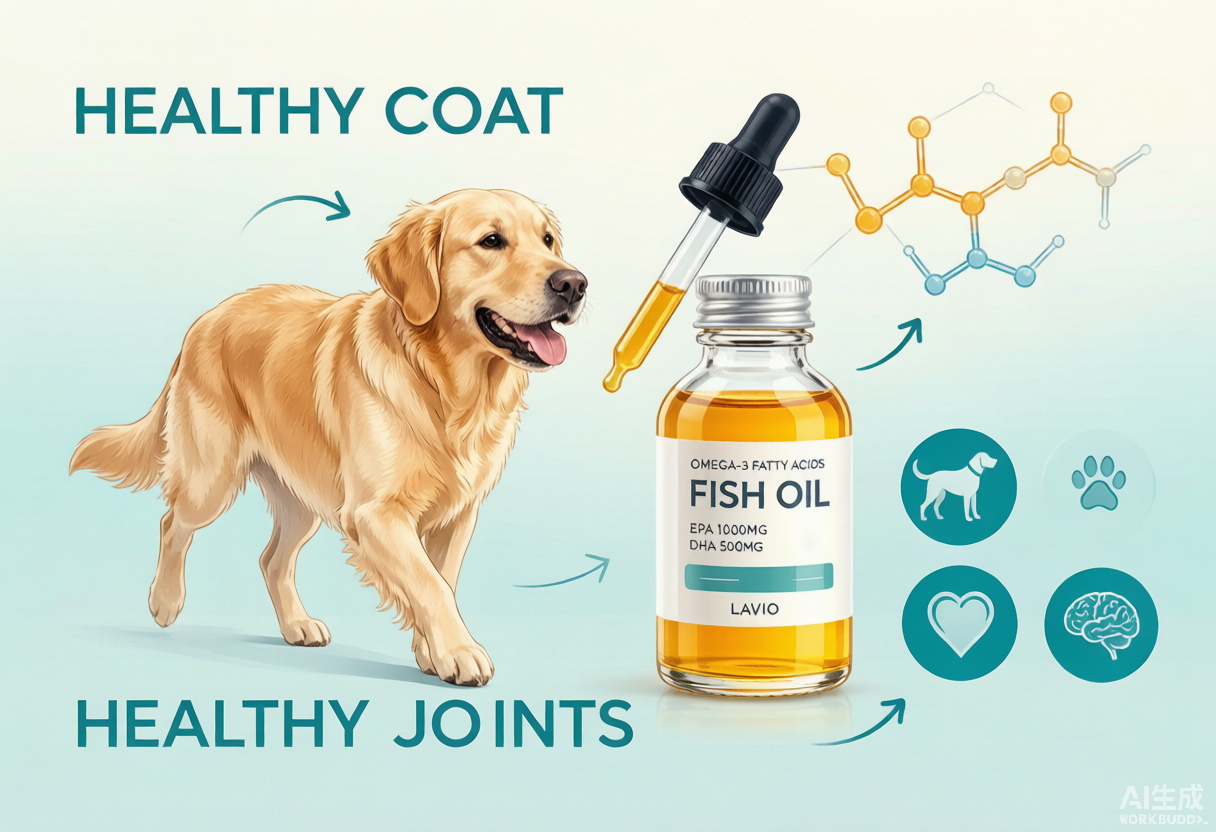
Fish oil is worth considering for most dogs, especially those with skin issues, joint stiffness, or inflammatory conditions. The key is choosing a fresh, low-contaminant product with a verifiable EPA and DHA content — and giving the right dose for your dog’s weight and health goals. More is not better, and oxidized oil is actively harmful.
—
Why Fish Oil Specifically? (And Not Just Any Omega-3)
Dogs need omega-3 fatty acids, but not all omega-3s are equal. The critical distinction is between long-chain and short-chain forms.
EPA (eicosapentaenoic acid) and DHA (docosahexaenoic acid) are long-chain omega-3s found in marine sources. They’re already in the form the body uses — no conversion needed. Dogs absorb them directly, and both have documented anti-inflammatory, neurological, and cardiovascular effects.
ALA (alpha-linolenic acid), found in flaxseed, chia, and walnuts, is a short-chain omega-3. Dogs (and humans) convert ALA to EPA and DHA extremely inefficiently — studies suggest less than 5-10% conversion in dogs. That means flaxseed oil, while healthy in other ways, is a poor source of the omega-3s that actually drive the benefits you’re after.
Fish oil delivers EPA and DHA directly. That’s why it’s the standard recommendation for dogs, rather than plant-based omega-3 sources.
—
Fish Oil vs. Other Marine Sources: A Quick Comparison
Not all marine omega-3 products are the same. Here’s how the main options compare for dogs:
| Source | EPA/DHA Content | Key Advantage | Key Limitation |
|---|---|---|---|
| **Anchovy/Sardine Oil** | Very high | Small fish = lower mercury/PCB accumulation; sustainable | Stronger taste (some dogs resist) |
| **Salmon Oil** | High | Balanced EPA:DHA ratio; palatable | Higher contaminant risk than small fish; sustainability concerns |
| **Krill Oil** | Moderate | Phospholipid-bound (better absorption); astaxanthin antioxidant | Lower total EPA/DHA per dose; expensive |
| **Algal Oil** | Moderate (DHA-heavy) | Plant-based; no fishy taste; sustainable | Lower EPA; less research in dogs |
| **Cod Liver Oil** | Moderate | Contains vitamins A and D | Risk of vitamin A toxicity in dogs; not recommended for routine use |
For most dogs, anchovy or sardine oil offers the best balance of high EPA/DHA, low contaminants, and cost-effectiveness. Salmon oil is a solid alternative if palatability is a concern. Krill and algal oils have niche uses but are harder to dose effectively.
—
How to Read a Fish Oil Label Like a Scientist
The front of the bottle tells you almost nothing useful. Here’s what to look for on the back:
1. Total EPA + DHA (Not Just "Omega-3")
Many labels list “total omega-3” — which can include ALA and other minor fatty acids that don’t deliver the same benefits. What you care about is EPA + DHA combined, in milligrams per serving.
A quality fish oil for dogs should clearly state:
- EPA per serving (mg)
- DHA per serving (mg)
- Total EPA + DHA per serving (mg)
If the label only says “1,000 mg fish oil” without breaking down EPA and DHA, you don’t know what you’re getting.
2. Purity and Contaminant Testing
Fish accumulate environmental contaminants — mercury, lead, PCBs, dioxins. Small fish (anchovies, sardines) are lower on the food chain and accumulate fewer toxins than large predatory fish (tuna, swordfish, some salmon).
Look for:
- **Third-party testing** for heavy metals and PCBs (IFOS, Eurofins, or similar)
- A **Certificate of Analysis (COA)** available on request
- Specific contaminant limits stated (e.g., "mercury < 0.1 ppm")
If a brand won’t show you a COA, that’s a red flag.
3. Oxidation: The Freshness Test That Matters Most
This is the single most overlooked quality factor — and it’s critical.
Fish oil is highly unstable. When exposed to heat, light, or oxygen, the fatty acids oxidize. Oxidized fish oil is pro-inflammatory rather than anti-inflammatory — it does the opposite of what you want.
Signs of oxidation include:
- A strong, fishy, or rancid smell (fresh fish oil smells mild and oceanic, not foul)
- Cloudiness or darkening of the oil
- Softgels that feel sticky or have leaked
Peroxide value (PV) and anisidine value are the lab measures of oxidation. A quality manufacturer tests these and reports them. Look for a peroxide value under 5 meq/kg — the lower, the fresher.
Storage matters enormously. Fish oil should be kept in a cool, dark place. Liquid oil should be refrigerated after opening. Softgels in opaque bottles last longer than clear bottles exposed to light.
—
4. The Smell Test (What You Can Do at Home)
You don’t need a lab to catch rancid oil. Here’s the simple test every dog owner should know:
Pierce or cut open a softgel and smell the oil directly. Fresh fish oil smells mildly oceanic — like the sea, not like a fish market. Rancid oil smells sharply fishy, sour, or paint-like. If you recoil, the oil is oxidized and should not be given to your dog.
For liquid oil, the same rule applies: pour a small amount into a spoon and smell. Any strong, unpleasant odor means the oil has turned.
Pro tip: If you’re using liquid oil, write the opening date on the bottle. Most liquid fish oils stay fresh for 30-60 days after opening if refrigerated. After that, oxidation accelerates regardless of the expiration date on the label.
—
Dosing EPA + DHA: The Framework That Actually Works
There’s no single “correct” fish oil dose for all dogs. The right amount depends on your dog’s weight and what you’re trying to achieve.
Veterinary researchers typically dose fish oil based on combined EPA + DHA, not total oil volume. Here’s a practical framework:
Maintenance / General Wellness
- **10-15 mg combined EPA + DHA per pound of body weight per day**
- Example: A 50-lb dog → 500-750 mg EPA + DHA daily
Skin and Coat Support (Mild Itching, Dryness)
- **20-25 mg combined EPA + DHA per pound per day**
- Example: A 50-lb dog → 1,000-1,250 mg EPA + DHA daily
- Expect visible improvement in 4-6 weeks
Joint Support / Osteoarthritis
- **25-30 mg combined EPA + DHA per pound per day**
- Example: A 50-lb dog → 1,250-1,500 mg EPA + DHA daily
- Expect 6-8 weeks before noticeable mobility improvement
- Works best alongside weight management and appropriate exercise
Chronic Kidney Disease (Under Veterinary Supervision)
- **30-40 mg combined EPA + DHA per pound per day**
- Requires veterinary guidance; not a DIY protocol
Practical Dosing Table
| Dog Weight | Maintenance | Skin/Coat | Joint Support |
|---|---|---|---|
| 10 lb | 100-150 mg | 200-250 mg | 250-300 mg |
| 25 lb | 250-375 mg | 500-625 mg | 625-750 mg |
| 50 lb | 500-750 mg | 1,000-1,250 mg | 1,250-1,500 mg |
| 75 lb | 750-1,125 mg | 1,500-1,875 mg | 1,875-2,250 mg |
| 100 lb | 1,000-1,500 mg | 2,000-2,500 mg | 2,500-3,000 mg |
All values = combined EPA + DHA, in milligrams per day
Important: These are total EPA + DHA amounts. Check your product label to see how much EPA + DHA is in each softgel or milliliter of liquid. A “1,000 mg fish oil” softgel might only contain 300 mg of EPA + DHA — meaning your 50-lb dog needs 2-5 softgels for joint support, not one.
—
Liquid Oil vs. Softgels vs. Soft Chews: Which Format for Your Dog?
| Format | Pros | Cons | Best For |
|---|---|---|---|
| **Liquid oil** | Easy to dose precisely; can mix with food | Goes rancid faster; messy; some dogs reject taste | Dogs who eat wet food; precise dosing needs |
| **Softgels** | Protected from oxidation; portable | Hard to dose fractionally; some dogs won't swallow | Dogs who take pills easily; travel |
| **Soft chews** | Palatable; pre-measured; often include other ingredients | Less control over exact EPA/DHA dose; may contain fillers | Dogs who resist pills and liquids; convenience |
For most dog owners, soft chews are the most practical daily option — especially if they combine omega-3s with other joint or skin-supporting ingredients like glucosamine, turmeric, or MSM.
PurePalsLab’s Omega 3-6-9 Complete Fatty Acid Complex delivers 800 mg of omega-3 (300 mg EPA + 300 mg DHA) per 2-chew serving, alongside omega-6, omega-9, glucosamine, turmeric, and MSM — in a palatable soft chew format. It’s designed for dogs who need comprehensive fatty acid and joint support without the mess of liquid oil or the pill-swallowing challenge of softgels.
—
How to Give Fish Oil to a Dog (Without the Mess)
- **Start low and increase gradually.** Begin at half the target dose for 3-5 days, then increase to the full dose. This reduces the chance of digestive upset.
- **Give with food.** Fish oil is fat-soluble and absorbs better with a meal. It also reduces the chance of fishy burps or stomach upset.
- **Consistency beats intensity.** Daily low-dose fish oil outperforms sporadic high doses. The benefits build over weeks as omega-3s incorporate into cell membranes.
- **Watch the calories.** Fish oil is calorie-dense. If your dog is on a weight-management plan, account for the extra calories — roughly 9 calories per gram of oil.
- **Don't double-dose.** If you miss a day, just resume the normal schedule. Doubling up doesn't help and increases the risk of digestive upset.
—
Side Effects and When to Be Cautious
Fish oil is generally safe, but it’s not risk-free:
- **Digestive upset** — loose stools, diarrhea, or fishy breath. Usually resolves with a lower dose or giving with food.
- **Bleeding risk** — omega-3s have mild anticoagulant effects. Stop fish oil at least 5-7 days before any surgery and tell your vet you're using it.
- **Vitamin E depletion** — high-dose fish oil can increase oxidative stress. Quality products include vitamin E as an antioxidant. If yours doesn't, consider a separate vitamin E supplement.
- **Interactions** — fish oil may interact with anticoagulant medications (e.g., aspirin, warfarin). Consult your vet if your dog is on any blood-thinning drugs.
- **Overdose** — extremely high doses can suppress immune function and increase bleeding risk. Stick to the dosing framework above.
—
Salmon Oil vs. Generic Fish Oil: When to Choose Which
If you’re deciding between salmon oil and a generic “fish oil” blend, here’s the practical breakdown:
Choose salmon oil when:
- Palatability is your top concern (salmon oil is generally more appealing to dogs)
- You want a roughly balanced EPA:DHA ratio
- You're supporting cognitive or neurological health (salmon's DHA content is well-documented for brain and retinal tissue)
Choose small-fish oil (anchovy/sardine) when:
- Contaminant minimization matters most (smaller fish = lower mercury/PCB)
- You want the highest EPA:DHA concentration per milliliter
- Sustainability is a priority (anchovy fisheries are generally better managed)
For a deeper dive into salmon oil specifically — including wild vs. farmed sourcing and what the research says about its unique benefits — see our guide on salmon oil for dogs.
—
The Bottom Line
Fish oil is one of the few pet supplements with a genuine evidence base — but only when it’s fresh, properly sourced, and dosed correctly. The most common mistakes owners make are buying based on marketing rather than EPA/DHA content, ignoring oxidation risk, and underdosing because they don’t realize how much EPA + DHA their dog actually needs.
If you approach fish oil with the same rigor you’d apply to any health decision — read the label, verify the dose, store it properly, and monitor your dog’s response — it’s one of the most cost-effective ways to support skin, joint, and inflammatory health over the long term.
—

Frequently Asked Questions
How much fish oil should I give my dog?
Dose based on **combined EPA + DHA**, not total oil volume. For general wellness, aim for 10-15 mg per pound of body weight daily. For skin and coat issues, 20-25 mg per pound. For joint support, 25-30 mg per pound. Always check your product’s label to see how much EPA + DHA is in each serving — a “1,000 mg fish oil” softgel may contain only 300 mg of EPA + DHA.
Is fish oil or salmon oil better for dogs?
It depends on your priority. **Small-fish oil** (anchovy/sardine) offers the highest EPA/DHA concentration and lowest contaminant risk. **Salmon oil** is more palatable and has a balanced EPA:DHA ratio that’s well-suited for cognitive and skin health. Both are valid choices — the key is freshness and verifiable EPA/DHA content, not the fish species alone.
What’s the difference between EPA and DHA for dogs?
**EPA** is the primary anti-inflammatory omega-3. It’s converted into signaling molecules that reduce inflammatory responses throughout the body — especially in skin, joints, and the cardiovascular system. **DHA** is structurally critical for neurological tissue (brain and retina) and plays a role in cognitive function and eye health. Both matter, but the ideal ratio depends on your dog’s needs: higher EPA for inflammation, balanced for general wellness, higher DHA for neurological support.
Can fish oil cause side effects in dogs?
Yes, though they’re usually mild. Common side effects include loose stools, fishy breath, and occasional digestive upset — often resolved by lowering the dose or giving with food. More serious concerns include bleeding risk (stop 5-7 days before surgery) and interactions with blood-thinning medications. High doses can also deplete vitamin E. Always consult your vet before starting fish oil, especially if your dog has a medical condition or takes medication. —
References
- VCA Animal Hospitals — Fish Oil for Dogs and Cats: EPA, DHA, and Clinical Uses
- Preventive Vet — Fish Oil for Dogs and Cats: Benefits, Dosing, and Safety
- Dog Nutrition Supplements — Science-Backed Guide to Omega-3 Fatty Acids in Canine Nutrition
- IFOS International Fish Oil Standards — Third-Party Testing and Quality Certification
—
Disclaimer: This article is for educational purposes and is not a substitute for professional veterinary advice. Always consult your veterinarian before adding any supplement — including fish oil — to your dog’s routine, especially if your dog has an existing health condition, is on medication, or is scheduled for surgery. PurePalsLab supplements are not intended to diagnose, treat, cure, or prevent any disease.