
# Dog Bloat: What It Actually Is, Why Some Dogs Get It, and How to Keep Yours Safe
Author: PurePalsLab Research Team
Reviewed by: Veterinary advisory panel
Reading time: 12 minutes
—
Ask any emergency veterinarian to name the condition they dread most, and gastric dilatation-volvulus, the medical term for what everyone calls dog bloat, will be near the top. It is fast, it is deadly, and it can take a perfectly healthy dog down in under two hours. Yet most owners have only the vaguest idea what actually goes wrong inside the body, why one dog ends up in surgery while a litter mate never has a problem, and which prevention steps genuinely move the odds.
The two most common questions about bloat are also the two most misunderstood. “What causes it?” and “How do I stop it?” The answers are not the scare-tactic folklore you hear at the dog park. The real research points to specific anatomical, genetic, and management factors, and to one surgical option that changes the picture more than any feeding trick ever will.
This is the deep-dive version of the bloat story. If you are mid-emergency right now, skip the analysis and jump to the treatment path section, then get your dog to a vet. If your dog is fine and you want to understand the disease well enough to prevent it, read on. For the minute-by-minute warning signs, our separate guides on puppy bloat signs and the signs of bloat in dogs cover the symptom timeline in detail. This article is about the disease itself.
—
The Short Answer
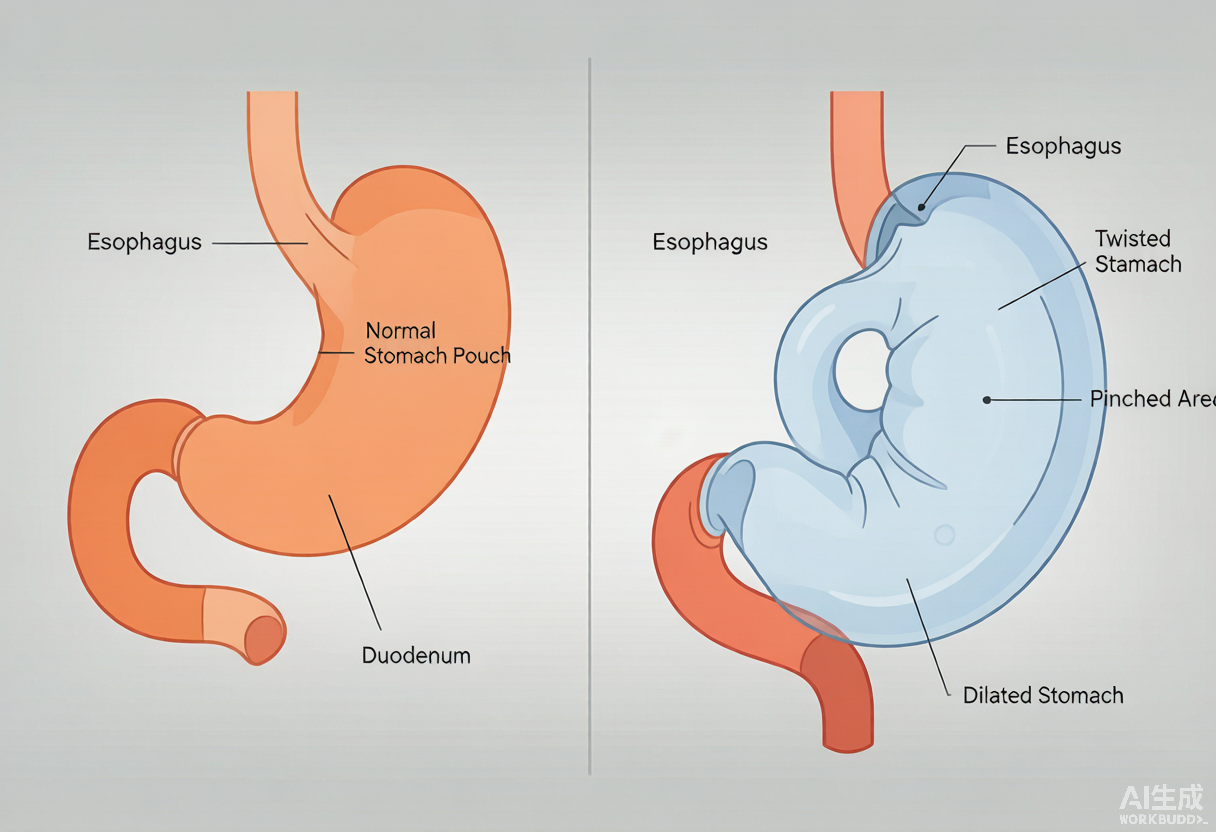
Dog bloat is a two-stage emergency. In stage one, called dilatation, the stomach fills with gas, fluid, or food and stretches like an over-inflated balloon. In stage two, volvulus, the full and heavy stomach rotates on its long axis, trapping gas and cutting off its own blood supply. The stomach wall starts dying within minutes, and without surgery the condition is almost always fatal.
Prevention is not a single magic habit. It is a layered strategy built on knowing your dog’s anatomical risk, managing how and when they eat and exercise, and, for the highest-risk breeds, seriously considering a preventive gastropexy. That last step, a surgical tuck that pins the stomach to the body wall, drops the recurrence rate from around 55 percent to near zero and is the single most effective preventive measure we have.
—
What Is Actually Happening Inside a Dog With Bloat
It helps to picture the canine stomach as a J-shaped pouch, fixed loosely at two points. When it is empty it folds on itself comfortably. When it fills with gas and food, it swings downward and forward, hanging like a swaying weight inside the abdomen.
The trouble begins when that weight rotates. Think of a hammock twisting on its ropes. As the stomach twists, it seals off both the entrance and the exit. Gas has nowhere to go, so the stomach keeps expanding. The expanding organ presses upward against the diaphragm, which makes breathing difficult, and squeezes the large vein that returns blood to the heart, which drives blood pressure dangerously low. The spleen, which is anatomically attached to the stomach, often rotates along with it and can become engorged or twisted itself.
What most people miss is how fast this spirals. The blood supply to the stomach wall gets pinched off at the twist. Without blood, the tissue begins to die within minutes. Dead tissue leaks toxins into the bloodstream, and the heart starts to fail under the combined load of low blood pressure, toxin exposure, and abnormal heart rhythms. This is why bloat is not something you can manage at home or wait out. Every minute of delay is stomach tissue lost.
The medical literature is blunt about the stakes. A large retrospective study of dogs with gastric dilatation-volvulus found that dogs brought to the hospital within the first 90 minutes of symptom onset had a survival rate above 90 percent, while dogs arriving more than six hours out dropped below 50 percent. The single biggest predictor of survival was not the dog’s age, breed, or the severity of the twist. It was time to treatment.
—
Why Some Dogs Get It and Others Never Do
This is the part that surprises most owners, because the popular narrative blames one big meal or one bout of exercise. In reality, bloat is a disease of accumulated risk. Researchers have spent decades pulling apart the factors that nudge a dog toward torsion, and a clear picture has emerged.
Body Shape and Breed
The single strongest risk factor is chest conformation. Deep-chested, narrow-waisted breeds have the anatomical setup that makes gastric rotation possible. The stomach sits in a deep, tall thoracic cavity where it can swing freely. The classic high-risk list includes Great Danes, Weimaraners, Irish Setters, Gordon Setters, Standard Poodles, and Saint Bernards. Several studies put Great Danes and Weimaraners at dramatically elevated risk compared with the general population.
Low-risk breeds are typically the broad-chested or deep-barreled dogs, like bulldogs, whose stomachs are held more snugly. That said, no breed is fully immune. Small dogs can bloat, and any dog with a naturally deep chest is at least theoretically at risk.
Size and Age
Within a breed, larger individuals face higher risk than smaller ones. Age matters too. Bloat is rare in puppies and young dogs, climbs through middle age, and peaks in dogs roughly seven to twelve years old. This is why “my dog is only five, we are safe” is a false comfort. The risk is a rising curve, not a cliff edge.
Genetics and Family History
Bloat runs in families. If a dog’s first-degree relative, a parent or a sibling, has bloated, the dog carries a meaningfully higher risk. Researchers have identified a hereditary component, which is one reason responsible breeders screen their breeding stock. A dog whose littermate bloated is a dog you should treat as high-risk even if the breed is not on the classic list.
Feeding and Behavior
Certain feeding patterns are consistently associated with higher risk. Eating very fast, especially gulping large meals, fills the stomach rapidly and pulls in air. Being fed only one large meal per day appears riskier than splitting food into smaller portions. Raised food bowls, once widely recommended, have actually been linked in some studies to higher risk and are now discouraged by many veterinary surgeons. And a temperament that is anxious, excitable, or prone to rapid gulping carries a higher baseline risk than a calm, slow eater.
—
High-Risk vs. Low-Risk Breeds at a Glance
| Risk Level | Typical Breeds | What Puts Them at Risk |
|---|---|---|
| **Highest** | Great Dane, Weimaraner, Irish Setter, Gordon Setter, Standard Poodle | Deep, narrow chest; loose stomach suspension; family history common |
| **High** | Saint Bernard, Doberman, German Shepherd, Bloodhound | Deep chest, large body size, older-age peak |
| **Moderate** | Labrador Retriever, Golden Retriever, Boxer | Broad but still deep-chested; fast eaters common |
| **Lowest** | Bulldog, Boston Terrier, Pug, most small mixed breeds | Shallow, broad chest holds the stomach more securely |
One important note: breed is a starting point, not a verdict. A lean, deep-chested mixed breed with a Great Dane build carries more risk than its “mixed breed” label suggests. When you are weighing whether to talk to your vet about preventive surgery, judge by chest shape and family history, not just by the name on the pedigree.
—
The Prevention Protocol That Actually Moves the Odds
Bloat cannot be prevented with certainty. Anyone who promises a guaranteed prevention method is not being honest with you. What the evidence does support is a layered protocol that meaningfully reduces risk, especially for high-risk dogs.
Manage How They Eat
Split daily food into two or three smaller meals instead of one big one. A stomach that is never stuffed to capacity has less to swing and less trapped gas. If your dog is a gulper, use a slow-feeder bowl or scatter food across a flat pan so they have to work for each mouthful. Some owners feed from puzzle toys, which naturally slows eating. The goal is to get the stomach filling gradually and without swallowed air.
Rethink Raised Bowls
The older advice to elevate food bowls has not held up. Several studies found higher bloat risk in dogs fed from raised bowls, and most veterinary specialists now recommend feeding from floor-level bowls. If your dog has always eaten from a raised bowl, moving them down is a reasonable, low-cost risk reduction.
Respect the Exercise Rule
Do not let a dog run, jump, or roughhouse immediately after a big meal. The evidence on exact timing is mixed, but the practical guidance from veterinary surgeons is to keep vigorous exercise away from mealtimes, especially for deep-chested breeds. Let the stomach settle before activity, and do not feed a hard-exercising dog a huge meal right before rest.
Watch Water Intake
Gulping large volumes of water quickly, especially right around meals, can distend the stomach and add swallowed air. Offer water throughout the day in smaller amounts rather than letting an excited dog inhale a bowl after exercise or a meal.
Consider Gastropexy for High-Risk Dogs
Gastropexy is a preventive surgery in which the veterinarian stitches the stomach wall to the inside of the body wall so the stomach cannot rotate. It is usually done during the same procedure as a spay or neuter, so the dog only goes under anesthesia once. The numbers are striking: in dogs that have bloated once, the recurrence rate without gastropexy is roughly 55 percent, and with gastropexy it drops to near zero.
Gastropexy does not prevent the stomach from filling with gas. A dog can still get dilatation, the first stage, but because the stomach cannot twist, the life-threatening volvulus is essentially prevented. For a Great Dane or Weimaraner, or any dog with a first-degree relative that bloated, this is a conversation worth having with your vet long before an emergency.
—
The Full Treatment Path, Start to Finish
If you suspect bloat, the only correct move is to go to an emergency vet immediately. Do not try to make the dog vomit, do not give home remedies, and do not wait to “see if it passes.” Here is what happens once you get there, so you know what to expect.
Stabilization Comes First
The team checks your dog’s heart, blood pressure, and hydration and starts IV fluids to support blood pressure. Dogs with bloat are often in shock, and fluids are the first line of defense. The vet may place a tube through the mouth into the stomach to release trapped gas, which relieves the pressure and can provide immediate comfort. This is a temporary measure, not a cure, because it does nothing to fix the rotation.
Imaging Confirms the Diagnosis
The veterinarian takes X-rays to confirm whether the stomach has rotated and in which direction. This matters because it guides the surgical approach. In some cases, if the dog is stable and torsion is not yet confirmed, imaging helps rule out simple dilatation.
Surgery Is the Definitive Treatment
Once the dog is stabilized, surgery is performed to untwist the stomach, assess how much stomach tissue has survived, and remove any dead sections. During the same procedure, most surgeons perform a gastropexy to prevent a future episode. The dog is hospitalized afterward for monitoring, IV fluids, and pain management, and the recovery period typically lasts several days to a week or more.
What Determines the Outcome
Survival hinges on two things: how quickly the dog reached treatment and how much stomach tissue was viable by the time of surgery. Dogs that arrive early, with healthy tissue, have an excellent prognosis, with survival rates above 80 to 85 percent in many series. Dogs that arrive late, or that have extensive tissue death, face a much tougher road. This is the single most important reason not to wait.
—
Common Myths That Cost Dogs Their Lives
Misinformation about bloat circulates constantly, and some of it is actively dangerous.
“Bloat only happens to huge dogs.” False. Large deep-chested breeds are at highest risk, but the condition occurs across sizes. Breed and body shape matter more than raw pounds.
“I should make my dog throw up to relieve the gas.” No. Forcing vomiting in a dog whose stomach may have rotated can cause aspiration, rupture, or make the twist worse. Leave the stomach alone and get to a vet.
“A raised bowl prevents bloat.” The evidence points the other way. Raised feeding has been associated with higher risk in multiple studies.
“My dog bloated once, so now they’re safe.” Wrong. A dog that has bloated once is at high risk of recurrence, which is precisely why gastropexy is so strongly recommended after a first episode.
“There’s nothing I can do, it’s genetic.” Genetic risk is real, but it is only part of the picture. Feeding management and preventive gastropexy meaningfully reduce risk even in genetically predisposed dogs.
—
Frequently Asked Questions
Is dog bloat always fatal?
No, but it is fatal far too often. Untreated, gastric dilatation-volvulus is almost always fatal, and even with treatment the outcome depends heavily on how quickly the dog reached surgery. Dogs brought in within the first 90 minutes routinely survive at rates above 90 percent, while those arriving after six hours often do not. Bloat is survivable when treated fast and treated surgically.
Can a small dog get bloat?
Yes. Small dogs are at lower risk because most lack the deep, narrow chest that makes rotation possible, but bloat has been documented in small breeds. Any dog with a deep-chested build or a family history of bloat should be treated as at risk regardless of size.
What is the difference between bloat and an upset stomach?
An upset stomach causes discomfort, gas, and sometimes mild vomiting that passes. Bloat is a surgical emergency in which the stomach physically rotates and cuts off its own blood supply. The two can feel similar at first, which is exactly why bloat is so dangerous. If a dog shows restlessness, a distended abdomen, or unproductive retching, treat it as bloat until proven otherwise and get to a vet.
Is gastropexy worth it for my dog?
For a deep-chested, high-risk breed, or any dog with a first-degree relative that bloated, most veterinary surgeons consider preventive gastropexy worth serious consideration. It is frequently done at the same time as a spay or neuter, adding minimal recovery burden. It cannot stop gas from building up, but it prevents the fatal rotation, dropping recurrence risk from about 55 percent to near zero. —
Bottom Line
Dog bloat is not a random stroke of bad luck. It is a disease of accumulated risk, and most of that risk is knowable in advance. Your dog’s chest shape, size, age, family history, and eating behavior all feed the equation. You cannot remove every variable, but you can stack the odds firmly in your dog’s favor: feed smaller, slower meals at floor level, keep vigorous exercise away from mealtimes, manage gulping, and for high-risk dogs, talk to your vet about gastropexy well before an emergency ever arrives.
The most important sentence in this entire article is the simplest one. If you ever suspect bloat, do not wait, do not search the internet, do not try a home fix. Go to an emergency vet. The difference between a dog that survives and a dog that does not is very often measured in minutes.
—
References
- American Animal Hospital Association (AAHA) — Gastric Dilatation-Volvulus clinical guidance and emergency care standards. aaha.org
- Glickman L.T., et al. (2000). Multiple risk factors for the development of gastric dilatation-volvulus in dogs. *Journal of the American Veterinary Medical Association*. avma.org
- Broome C.J., Walsh V.P. (2003). Gastric dilatation-volvulus in dogs. *Journal of Small Animal Practice*. bsava.com
—
Disclaimer: This article is for educational purposes only and is not a substitute for professional veterinary advice, diagnosis, or treatment. If you suspect your dog has bloat, seek emergency veterinary care immediately. Always consult a licensed veterinarian for any health concern regarding your pet.