
# Remedy Dog Throwing Up: A Step-by-Step Home Plan (and When It Stops Being a Home Problem)
Author: PurePalsLab Research Team
Reviewed by: Veterinary advisory panel
Reading time: 10 minutes
—
Your dog just threw up on the kitchen floor. Again. It is ten at night, the vet clinic is closed, and you are doing the thing every owner does in this moment: trying to remember whether this is normal dog throwing up behavior or a problem you should be driving somewhere for.
Here is the honest answer. Most episodes of vomiting in otherwise healthy dogs are short, self-limiting, and completely manageable at home with the right protocol. But a small percentage of vomiting is the first warning of something dangerous, and the skill that matters most is telling the two apart before the bad one gets time to progress.
This is a remedy guide, so we are going to be practical. You will get the exact step-by-step home plan for a mild episode, a clear system for reading what the vomit tells you, and an unmissable list of the situations where the right remedy is a car ride to the emergency vet, not anything you do in your kitchen. We are deliberately not covering the full spectrum of belly problems here; for the broader picture of digestive upset, our complete guide to a dog’s belly upset walks through causes and prevention in detail. This article is the focused playbook for the moment your dog throwing up.
—
The Short Answer
For a single episode of vomiting in a bright, otherwise normal dog, the standard home approach is: withhold food for 12 to 24 hours while offering small amounts of water frequently, then reintroduce a bland diet of boiled chicken and white rice in tiny portions, and watch closely for 24 to 48 hours. If the vomiting stops and the dog returns to normal, you are likely done.
The moment any of these appear, stop the home plan and call a vet: repeated vomiting, blood in the vomit, a dog that cannot keep water down, lethargy, belly pain, or any vomiting in a puppy, a senior dog, or a dog with an underlying illness. When in doubt, err on the side of calling. The cost of a phone call is nothing; the cost of waiting can be everything.
—
First, Get This Straight: Vomiting and Regurgitation Are Not the Same
This distinction is the single most useful diagnostic tool you have at home, and most owners have never been shown it.
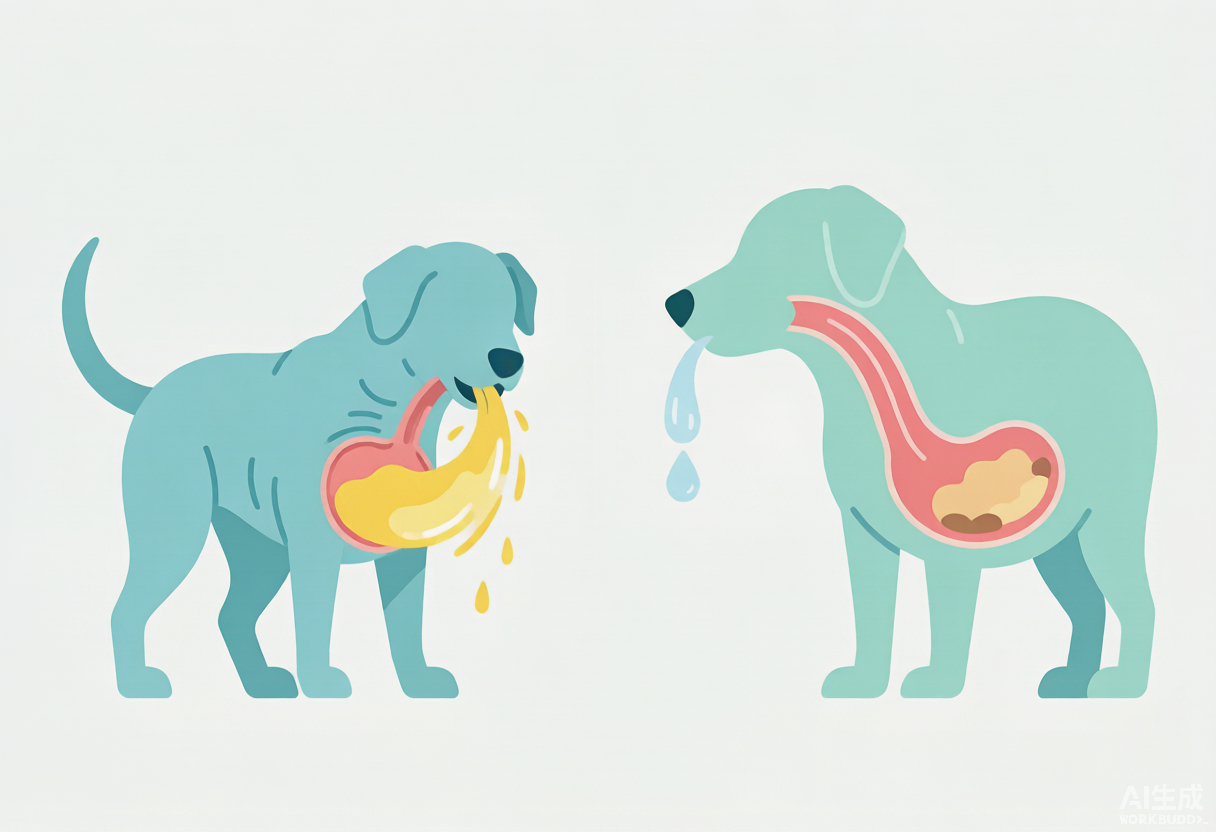
Vomiting is an active process. The dog heaves, retches, and uses its abdominal muscles to forcefully expel stomach contents. It is usually preceded by nausea signs: lip licking, drooling, restlessness, or swallowing. The material is partially digested and often yellow with bile.
Regurgitation is passive. Food, water, or foam just comes back up without heaving or retching, often shortly after eating. The dog’s head just drops and out it comes. It looks like it bypassed the stomach entirely, because it often did. Regurgitation usually points to a problem in the esophagus, not the stomach, and it has a different set of causes and a different treatment path.
Knowing which one your dog is doing tells you and your vet which organ system is involved. If you are not sure, record a short video with your phone. Vets can tell from a few seconds of footage more reliably than from any description.
—
The Home Remedy Playbook for a Mild Episode
If your dog had one episode, is otherwise acting fine, and has none of the red flags listed later in this article, here is the standard protocol veterinarians recommend. Do the steps in order, and do not rush any of them.
Step 1: Withhold Food, Briefly
Give the stomach a rest. Withhold all food for 12 to 24 hours. This is not cruel; a vomiting stomach needs to settle, and food thrown back up just irritates it further. Healthy adult dogs tolerate a short fast fine. Do not extend it beyond 24 hours without checking in with a vet.
Step 2: Manage Water Carefully
Do not let a dog that just vomited gulp a full bowl of water, because that can trigger another round. Offer small amounts frequently, a few laps at a time, every 30 to 60 minutes. If your dog cannot hold water down at all, that is a red flag and a reason to call the vet, because dehydration can set in quickly.
Step 3: Reintroduce a Bland Diet in Tiny Portions
After the fast, do not go straight back to regular food. Start with a bland diet of boiled, skinless chicken breast and plain white rice, or a commercial bland diet designed for sensitive stomachs. Give a small portion, about a quarter of what the dog normally eats, and wait to see how it lands. If it stays down, offer another small portion a few hours later.
Step 4: Watch, and Only Slowly Return to Normal
Monitor the dog over 24 to 48 hours. If the bland diet stays down and the dog’s energy is normal, you can gradually mix in their regular food over the next couple of days. If vomiting resumes at any point, stop and call your vet.
Step 5: Recognize When the Plan Is Not Working
The home playbook assumes a single, mild episode. If the dog vomits more than two or three times in a day, cannot hold water down, or seems to be getting worse, the plan has served its purpose and it is time for professional help. Home remedies are for the mild case; they are not a substitute for veterinary care in a dog that is deteriorating.
—
Read the Vomit: What the Contents Tell You
The appearance of what came up is not a diagnosis, but it is genuinely useful signal. Use it as a guide, not a verdict.
| What You See | Likely Story | What to Do |
|---|---|---|
| **Yellow, foamy liquid** | Bile; stomach empty, often from fasting or too long between meals | If otherwise fine, offer a small bland meal |
| **White, frothy foam** | Often saliva and stomach acid; can be an empty-stomach or motion issue | If one-off, monitor; watch for repetition |
| **Undigested food** | Food never moved on; can be fast eating or a stomach that rejected a meal | If single episode, proceed with the home plan |
| **Green liquid** | Bile mixed with stomach contents | Monitor; vet if repeated |
| **Dark, coffee-ground material** | Partially digested blood from the stomach | Call a vet promptly |
| **Bright red blood** | Fresh bleeding in the stomach or esophagus | Call a vet immediately |
| **Worms or worm segments** | Intestinal parasites | Call a vet for deworming |
| **Suspicious object or toxin** | A swallowed toy, bone, or poison | Call a vet or pet poison control immediately |
The most important column is the last one. Any vomit with dark, coffee-ground material, bright blood, or a suspicious swallowed object or poison moves this out of the home-remedy category and into a phone call to a professional.
—
Red Flags: When the Right Remedy Is an Emergency Vet
These are the situations where you stop the home plan and seek veterinary care, and some of them are genuinely time-sensitive. It is worth knowing them cold, because in the moment it is easy to talk yourself into waiting.
- **Repeated or projectile vomiting**, especially more than a few episodes in a short window.
- **Blood in the vomit**, either fresh red or dark coffee-ground material.
- **The dog cannot keep water down** and is at risk of dehydration.
- **Lethargy, weakness, or collapse** alongside the vomiting.
- **Signs of belly pain**: a dog that flinches, is hunched, paces, or does not want to be touched on the abdomen.
- **A bloated or distended abdomen**, which can signal bloat, a fast-moving emergency covered in detail in our [dog bloat guide](/dog-bloat/).
- **Vomiting in a puppy, a senior dog, or a dog with a chronic illness**, such as kidney disease or diabetes, where the stakes are higher and dehydration escalates faster.
- **Suspected ingestion of a toxin, medication, or foreign object.**
- **Vomiting that has not resolved after 24 hours** or that keeps recurring over days.
If more than one of these applies, or if your gut says something is wrong, call your vet or the nearest emergency clinic. You will not be judged for a false alarm. You will be grateful for a real one caught early.
—
Time to Recover: What a Normal Trajectory Looks Like
A typical mild episode resolves within 24 to 48 hours. The dog fasts, settles, and then tolerates a bland diet within a day. Energy returns to normal, appetite comes back, and bowel habits stabilize. That is the reassuring pattern.
What should worry you is a departure from that pattern. Vomiting that does not stop, a dog that stays lethargic for more than a day, or a dog that cannot hold down food or water for more than 24 hours all point to something beyond a passing stomach upset. Chronic, intermittent vomiting, meaning vomiting that keeps coming back over weeks, also deserves a workup rather than endless home management, because it can signal an underlying condition that no amount of chicken and rice will fix.
—
How to Reduce the Odds of a Repeat Episode
Once your dog is back to normal, a few habits lower the chance of a repeat bout. Feed smaller, more frequent meals so the stomach is never overwhelmed. Slow down fast eaters with a slow-feeder bowl or puzzle toy, since gulping pulls in air and food too quickly. Keep a consistent diet, and introduce any new food gradually over several days rather than all at once. Keep trash and toxic household items out of reach, because a large share of vomiting in dogs is just “ate something they should not have.” And keep your dog current on deworming, since intestinal parasites are a common and easily treated cause of recurrent vomiting.
If a dog vomits only occasionally, after overeating or eating something they should not have, that is often normal. If it is becoming a pattern, especially with weight loss or a poor appetite, that is a reason to see a vet rather than keep reaching for home remedies.
—