
# Joint Supplements for Dogs: What’s in Them, How to Choose, and Whether Yours Actually Needs One
Author: PurePalsLab Research Team
Reviewed by: Veterinary advisory panel
Reading time: 12 minutes
—
Walk down the pet supplement aisle and you will see more joint formulas than you can count. Some promise “advanced joint care.” Others claim a dozen ingredients and a mouthful of scientific-sounding names. The price tags range from budget to genuinely alarming. It is enough to make you wonder whether you are being sold a real solution or just a clever label.
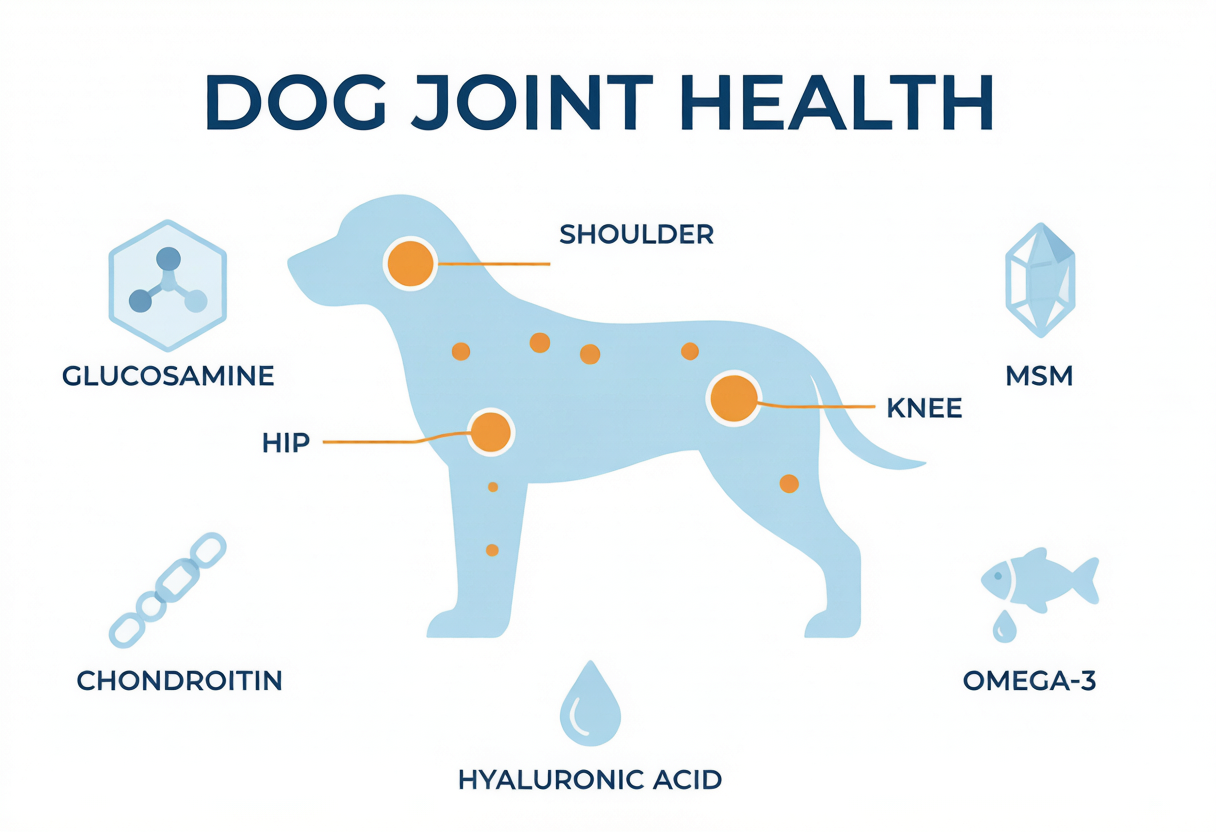
Here is what most of the marketing does not tell you. A joint supplement is not one thing. It is a family of ingredients, each with a different job, different evidence behind it, and different relevance depending on your dog’s age, breed, and symptoms. Glucosamine, chondroitin, MSM, omega-3 fatty acids, hyaluronic acid: these are not interchangeable substitutes. They are tools, and the right one depends on the dog in front of you.
So before you spend another dollar, let us break this down the way a good vet would. What these ingredients actually do in the body, which ones have real evidence, how to match a supplement to your dog’s specific situation, and how to read the label well enough to spot quality from marketing. If you want the deep dive on glucosamine and chondroitin specifically, our clinical review of glucosamine & chondroitin for senior dogs has the full evidence breakdown. This guide is the wider view, the one that helps you pick.
—
The Short Answer
For a senior dog with early arthritis, the most common and best-supported approach combines glucosamine and chondroitin with omega-3 fatty acids for inflammation, and sometimes MSM for comfort. The evidence is strongest for easing mild to moderate stiffness, not for reversing joint damage. Give a supplement a genuine 6 to 8 week trial at the right dose before deciding it does not work, and keep body weight under control, because every extra pound loads the joints more than any supplement can offset.
Not every dog needs a joint supplement. A young, healthy, normal-weight dog usually does not. The decision should be driven by signs of stiffness, by breed and age risk, and by what your vet sees on exam, not by a label that says “for all ages and sizes.”
—
What a Joint Supplement Actually Does (and Doesn't Do)
Let us be straight about the limits first, because the advertising will not tell you this. No joint supplement regrows cartilage. None of them cures arthritis. What the better-studied ingredients can do is support the joint environment: reduce the inflammation that drives pain, provide raw material the body uses to maintain cartilage, and, in some dogs, meaningfully ease the stiffness that shows up after a nap or a long walk.
The realistic picture looks like this. A dog with mild to moderate osteoarthritis who gets a combination supplement with adequate doses of the right ingredients often shows a measurable improvement in comfort and mobility over several weeks. A dog with severe, bone-on-bone arthritis is unlikely to be saved by supplements alone and will need veterinary treatment that may include prescription pain medicine. Supplements occupy the middle ground, and that is where they genuinely earn their place.
It is also worth saying what a supplement is not: a quick fix. These ingredients work slowly, at the cellular level, and that is why the standard advice is to trial a joint supplement for six to eight weeks before judging it. Give it that window at a proper dose, and you will know far more than any label promises.
—
The Core Ingredients, Compared
The active ingredients in joint supplements fall into a few distinct families. Here is what each one does and what the evidence says.
| Ingredient | What It Does | Evidence Level | Best For |
|---|---|---|---|
| **Glucosamine** | Building block for cartilage; supports cartilage maintenance | Moderate (varies by study) | Mild to moderate arthritis, stiffness |
| **Chondroitin** | Helps cartilage retain water and resist compression | Moderate | Joint cartilage support, often paired with glucosamine |
| **MSM** | Sulfur source; supports connective tissue; may ease discomfort | Emerging | Comfort, dogs that stiffen after exercise |
| **Omega-3 (EPA/DHA)** | Anti-inflammatory; reduces inflammatory chemicals in joints | Strongest for inflammation | Dogs with active joint inflammation, soreness |
| **Hyaluronic acid** | A component of joint fluid; supports lubrication | Moderate | Dogs with reduced joint fluid, stiff joints |
Two things stand out from this table. First, there is no single “best” ingredient, because they work differently. Second, the strongest evidence for a meaningful effect, especially on inflammation, actually belongs to omega-3 fatty acids, which many owners overlook because they think of fish oil as a coat supplement rather than a joint one. The most effective protocols usually stack several of these, each doing its part.
—
MSM: The Ingredient Everyone Skips
Glucosamine gets all the attention, but MSM, short for methylsulfonylmethane, quietly earns its place in many of the better formulas. MSM is a source of sulfur, which the body uses to make connective tissue, and it has a reputation for supporting joint comfort, particularly in dogs that stiffen up after a hard day.
The research on MSM in dogs is thinner than the research on glucosamine or omega-3, which is why it is often described as “emerging.” But it shows up repeatedly in veterinary joint formulations, often paired with glucosamine and chondroitin, because the combination appears to support the joint from more than one angle at once. If a formula you are considering includes MSM at a meaningful dose, that is a reasonable plus, not a gimmick, as long as the other core ingredients are there too.
—
Omega-3 for Joints: The Anti-Inflammatory That Doubles as a Coat Supplement
Here is the angle most owners miss. The joint ingredient with the strongest anti-inflammatory evidence is not glucosamine. It is omega-3 fatty acids, specifically EPA and DHA. These fatty acids help reduce the inflammatory chemicals that drive joint pain and stiffness, which is why omega-3 is a standard recommendation in veterinary arthritis care.
This matters for a practical reason. If your dog is stiff and sore, a formula that only has glucosamine and chondroitin may be leaving the inflammation half of the problem untouched. Combining a joint formula with a solid dose of omega-3 from fish oil is a common and sensible approach, and it is why some combined products include both. When you read the label, check that the omega-3 is actually present at a meaningful EPA and DHA dose, not just listed for show.
—
Which Supplement for Which Dog: A Decision Framework
This is the part that most guides skip, and it is the part that actually helps. The right joint supplement depends on what your dog is dealing with. Here is a practical way to match them.
The young, active dog with no signs of trouble. A supplement is usually not needed. Good nutrition, healthy weight, and smart exercise do more here than any bottle.
The middle-aged large-breed dog at genetic risk. Breed and size put joints under load before symptoms show. A preventive combination of glucosamine, chondroitin, and omega-3 is a reasonable conversation to have with your vet, especially for breeds prone to joint problems.
The senior dog that’s stiff after rest but warms up. This is the classic early-arthritis pattern. A glucosamine-plus-chondroitin combination, stacked with omega-3 for inflammation, is the most common and best-supported choice. Add MSM if stiffness is the dominant complaint.
The dog with active inflammation, obvious soreness, or diagnosed arthritis. Omega-3 becomes central here because inflammation drives the pain. Work closely with your vet, because this dog may also need prescription anti-inflammatory care, and supplements are one layer, not the whole plan.
The overweight dog. Weight loss is the single most powerful “joint supplement” there is. Every pound a dog carries multiplies the load on each joint, and no ingredient can out-supplement the mechanical benefit of a healthier weight. Fix the scale first, and the supplements work far better.
If you are unsure which category your dog fits, that is a great question for your vet, who can look at the joints directly. What you should not do is guess blindly or rely on a label aimed at “all dogs.”
—
Dosing, Timeframes, and What "Working" Looks Like
Dosing is where many good intentions fail, because too-low doses are common in cheaper products. The dose should be based on your dog’s weight, and the active ingredient amounts on the label need to be high enough to matter. A product that lists 50 mg of glucosamine per chew, for a large dog that needs hundreds of milligrams a day, is not going to do much no matter how good it sounds.
Give any joint supplement a genuine 6 to 8 week trial. These ingredients work slowly. If a dog is going to respond, you usually see it within that window: less stiffness getting up, easier time with stairs, better willingness to walk or play. If there is no change after eight weeks at a proper dose, it is reasonable to reconsider the product or the approach with your vet rather than keep buying the same thing.
One more honest note. The response is individual. Some dogs improve clearly, some improve modestly, and some do not improve at all. That variability is normal and does not mean supplements are worthless; it means joints are complicated and each dog is different. The goal is to find what helps your particular dog, and that takes a bit of patience.
—
Reading a Label: How to Spot Quality From Marketing
A good label tells you what you need to know. A marketing label hides it. Here is what to look for.
First, check that the active ingredients are listed with actual amounts, not a vague “proprietary blend.” If you cannot tell how much glucosamine or omega-3 is in each dose, you cannot judge whether the dose is adequate. Transparency on amounts is a sign of a quality product.
Second, look for the ingredients that matter for your dog’s situation, at meaningful doses, rather than a long list of everything under the sun. More ingredients is not automatically better. A focused formula with adequate amounts of the right ingredients beats a “shotgun” blend with tiny doses of twenty things.
Third, look at how the product presents its claims. A supplement that talks about “supporting joint health” is staying in the language a responsible company uses. One that implies it “cures arthritis” or “fixes joints” is overpromising, and that should be a red flag about its credibility.
—
Weight and Exercise: The Underrated "Supplements"
No discussion of dog joints is honest without this. Body weight is the single biggest controllable factor in joint health, because every extra pound is extra mechanical load on the joints with every step. For an overweight dog, the most effective “supplement” you can give is weight loss, and it often outpaces any ingredient in a bottle.
Exercise matters just as much, done sensibly. Regular, moderate, low-impact activity keeps joints mobile and muscles strong, and strong muscles stabilize joints. But hard, repetitive impact on already-sore joints can make things worse. The ideal is consistent, gentle movement: regular walks, swimming if it is available, and avoiding long bursts of hard impact on stiff joints. Movement keeps a stiff joint from locking up, and it works alongside supplements rather than instead of them.
—

Frequently Asked Questions
How do I know which joint supplement is right for my dog?
Match the supplement to your dog’s situation. A young, healthy dog usually needs none. A stiff senior dog typically benefits from a glucosamine-and-chondroitin combination with omega-3 for inflammation. A dog with active soreness and diagnosed arthritis needs omega-3 central, plus veterinary guidance. When unsure, ask your vet, who can examine the joints and tailor a plan.
Do puppies need joint supplements?
Usually not. A growing puppy is not the typical candidate for joint supplements, and the priority is proper nutrition, controlled growth, and avoiding excess weight and hard impact. There are specific cases where a vet might recommend joint support for a young large-breed dog, but that is a veterinary decision, not a routine one.
Can I give my dog glucosamine and fish oil at the same time?
Yes, this is a common and sensible combination. Glucosamine supports cartilage maintenance, while the omega-3 in fish oil works on inflammation, so they target different parts of the joint problem. Many combined formulas include both for exactly this reason. Just make sure the omega-3 is present at a meaningful EPA and DHA dose.
Do joint supplements really help dogs with arthritis?
For mild to moderate osteoarthritis, a combination supplement with adequate doses of glucosamine, chondroitin, and omega-3 often helps ease stiffness and discomfort over six to eight weeks. The evidence is strongest for this middle ground. Severe arthritis usually needs veterinary treatment beyond supplements, so match expectations to the stage of the disease. —
Bottom Line
Joint supplements for dogs are a real tool, but they are not a magic pill and they are not one-size-fits-all. The ingredients do different jobs, the evidence is strongest for the mild-to-moderate middle ground, and the right product depends on your dog’s age, breed, symptoms, and weight. Combine the right ingredients at meaningful doses, give them a proper six-to-eight-week trial, and keep body weight and sensible exercise in the picture. That combination is what actually moves the needle for a stiff dog.
And if your dog is showing real discomfort, talk to your vet. Supplements are one layer of a good joint-care plan, not the whole plan. A veterinarian can look at the joints directly and help you build the right approach, with supplements in their proper place.
—
References
- Cummings School of Veterinary Medicine, Tufts University — Nutrition and joint health resources. vetmed.tufts.edu
- Veterinary Practice News — Canine joint health and supplement reporting. veterinarypracticenews.com
- American Animal Hospital Association (AAHA) — Canine joint and mobility care guidance. aaha.org
—
Disclaimer: This article is for educational purposes only and is not a substitute for professional veterinary advice, diagnosis, or treatment. These statements have not been evaluated by the FDA. This product is not intended to diagnose, treat, cure, or prevent any disease. Always consult a licensed veterinarian for any health concern regarding your pet.