
# Skin Problems in Dogs: How to Tell What’s Really Going On (and What to Do About It)
Author: PurePalsLab Research Team
Reviewed by: Veterinary advisory panel
Reading time: 12 minutes
—
Somewhere on your dog’s body there is almost certainly something that does not belong. A patch of hair that is thinner than it should be. A spot they keep licking raw. An ear that smells faintly of yeast. A dandruff-like flake that shows up on the brush. Every one of these is a skin problem, and here is the uncomfortable truth: they all look alike at first.
This is the trap. Itchiness, hair loss, redness, flaking, and odor are the skin’s way of saying “something is wrong” with a very limited vocabulary. Parasites, allergies, bacteria, yeast, hormonal changes, and simple dry air can all produce the same handful of symptoms. So if you jump to “it must be allergies” and treat it as such, you can spend weeks, or months, going down the wrong path while the real cause keeps chewing away at your dog’s skin.
The useful skill is not memorizing a list of diseases. It is learning to read the clues, to see which pattern of symptoms points where, and to know when the situation is a home-care job and when it needs a vet. That is what this guide is for. We will walk through the major families of dog skin problems, how to tell them apart, and what each one usually needs. For the deep dives on the allergy side specifically, our guides on allergy dog remedies and dog allergy medicine cover that territory in detail, and our dog yeast infections guide does the same for fungal causes. This article is the wide-angle view that helps you figure out which of those deep dives you need.
—
The Short Answer
Most dog skin problems fall into six families: allergies, parasites, bacterial infections, yeast and fungal infections, hormonal causes, and dry-skin or environmental issues. They look similar at first, so the first step is not treatment but identification. Learn to read the pattern, check for obvious culprits like fleas, and get a vet involved for anything that spreads, gets worse, or does not respond to simple care.
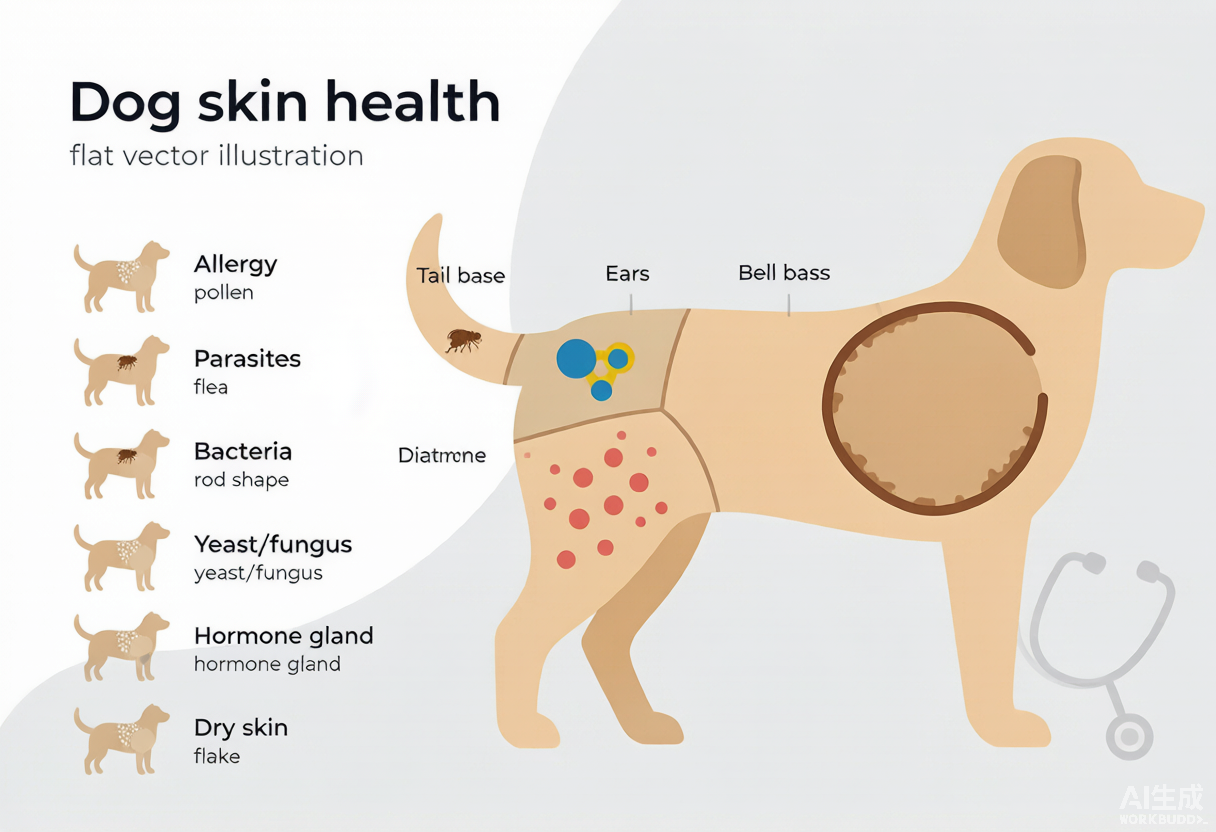
The single most common mistake owners make is treating every itchy dog for allergies. Itchiness is a symptom, not a diagnosis. Behind that itch could be a flea, a yeast overgrowth, a bacterial infection, or a food reaction. Until you know which one, you are guessing.
—
"Itchy Dog" Is Only Half the Diagnosis
Start with the most important reframe: an itchy dog is not a diagnosis. It is a starting point. The word “itch” covers everything from a single flea bite to a full-body allergic flare, and the treatment for one is useless or harmful for another.
Think of the skin as the dog’s largest organ and its most visible early-warning system. When something is off internally, whether that is an allergen, a parasite, a hormone imbalance, or a dietary trigger, the skin often shows it first. That is why skin symptoms are so common and so nonspecific. The skin has one way of saying “help,” and it is itching, licking, shedding, and flaking.
So the real question is not “is my dog itchy?” It is “what is the pattern?” Where on the body is it worst? When did it start? Is it constant or seasonal? Did it come with hair loss, odor, or scabs? Those details are the difference between a lucky guess and a real answer.
—
The Six Families of Dog Skin Problems
To make sense of the noise, it helps to sort skin problems into six families. Most cases fit one of these, and each has a different cause, different pattern, and different approach.
| Family | Typical Clues | Common Examples |
|---|---|---|
| **Allergies** | Itching, red skin, paws and ears, often seasonal | Environmental, food, flea allergy |
| **Parasites** | Itching at specific spots, visible fleas/dirt, hair loss | Fleas, mites, lice |
| **Bacterial** | Pustules, scabs, hot spots, odor, "pimples" | Pyoderma, hot spots |
| **Yeast / Fungal** | Musty odor, greasy skin, ear involvement, circular patches | Yeast overgrowth, ringworm |
| **Hormonal** | Symmetrical hair loss, no major itching | Thyroid, adrenal issues |
| **Dry / Environmental** | Flaking, dull coat, winter dry skin | Low humidity, over-bathing |
Two patterns are especially important to recognize early. Symmetrical hair loss with little itching points toward a hormonal cause, not an allergy, even though hair loss screams “skin problem.” And hair loss concentrated around the tail base and hindquarters with intense chewing is a flea pattern, not a food allergy. Reading these patterns is how you avoid treating the wrong thing.
—
A Differential Checklist: What You're Actually Looking At
This is the practical core. When you notice a skin issue, run through these clues and see which pattern matches. Use it to narrow down the possibilities before you act.
Where is the problem?
- Paws and ears, with itching: strongly suggests allergies
- Tail base and hindquarters, with intense chewing: think fleas
- Symmetrical patches on both sides of the body: hormonal
- Scattered single lesions or “pimples”: bacterial
- Ears and skin folds: yeast is common here
What does it look like?
- Red, moist, inflamed spot that grew fast: hot spot (bacterial)
- Circular patch with hair loss and a ring edge: could be ringworm (fungal)
- Black or “elephant skin” thickening: often chronic allergy or yeast
- Flakes and dandruff with dull coat: dry skin or nutritional
- Pustules that look like pimples: bacterial pyoderma
What does it smell like?
- Musty, bread-like, or “yeasty” odor: yeast overgrowth
- Foul, sour smell: often bacterial
- No strong odor: could be allergy, dry skin, or hormonal
Does it itch a lot or barely?
- Intense, nonstop itching: allergy or parasite
- Hair loss with little to no itching: hormonal
- Mild, occasional itching: could be dry skin
When you have matched the pattern, you know which direction to look. If the clues point to allergies, our allergy remedies guide and allergy medicine guide are your next step. If they point to yeast, the yeast guide takes over. If you cannot place it, or the picture is mixed, that is a sign to involve a vet.
—
Parasites: Fleas, Mites, and the Ones You Can't See
Fleas are the most common external parasite and the most fixable, but they are also easy to miss because a heavy infestation may not even itch much in some dogs, while a single bite sends a sensitive dog into a frenzy. The classic sign is intense chewing and scratching around the tail base, back, and hind legs. Look for the flea’s droppings, which look like black pepper or coffee grounds, in the fur, especially along the spine and tail.
Mites are smaller and sneakier. Sarcoptic mange causes intense itching and small red bumps, often starting on the ears, elbows, and belly. Demodectic mange causes patchy hair loss, more than itching, and usually affects young or immune-compromised dogs. Ringworm, despite the name, is a fungus, not a worm, and it shows up as circular patches of hair loss with a scaly, red edge that can spread.
The good news is that many parasites are easy to prevent with routine flea and tick prevention, and mites and ringworm, while more stubborn, are treatable. If you suspect mites or ringworm, that is a vet visit, because the treatment needs a proper diagnosis and prescription care.
—
Pyoderma and Hot Spots: The Bacterial Side
When bacteria take hold in the skin, you get pyoderma, which is a bacterial skin infection. It shows up as pustules that look like pimples, red bumps, crusts, and scabs, often with a sour smell. It can happen anywhere but is common on the belly, armpits, and skin folds, and it frequently follows an underlying cause that made the skin vulnerable in the first place, like an allergy or a wound.
Hot spots, also called acute moist dermatitis, are a dramatic, fast-moving version. A hot spot is a red, wet, inflamed area that seems to appear overnight, often from a dog licking and chewing a spot obsessively. They can grow quickly and are genuinely painful. Hot spots need prompt attention, usually veterinary care to clean and treat the area and address the trigger.
The key point about bacterial skin problems is that they rarely exist alone. The bacteria usually take advantage of skin that is already damaged by an allergy, a parasite, or moisture. So treating the bacterial infection is necessary, but finding and managing the underlying cause is what keeps it from coming back.
—
Yeast and Fungal Infections: The Musty, Itchy, Recurrent One
Yeast is a normal part of a dog’s skin and ears, but when the balance tips, it overgrows. The result is a distinctive musty, “bread-like,” or “corn-chip” odor, greasy skin, intense itching, and often ear involvement. Yeast loves warm, moist, folded areas, so it is common in ears, between toes, and in skin folds. Dogs with allergies, floppy ears, or a history of moisture problems are prone to it.
Yeast overgrowth is often secondary to allergies, which is why it keeps coming back in some dogs until the underlying allergy is managed. Our guide to dog yeast infections covers the full picture of yeast causes and management. Ringworm, the fungal infection, is different from yeast and usually needs veterinary diagnosis because it can look like many other conditions and is contagious.
If you suspect yeast, the musty smell and ear involvement are your best clues. Keeping ears and skin folds dry, and managing any underlying allergy, are the pillars of keeping yeast in check.
—
Hormonal and Internal Causes: When the Problem Is Under the Skin
Not every skin problem starts on the skin. Some of the most confusing ones come from hormones. When a dog’s thyroid is underactive, a condition called hypothyroidism, the skin shows it as symmetrical hair loss on the trunk, a dull, brittle coat, dry flaky skin, and sometimes darker patches, often with very little itching.
Similarly, excess cortisol from the adrenal glands can cause hair loss, a thin skin, and a pot-bellied appearance. The hallmark of these hormonal problems is that the hair loss is often symmetrical, affecting both sides of the body equally, and it happens without the intense itching you see with allergies or parasites.
Hormonal skin disease needs a veterinarian to diagnose with blood work, because the skin changes are just the visible sign of a deeper internal condition. If you notice symmetrical hair loss with little to no itching, that is a strong signal to get a vet involved rather than reaching for an anti-itch product.
—
Dry Skin and Environmental Factors: The Overlooked One
Sometimes a skin problem is simpler than it looks. Dry, flaky skin with a dull coat and mild itching can come from low humidity, especially in winter, from over-bathing that strips natural oils, or from a diet lacking the fatty acids that support skin health.
Omega-3 and omega-6 fatty acids are the nutritional cornerstones of skin barrier health. When a dog’s coat is dry and brittle, or their skin flakes, adding a quality omega-3 source can help support the skin barrier from the inside. This is a genuine, well-supported role for fatty acids in coat and skin condition.
If dry skin is the issue, the fix is often environmental and nutritional: reduce over-bathing, use a moisturizing shampoo, add humidity in dry months, and consider a fatty-acid supplement. Our guide to natural supplements for dog skin allergies covers the supplement side of skin and coat support in more detail.
—
Red Flags: When a Skin Problem Needs a Vet Now
Most skin issues are not emergencies, but some are, and it helps to know which ones. Get a vet involved quickly if you see any of these.
- A hot spot or red, inflamed area that is growing fast and your dog cannot leave alone.
- Hair loss that is spreading or appearing in multiple spots, especially with scaling or crust.
- Intense, nonstop itching that has your dog miserable or not sleeping.
- Skin with a strong, foul odor or discharge, which can signal a serious infection.
- Lethargy, poor appetite, or signs of illness alongside the skin problem, because the skin may be reflecting something deeper.
- Suspected mites or ringworm, which need a proper diagnosis and prescription care.
- Symmetrical hair loss with no itching, which points to a hormonal cause needing blood work.
- Any skin issue that has not improved after a week or two of simple home care, or that keeps coming back.
When in doubt, an exam is worth the trip. Skin problems that are caught and identified early are far easier to fix than ones that have had months to dig in.
—
Frequently Asked Questions
What is the most common cause of skin problems in dogs?
Allergies are among the most common, but “allergy” is not one thing. Environmental allergens, food, and flea allergies all cause skin trouble, and parasites, bacteria, yeast, and hormonal issues do too. Because the causes are so varied, identifying the specific pattern matters more than assuming the cause. Many cases also involve more than one factor.
How can I tell if my dog has allergies or a bacterial infection?
Look at the pattern. Allergies usually cause itching, red skin, and paw and ear involvement, often with a pattern that recurs or changes with seasons. A bacterial infection shows up as pustules that look like pimples, scabs, crusts, and a sour smell. Bacteria often take over skin that allergies have already damaged, so the two can happen together, which is a common reason dogs need both diagnosis and treatment.
Why does my dog’s skin problem keep coming back?
Recurring skin problems usually mean the underlying trigger is not being managed. Yeast and bacterial infections, for example, often flare up again when an allergy, a parasite, or a moisture issue is still present. Treating the visible infection without addressing the root cause sets up the next flare. A vet can help identify and manage the underlying driver so the problem stops cycling.
What skin problems in dogs are emergencies?
Fast-growing hot spots, spreading hair loss with crusts, intense nonstop itching, skin with a foul odor or discharge, or any skin issue accompanied by lethargy or poor appetite warrants prompt veterinary attention. Symmetrical hair loss with no itching also needs a vet, since it can signal a hormonal cause. When in doubt, an exam is the safer choice. —
Bottom Line
Dog skin problems look alike because the skin has a limited way of complaining, but the causes behind them are not the same. Sorting them into the six families, allergies, parasites, bacteria, yeast and fungus, hormonal, and dry skin, is the fastest way to stop guessing and start doing the right thing. Read the pattern, check the obvious culprits, match the clues, and know when a problem needs a vet.
The dog that keeps scratching deserves better than a lucky guess. Give them the benefit of a real look, and you will save them, and yourself, from a long, frustrating cycle of the same problem coming back.
—
References
- VCA Animal Hospitals — Canine skin and dermatology guidance. vcahospitals.com
- Merck Veterinary Manual — Canine skin disease overview. merckvetmanual.com
- American Animal Hospital Association (AAHA) — Canine skin and allergy care guidance. aaha.org
—
Disclaimer: This article is for educational purposes only and is not a substitute for professional veterinary advice, diagnosis, or treatment. These statements have not been evaluated by the FDA. This product is not intended to diagnose, treat, cure, or prevent any disease. Always consult a licensed veterinarian for any health concern regarding your pet.