
# Can Dogs Eat Bananas? The Answer Changes With the Ripeness
Breakfast comes with a built-in audience. You peel a banana, and the dog appears at your feet with the patience of a professional, offering the exact eye contact that has worked on humans for ten thousand years. Bananas look like the perfect dog treat: soft, sweet, natural, wrapped in their own packaging. And unlike some fruits in the produce aisle, bananas carry no dark legend, no grape-style toxicity story lurking behind the sweetness.
The honest answer is yes, with two catches that most quick-answer articles skip. First, the banana you hand over is not one food but three different foods depending on ripeness, and the differences matter more for dogs than they do for you. Second, the fruit’s headline nutrients, sugar and potassium, are exactly the two things some dogs should not get extra of. Here is how to read the yellow signal properly.
—
The Short Answer
Dogs can eat banana, in small portions, with the peel off. A few slices or half a banana a day is a reasonable ceiling for a medium dog, keeping treats at or under 10 percent of daily calories. Underripe bananas act more like a fiber supplement, ripe bananas are mostly sugar with some soft fiber, and the peel belongs in the compost, not the dog. Dogs with diabetes, dogs on weight-loss plans, and dogs with kidney disease should clear banana with their vet first, because potassium and sugar are the two nutrients those conditions watch most closely.
—
One Fruit, Three Different Foods
A banana is not a fixed food. Between the green stage and the brown-spotted stage, its chemistry rewrites itself, and each version behaves differently inside a dog.
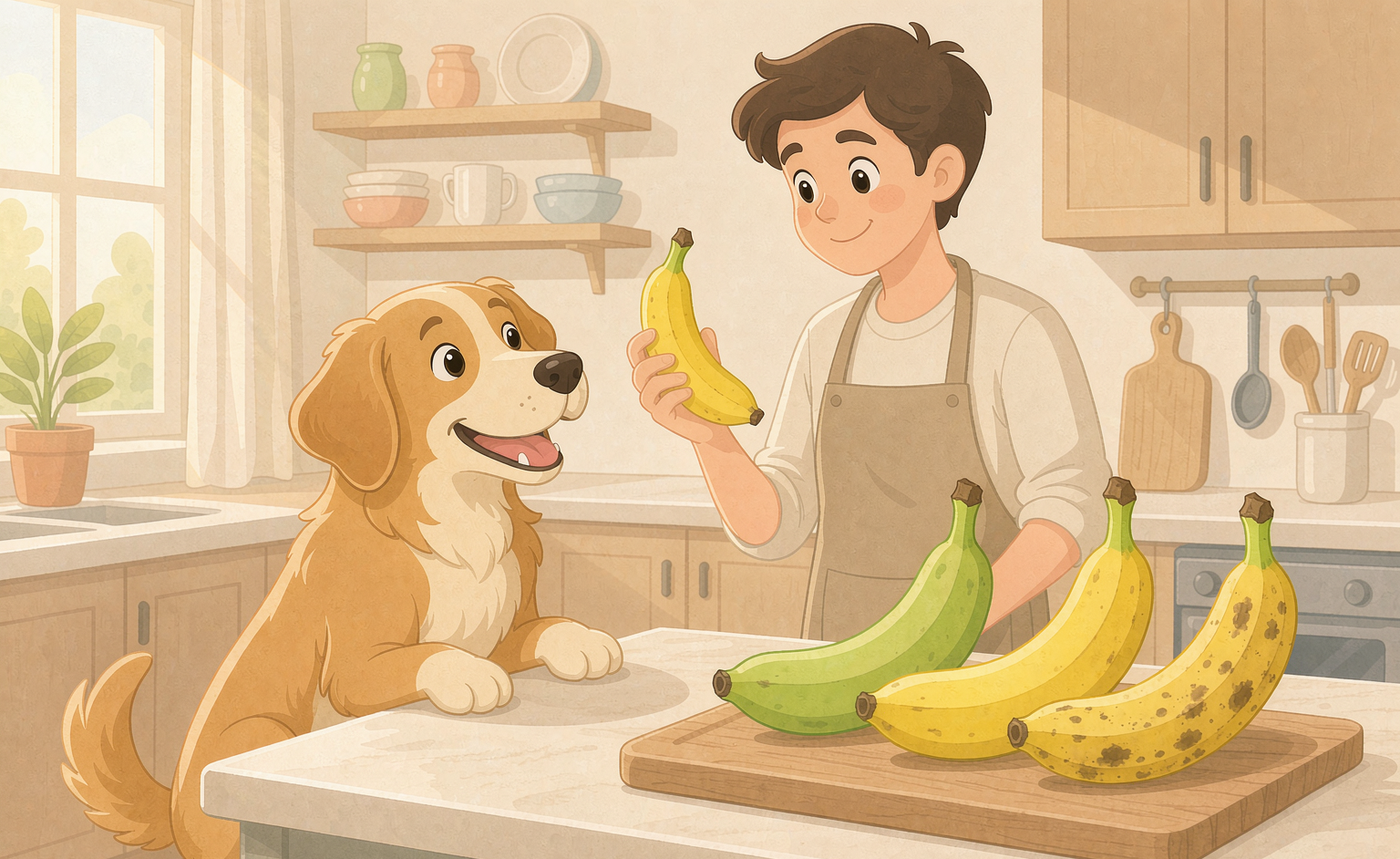
The green banana. An underripe banana is loaded with starch, and most of it is a specific kind called resistant starch, named because it resists digestion in the small intestine. Instead of becoming sugar, it travels to the colon, where gut bacteria ferment it into beneficial short-chain fatty acids. It is a natural prebiotic, the same logic behind some fiber supplements. The catch is texture and tannins: green banana is chalky, astringent, and harder on a sensitive stomach, and too much of it firms stool very effectively. For a healthy dog, a slice of green banana is harmless. For an upset stomach, it is not the gentle choice people assume.
The yellow banana. Fully ripe is where the fruit turns sweet. Enzymes have converted most of that starch into simple sugars, the flesh has softened, and the flavor peaked. This is the version dogs prefer, which is no coincidence: they taste sugar the same way we do. Nutritionally it is now a candy-fiber hybrid: quick energy, modest potassium, and a small amount of pectin, a soluble fiber that helps stool hold its shape.
The brown-spotted banana. Spots mean the sugar conversion has gone further still. Flavor intensifies, and the fruit gets a slightly softer, sweeter profile. Fine for a dog in the same small quantities, with one caveat: the riper the banana, the faster the sugar hits. For a diabetic or overweight dog, the difference between green and brown is not cosmetic, it is the whole point.
| Stage | What dominates | Best for |
|---|---|---|
| Green, underripe | Resistant starch, tannins | Occasional fiber bump for a healthy dog |
| Yellow, ripe | Simple sugars, pectin | The standard treat version |
| Brown spots | Higher sugar, soft flesh | Same as ripe, in smaller amounts |
The practical translation: if you are handing banana to a healthy dog as a treat, ripe yellow is the default. If you are thinking of it as a digestive aid, you are reaching for the wrong tool, and the next section covers why.
The Sugar Math Nobody Runs
Numbers first. One medium banana, about 118 grams, carries roughly 105 calories, 14 grams of sugar, 3 grams of fiber, and around 420 milligrams of potassium, along with small amounts of magnesium and vitamin C. Useful, ordinary numbers for a human snack. For a dog, scale matters.
A 20-pound dog needs somewhere in the range of 500 to 600 calories a day, depending on activity and metabolism. The universal rule, endorsed across veterinary nutrition guidance, is that all treats combined should stay at or under 10 percent of daily calories, which for that dog is a ceiling of 50 to 60 treat calories. One whole banana nearly doubles the ceiling before lunch. Half a banana, or a few coin-sized slices, sits comfortably inside it.
For a 60-pound dog the math loosens up: a whole banana is still pushing the budget, but half of one is a rounding error. This is also where the peanut butter comparison earns its place, since the two foods share a job: the high-value, smearable reward. Two tablespoons of peanut butter run about 190 calories, so banana slices are actually the lighter currency, provided the peanut butter is checked first for xylitol, the sweetener that makes that otherwise ordinary jar dangerous.
Potassium: The Nutrient That Cuts Both Ways
Potassium is banana’s reputation. It is also the reason a small group of dogs should not get unlimited access.
For a healthy dog eating a complete diet, banana potassium is a non-event. Commercial diets already meet potassium requirements, the kidneys handle the surplus, and a few slices of banana will not move the needle. There is no upside worth chasing, and no meaningful downside. Bananas do not prevent cramps in dogs, and they do not fill a gap that complete food leaves open.
Dogs with kidney disease are the real exception, and the reason is subtler than most articles explain. Failing kidneys lose their ability to keep potassium in the right range, drifting low in some stages and climbing dangerously high in others, and the medications and prescription diets used to manage kidney disease interact with that balance. High-potassium treats are exactly the kind of variable a renal dog’s vet wants to control. If your dog has any kidney diagnosis, treat banana as an ask-first food rather than a default treat.
Diabetes and obesity deserve the same caution for the simpler reason: 14 grams of sugar in a ripe banana is a genuine glycemic event for a small dog with poor glucose control. A slice will not hurt a well-regulated diabetic dog on a vet-approved plan, but this is not a food to improvise with.
The Peel, the Freezer, and the Best Serving Ideas
The peel is not food. Banana peel is not toxic, which is worth saying clearly because “toxic” and “inedible” get merged online. It is, however, fibrous and waxy, dogs cannot break it down, and a dog that swallows a large piece of peel, especially a small dog, risks a stomach upset or, rarely, an obstruction that needs veterinary attention. Compost it, keep the counter edge out of reach, and if your dog raids the trash and eats peel, watch for vomiting, appetite loss, or lethargy over the next day or two.
Serving ideas that actually work in practice:
- Coin slices. The default. Cut a ripe banana into half-inch coins and use them as individual training rewards.
- Frozen chunks. Cut larger chunks and freeze them. The texture turns them into a long-lasting summer treat, and for a teething puppy the cold is the entire point, which the puppy teething guide covers in more depth.
- Frozen smear. Mash banana, spread it inside a rubber toy, freeze it. A project that occupies twenty minutes.
- The topper. A few slices on a bowl of regular food as a flavor lift, remembering that calories count even when they ride in on kibble.
One more comparison for the fruit-shopping dog owner: banana is the sugariest of the common safe fruits by a wide margin. Blueberries deliver their antioxidants at a fraction of the sugar, and plain pumpkin delivers fiber with almost none. Banana is not the healthiest option in the bowl, it is the tastiest one, and it deserves to be spent like currency.
Fiber, Stool Quality, and a Glandular Detour
There is one quiet connection between everyday banana feeding and a problem owners know by its most embarrassing symptom: the scoot.
A dog’s anal glands express themselves naturally when a firm, well-formed stool passes over them. Every gram of insoluble fiber in the diet contributes to that stool quality, and every soft, unformed stool is a missed emptying. Dogs with chronically soft stools are the ones who end up dragging their bottoms across the rug, and a diet pattern that keeps stool consistently firm is the foundation of anal gland comfort.
A few slices of banana contribute a modest amount of fiber to that project. But banana alone is a light tool, and if your dog is a repeat scooter, the more reliable strategy is a deliberate fiber plan: pumpkin is the classic, and for a daily approach, our anal gland support chews combine pumpkin seed, oat fiber, psyllium husk, and prebiotics with digestive enzymes, in a chicken-flavored chew with 200 chews per bottle, sourced from USA ingredients. The purpose is stool consistency, because consistent, formed stools are what keep the glands draining on their own schedule. It is a nutritional support product, not a treatment for impacted or infected glands, which need hands-on veterinary care, and the dog scooting guide covers those red flags.

Frequently Asked Questions
How much banana can a dog eat per day?
A practical ceiling is about half a banana for a medium dog, a few coins for a small dog, and up to a whole banana only for large dogs on active days. The rule behind the numbers is the 10 percent rule: all treats combined should stay at or under 10 percent of daily calories. For most dogs that leaves plenty of room for training rewards without touching the budget of a complete diet.
Can puppies eat banana?
Yes, in small amounts. A few slices of ripe banana suit most puppies, and frozen chunks double as a teething soother. Puppies have smaller calorie budgets than their begging suggests, so keep portions tiny, and introduce any new food gradually, one at a time, so an upset stomach has an obvious culprit.
Can diabetic dogs eat bananas?
Only with a plan. A ripe banana is concentrated sugar, and diabetic dogs need their carbohydrate intake matched to their insulin regimen. A single small slice will not derail a well-regulated diabetic dog, but banana should never be a freestyle treat for one. If your dog is diabetic and you want fruit in the rotation, ask your vet which fruits fit and in what portions.
Are banana peels toxic to dogs?
No, and that distinction matters. Peels are indigestible rather than poisonous, so a dog that swallows a piece usually gets away with an upset stomach or nothing at all. The real risk is mechanical: a large piece can block the gut in a small dog. Keep peels out of reach, and if one disappears, watch for vomiting, refusing food, or listlessness and call your vet if they appear.
Will bananas help my constipated dog?
Modestly at best, and the details matter. Ripe banana brings a small amount of soluble fiber, which helps stool hold water and form. Plain canned pumpkin is the more reliable and lower-sugar choice, and underripe banana can actually work against you, since its tannins and starch firm stool rather than loosen it. For constipation lasting more than a day or two, the conversation belongs with your vet, not the fruit bowl.
Bottom Line
Bananas are a safe treat framed by two honest caveats: portion and ripeness. The fruit is sugar-dense enough that a whole banana belongs to large dogs and special occasions, and the green-to-brown spectrum changes what you are actually feeding. Healthy dogs enjoy ripe slices with zero drama, kidney and diabetic dogs should route banana through their vet’s plan, and every dog skips the peel. Used as currency rather than as a health program, banana earns its spot in the treat drawer, somewhere below blueberries for nutrition and somewhere above almost everything for enthusiasm.
Disclaimer
This article is for general education only and is not veterinary advice. If your dog has diabetes, kidney disease, or another diagnosed condition, consult your veterinarian before adding fruit to the diet. If your dog swallows a banana peel and shows vomiting, lethargy, or refuses food, contact your veterinarian promptly. Dietary supplements are not intended to diagnose, treat, cure, or prevent any disease, and you should consult your veterinarian before starting any supplement.
References
- USDA FoodData Central. “Bananas, raw.” Food Group: Fruits and Fruit Juices.
- American Kennel Club. “Can Dogs Eat Bananas?”
- World Small Animal Veterinary Association. “Global Nutrition Guidelines.”
- Englyst HN, Kingman SM, Cummings JH. “Classification and measurement of nutritionally important starch fractions.” European Journal of Clinical Nutrition. 1992;46:S33-S50.