
# Dog Separation Anxiety: How to Tell It From Boredom, and the Only Training Protocol That Works
Most dogs labeled with separation anxiety do not have it. That is not a claim about owners being careless; it is a claim about how the label gets applied. A dog that chews the door frame, howls for an hour, and urinates by the front door while the family is at work looks identical from the outside whether the problem is genuine panic at being alone, simple under-stimulation, or a medical issue that has nothing to do with anxiety at all. The distinction is not academic, because the standard treatment for real separation anxiety makes the other two worse, and the standard advice for the other two makes separation anxiety dramatically worse.
This guide separates those three cases with the observations that actually distinguish them, then lays out the desensitization protocol that has the strongest evidence base in veterinary behavior, including the specific mistakes that cause most home attempts to fail. General anxiety, including noise phobia and situational fear, is covered in our guide to dog anxiety; this article is specifically about dogs who cannot cope with being alone.
The Short Answer
True separation anxiety produces a specific pattern: the behavior happens only or almost only when the dog is alone, starts within the first 30 minutes of departure, includes distress vocalization and destructive attempts focused on exits, and often includes panting, salivation, and escape injuries. Boredom produces destruction that is not exit-focused and typically starts later. Incontinence has a medical differential that must be ruled out first, because a dog with a urinary tract infection or orthopedic pain is not anxious, it is uncomfortable. The treatment with real evidence is gradual desensitization to departure cues combined with counter-conditioning, done at a pace the dog sets, usually alongside behavior medication for moderate to severe cases. Punishment, a second dog, and “just leaving more often so he gets used to it” all make it worse.
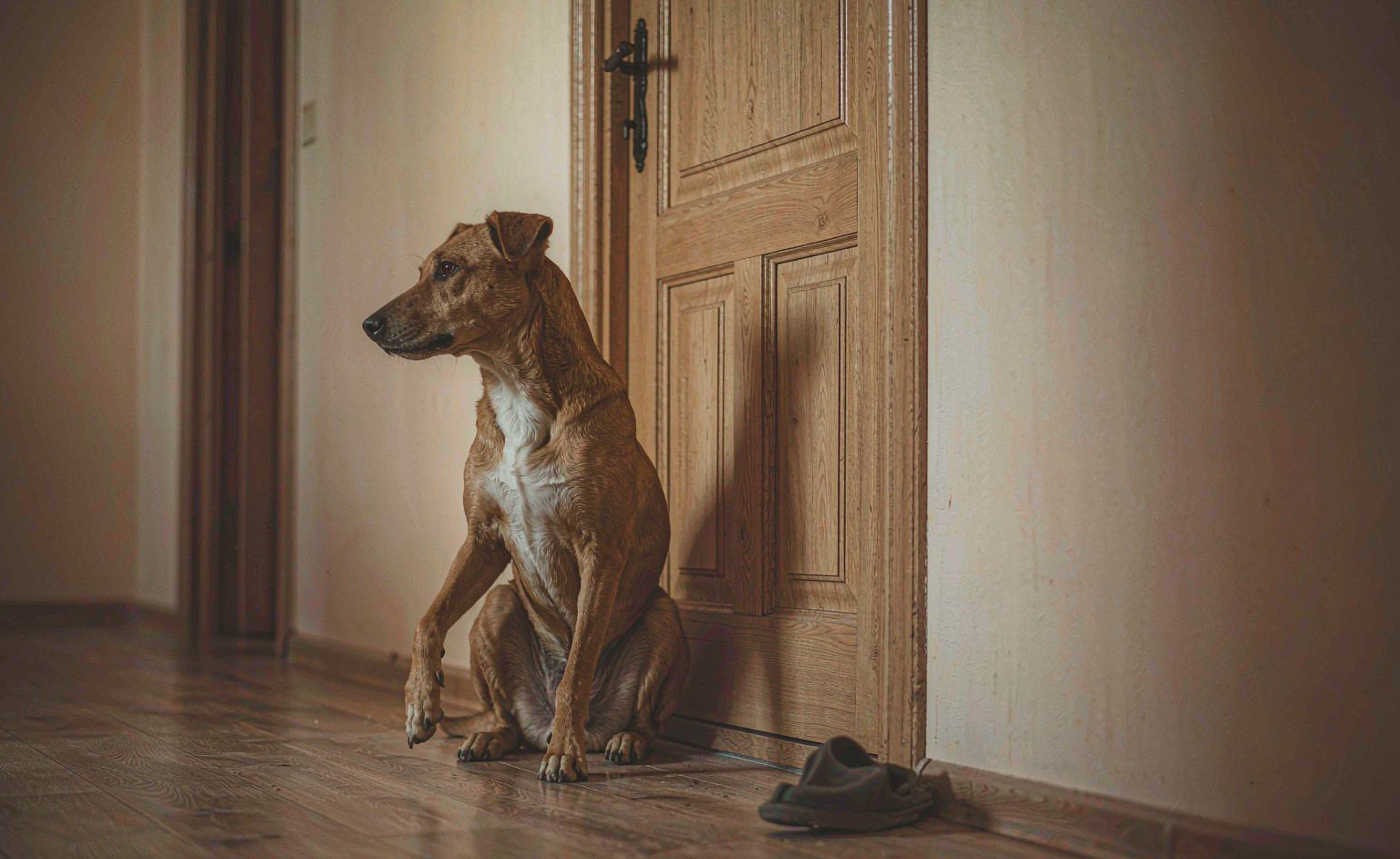
What Separation Anxiety Actually Is
The clinical term is separation-related behavior, and it describes a panic response rather than disobedience. The dog’s attachment figure leaves, and the dog’s arousal system escalates in a way it cannot self-regulate out of. Physiologically this looks like a panic attack: heart rate up, cortisol up, panting, salivation, and a strong drive to reunite that overrides everything else.
Three features separate this from ordinary displeasure at being alone.
It is attachment-specific. Most dogs with separation anxiety are fine when a stranger is in the house, or when another family member stays home. The trigger is the specific person, not aloneness in general. This is why a second dog usually does not fix it, and why “she’s fine with the sitter” does not rule it out.
It is departure-specific. The distress is tied to the sequence of leaving: keys, shoes, the specific jacket. Many dogs begin panting and pacing while the owner is still getting ready.
It is time-locked. Distress begins within minutes of departure, peaks in the first 30 minutes, and often settles after 45 to 60 minutes as exhaustion takes over. This timing is the single most useful diagnostic detail, and it is why a camera recording of the first hour is worth more than any description.
Ruling Out the Impostors
Before any training plan, three categories need to be excluded. Skipping this step is the most common reason a behavior plan fails.
Boredom and Under-Stimulation
A dog that is alone for nine hours with no exercise, no enrichment, and no opportunity to chew will find something to do. The distinguishing features:
| Feature | Separation anxiety | Boredom or under-stimulation |
|---|---|---|
| Timing of destruction | Within the first 30 minutes | Often later, after a period of settling |
| What gets destroyed | Doors, frames, blinds, exit points | Whatever is available; furniture, cushions, shoes, trash |
| Vocalization | Continuous howling, whining, screaming | Occasional barking, often at outside triggers |
| Behavior when alone | Pacing, panting, salivating, attempts to escape | Sleeping, then playing, then destroying |
| Body language on return | Frantic greeting, clingy for 20+ minutes | Normal greeting |
| Response to a long walk before departure | Little change | Marked improvement |
The last row is the practical test. If a hard 45-minute exercise session plus a food puzzle before departure substantially changes the behavior, the problem is closer to under-stimulation than to panic.
Medical Causes
Several conditions mimic separation anxiety and will not respond to training at all.
Incontinence. A dog that urinates while alone may have a urinary tract infection, bladder stones, hormone-responsive incontinence in spayed females, or orthopedic pain that makes holding a posture difficult. Our guide to dog urinary tract infection covers the diagnostic sequence, which starts with a urine sample rather than a behavior plan.
Gastrointestinal urgency. A dog with colitis or chronic diarrhea may genuinely be unable to wait. Our article on dog diarrhea explains the stool-quality signals that separate urgency from anxiety.
Cognitive dysfunction. Senior dogs with canine cognitive dysfunction vocalize at night, pace, and lose house training. Night vocalization in a 12-year-old dog is a veterinary question, not a training one.
Pain. Any source of chronic pain increases restlessness and vocalization. A dog that cannot settle when alone may simply hurt more when there is nothing to distract from it.
Incomplete House Training or Lack of Alone-Time Skills
A puppy or a newly adopted dog that has never been taught to be alone is not anxious; it is unskilled. The behavior looks similar in the first weeks and resolves with graded practice rather than with a panic protocol.
The Diagnostic Tool That Settles the Question
Record the dog. A phone on a tripod or a cheap indoor camera answered more diagnostic questions than any questionnaire, and it changes the plan in three ways.
Timing tells you the severity. Destruction in the first five minutes, with the dog not eating the food toy left for it, is severe panic. Destruction at minute 90 after the food toy was finished is boredom.
Behavior tells you the mechanism. Pacing, panting, drooling, and staring at the door are panic. Sleeping and then chewing is boredom. Attempting to follow the car is separation distress.
Response to return tells you the cycle. A dog that greets frantically and then follows the owner from room to room for half an hour is displaying the reunion behavior that also needs work.
Record three departures: one short (10 minutes), one medium (one hour), one long (four hours). Review the audio too; a single howl at minute two is diagnostic in a way that a chewed cushion is not.
The Desensitization Protocol, Precisely
The evidence base for treating separation anxiety rests on two procedures used together: systematic desensitization, which exposes the dog to the departure sequence in amounts it can tolerate, and counter-conditioning, which pairs that sequence with something the dog wants.
Step 1: Break the Departure Sequence Into Pieces
The departure cue chain in most homes runs: pick up keys, put on shoes, pick up bag, walk to door, open door, step out, close door, walk away, car starts, car leaves. The dog has learned this chain and starts reacting at the first link.
List your own chain, in order, and prepare to practice each link separately, at a level where the dog shows no distress at all. That last phrase is the entire method. If the dog is panting, the step was too big and the session is already failing.
Step 2: Pair Each Link With Food
Use something the dog only gets during this training: a stuffed food toy, freeze-dried liver, whatever produces real enthusiasm. The pairing is: cue appears, food appears. Keys picked up, treat delivered, keys put down. Shoes on, treat, shoes off. No leaving yet.
Repeat each link until the dog’s response to it is anticipation rather than alarm. This can take a week for the early links.
Step 3: Add the Door, Then Absence in Seconds
Open the door, treat, close the door, no departure. Then step out for one second, return, treat. Two seconds. Five. The increments should be small enough that the dog never has time to escalate.
A useful rule: increase duration by no more than 50 percent per successful repetition, and if the dog shows distress, drop back two steps and rebuild. Sessions should be ten to fifteen minutes, once or twice a day, and they end on a success.
Step 4: Build Past the Panic Window
The hard part of separation anxiety treatment is that progress often stalls at the point where the owner’s absence exceeds the dog’s tolerance, typically somewhere between 20 and 40 minutes. Getting past that point requires either very gradual extension with the camera confirming calm, or a bridge: daycare, a sitter, or a family member, used strategically so the dog is not practicing panic daily while the training catches up.
Practicing panic is not neutral. Every full-blown episode reinforces the association between aloneness and terror, which is why the standard advice to “leave more often so he learns” backfires so reliably. The dog is not learning to cope; it is rehearsing the fear.
Step 5: Manage the Reunion
Reunion behavior follows the same rules. Greet the dog calmly, without the high-pitched welcome that confirms departure was a big deal, and give it something to do on arrival, such as a food toy or a cue to go to a mat. Ten minutes of ignoring the dog followed by calm attention works for some dogs; the principle is predictability rather than coldness.
What Does Not Work, and Why Owners Try It Anyway
Punishment on return. Showing a dog the chewed door and scolding it hours later teaches nothing about the emotional state during departure, and it adds fear of the owner’s return to an already frightened dog.
Getting a second dog. It works for boredom and sometimes for dogs who are fine with other dogs. It does not work for attachment-specific panic, and it doubles the household management if it fails.
Crating a panicking dog. A dog in panic will injure itself against a crate, break teeth, and damage the crate. Crating is appropriate for a dog that is calm in a crate and destructive outside it. It is dangerous for a dog with true panic, and a dog that has broken out of a crate has told you which one it is.
Calming chews and diffusers alone. Pheromone products and L-theanine supplements have modest evidence for situational anxiety and essentially none as monotherapy for separation anxiety. They are adjuncts, and an over-the-counter product does not replace a behavior plan. The same holds for weighted vests and music, which help some dogs and change nothing for others; if you cannot measure an effect on the camera, it is not working.
Waiting for the dog to grow out of it. Puppies who show distress at being alone often worsen without intervention, and the behavior becomes entrenched by 18 months.
When Medication Belongs in the Plan
For moderate to severe cases, medication is not a shortcut; it is what makes the training possible. A dog in panic cannot learn, and the standard of care in veterinary behavior is to lower the arousal enough that desensitization can take hold.
The medications used, in general order of appearance:
- Fluoxetine or clomipramine, daily, for ongoing anxiety. Both take four to six weeks to reach effect and are given with the training, not instead of it.
- Trazodone, used situationally or daily, particularly for dogs that need to be left during the training period.
- Short-acting options for specific departures while the longer-term plan takes hold.
None of these are available over the counter, and none should be started without a behavior assessment. The relevant point for owners is that asking about medication early is not a failure of training commitment; it is often what makes training work.
A Realistic Timeline
Owners consistently underestimate this and quit in week three. Real separation anxiety treatment takes two to six months of consistent daily work, longer when the dog’s tolerance is under 20 minutes at the start. The measurable milestones are: the dog stops reacting to the key cue, then tolerates five minutes of absence calmly, then thirty, then the actual work absence. A dog that plateaus at a given duration for two weeks needs the training plan adjusted, not more repetitions of the same failing step.
Bottom Line
Determine first whether this is panic, boredom, or a medical problem, using a camera and a urine sample rather than intuition. If it is panic, the treatment is gradual desensitization to the departure cues plus counter-conditioning, run at a pace the dog sets, with medication support for moderate and severe cases and a bridge arrangement so the dog is not rehearsing panic every workday. If it is boredom, the fix is exercise, enrichment, and chewing outlets before departure. If it is medical, no amount of training will help, and the diagnostic step comes first.

Frequently Asked Questions
How do I know if my dog has separation anxiety or is just bored?
Timing and target are the distinguishing features. Separation anxiety produces distress within the first 30 minutes of departure, with pacing, panting, drooling, howling, and destruction focused on doors, frames, and windows. Boredom produces destruction later, aimed at whatever is available, and the dog usually sleeps first. A camera recording of the first hour answers the question more reliably than any description.
Does getting a second dog help separation anxiety?
Usually not. True separation anxiety is attachment-specific, so a second dog does not replace the absent person, and many affected dogs are fine with other dogs present but still panic when the person leaves. A second dog can help a dog that is simply lonely or under-stimulated, but it is a poor bet as a treatment for diagnosed separation anxiety and it doubles the management burden if it fails.
Should I crate my dog with separation anxiety?
Only if the dog is already calm in a crate. A dog in genuine panic can break teeth, tear nails, and injure itself badly against crate bars, and dogs have broken out of crates and through doors during panic episodes. If the dog has injured itself escaping a crate, crating is contraindicated and the plan needs veterinary behavior input.
How long does it take to fix separation anxiety in dogs?
Typically two to six months of consistent daily desensitization work, longer when the dog cannot tolerate even a few minutes of absence at the start. Progress is measured in tolerated absence duration, not in how the dog seems on any given day. Plateaus of more than two weeks at one duration mean the plan needs adjusting.
Can separation anxiety be cured with medication alone?
No. Medication lowers arousal enough for training to work, and the training is what changes the behavior. Daily medications such as fluoxetine or clomipramine take four to six weeks to reach effect and are prescribed alongside a desensitization plan. Medication without behavior work tends to produce a calmer dog that still panics when the dose wears off or the situation intensifies.
What should I do with my dog while I am at work during treatment?
Use a bridge so the dog is not practicing panic daily: daycare, a midday sitter, a family member, or a neighbor, for the weeks the training needs to catch up. Practicing a full panic episode reinforces the fear association and undoes progress. This is why treatment for a dog with a low tolerance often requires temporary daytime arrangements rather than willpower.
Is it cruel to leave a dog with separation anxiety alone?
Leaving a panicking dog alone repeatedly is harmful because each episode strengthens the fear, which is why management comes before exposure. The goal is not to avoid all absences forever; it is to build tolerance in increments the dog can handle, with management covering the gap. Abandoning the training and simply leaving the dog to cry it out is the outcome to avoid.
References
- Sherman BL, Mills DS. Canine anxieties and phobias: an update on separation anxiety and noise aversions. Veterinary Clinics of North America: Small Animal Practice. 2008. https://pubmed.ncbi.nlm.nih.gov/18675723/
- Overall KL, Dunham AE, Frank D. Frequency of nonspecific clinical signs in dogs with separation anxiety, thunderstorm phobia, and noise phobia, alone or in combination. Journal of the American Veterinary Medical Association. 2001. https://pubmed.ncbi.nlm.nih.gov/11549185/
- Blackwell E, Casey RA, Bradshaw JWS. Controlled trial of behavioural therapy for separation-related disorders in dogs. Veterinary Record. 2006. https://pubmed.ncbi.nlm.nih.gov/16581996/
- Landsberg GM, Melese P, Sherman BL, et al. Effectiveness of fluoxetine chewable tablets in the treatment of canine separation anxiety. Journal of Veterinary Behavior. 2008. https://www.sciencedirect.com/science/article/abs/pii/S1558787807001141
- King JN, Simpson BS, Overall KL, et al. Treatment of separation anxiety in dogs with clomipramine: results from a prospective, randomized, double-blind, placebo-controlled, parallel-group, multicenter clinical trial. Applied Animal Behaviour Science. 2000. https://www.sciencedirect.com/science/article/abs/pii/S0168159100001244
- Sherman BL. Separation anxiety in dogs. Veterinary Medicine. (treatment protocol and time course)
- Herron ME, Shofer FS, Reisner IR. Survey of the use and outcome of confrontational and non-confrontational training methods in client-owned dogs showing undesired behaviors. Applied Animal Behaviour Science. 2009. https://www.sciencedirect.com/science/article/abs/pii/S0168159108002131
- American Veterinary Society of Animal Behavior. Position Statement on the Use of Punishment for Behavior Modification in Animals. https://avsab.org/resources/position-statements/
Disclaimer
This article is educational and is not veterinary behavior advice for your individual dog. Separation-related behavior requires assessment that can rule out medical causes and identify concurrent conditions. Medications mentioned here are prescription-only and must be prescribed by a veterinarian who has evaluated the dog. If your dog is injuring itself attempting to escape, has stopped eating when alone, or the household cannot safely manage the situation, seek veterinary behavior support promptly.