
# Dog Tear Stains: What Causes Them, How to Clean Them, and When They Matter
Author: PurePalsLab Research Team
Reviewed by: Veterinary advisory panel
Reading time: 10 minutes
—
If you have a light-coated dog, you have probably looked at the reddish-brown streaks under their eyes and wondered where they came from. Tear stains are one of the most common cosmetic complaints dog owners bring up, and also one of the most misunderstood. Some people assume they mean the dog is dirty or unhealthy. Others panic and think it is an infection. The truth sits in the middle, and it is worth understanding because sometimes tear stains are simply a cosmetic thing, and sometimes they are a clue that something needs attention.
This guide walks through what tear stains actually are, why some dogs get them and others never do, how to clean and manage them safely, which product ingredients people reach for and what the evidence says, and the specific situations where tear staining stops being a grooming issue and becomes a reason to call your vet.
—
The Short Answer
Tear stains are the reddish-brown or rust-colored marks left where tears spill onto the fur under a dog’s eyes. They happen when a dog produces more tears than the drainage system can handle, a condition called epiphora, or when the tears that do drain are high in compounds that darken on contact with air and light. The staining itself is not a disease. It is a cosmetic byproduct. The underlying causes range from simple anatomy, like a flat face and shallow eye sockets, to allergies, blocked tear ducts, eyelash or eyelid problems, and, less often, infections. You can usually manage the stains at home with gentle cleaning and good facial hygiene. But if the eye itself looks red, swollen, painful, or has colored discharge, or if the staining appeared suddenly along with other symptoms, that is a vet situation, not a cleaning situation. For everyday management, keeping the area clean and dry helps more than any product, and addressing the root cause, whether that is allergies, a blocked duct, or just your dog’s face shape, is what actually reduces the stains over time.
—
What Tear Stains Actually Are
Tear stains are not dirt, and they are not a sign that your dog is unkempt. They are the result of a chemical reaction between compounds in tears and the environment.
Tears are not just water. They carry proteins, minerals, and other substances. One compound that gets a lot of attention in this discussion is porphyrin, an iron-containing pigment that tears and saliva naturally contain. When porphyrin-rich tears sit on light-colored fur and are exposed to oxygen and sunlight, they oxidize and turn a reddish-brown color. That is the stain you see.
A few things follow from this. Because the color comes from porphyrin, the effect is far more visible on white, cream, and pale fur than on dark coats, where the same tearing leaves little or no visible mark. That is why tear stains look like a light-coat problem, even though many dark-coated dogs tear just as much. The tear volume matters too. A dog that produces normal tears but drains them efficiently rarely stains, because the tears never sit on the fur long enough to oxidize. The dogs that stain are usually the ones producing excess tears, draining them poorly, or both.
This is the key to the whole topic: tear stains are a symptom, and the real question is always why the dog is tearing and why the tears are spilling over.
—
Why Some Dogs Tear More Than Others
Excess tearing, the medical term is epiphora, has several distinct causes, and knowing which one you are dealing with changes how you handle it.
Face shape and anatomy. This is the most common cause and the one no product will change. Brachycephalic breeds, the flat-faced dogs like Shih Tzus, Pekingese, Pugs, Bulldogs, and Bichon Frises, often have shallow eye sockets and a facial structure that does not drain tears well. The tears pool in the corner of the eye and spill down the face instead of running down the tear duct into the nose. In these breeds, some degree of tear staining is often just part of the look, not a problem to fix.
Blocked or narrow tear ducts. Sometimes the drainage channel itself is the problem. A tear duct can be narrow, blocked by debris or inflammation, or, in rare cases, not fully formed. When the duct cannot move tears to the nose, they back up and overflow onto the fur. This is worth a vet check because some blockages are treatable.
Allergies and irritants. Allergic dogs, whether to pollen, dust, food, or something in the environment, often get watery, itchy eyes. The increased tearing spills onto the face. So do irritants like dust, smoke, and shampoo that gets in the eyes during a bath.
Eyelashes, eyelids, and hair. An eyelash that grows inward and rubs the eye, a rolled-in eyelid, or fur that constantly pokes the eye all cause irritation and reflex tearing. These are mechanical problems that can be corrected, sometimes surgically.
Infections and other eye conditions. A bacterial or viral infection, a corneal scratch, or inflammation inside the eye can all cause excess tearing. This is the category that should never be treated with a stain remover, because the eye itself is the problem.
Teething, in puppies. Many puppies show a temporary increase in tearing and staining while they are teething. It often settles on its own once the adult teeth come in.
—
The Color Tells You Something
The color of the staining is worth paying attention to, because it is not always the same.
The classic reddish-brown stain is porphyrin, from normal tears oxidizing on light fur. This is the everyday, cosmetic version.
A darker, almost black-brown staining can be a yeast or bacterial overgrowth in the moist fur under the eye. The warm, damp area under the eye, especially on flat-faced breeds, is a good environment for microbes, and they can darken the stains and add an odor. This is more of a hygiene issue than an eye issue.
A green or yellow discharge is not a stain, it is a sign of pus or infection and needs a vet, not a wipe.
So when you look at the stain, you are also doing a quick health check. Reddish-brown that looks the same as always is the everyday version. Dark, smelly, or green changes the picture.
—
How to Clean and Manage Tear Stains Safely
Most tear stains can be managed at home with patience and gentle technique. The goal is not to chase the stains away overnight, it is to keep the area clean and dry so new stains form more slowly and old ones fade.
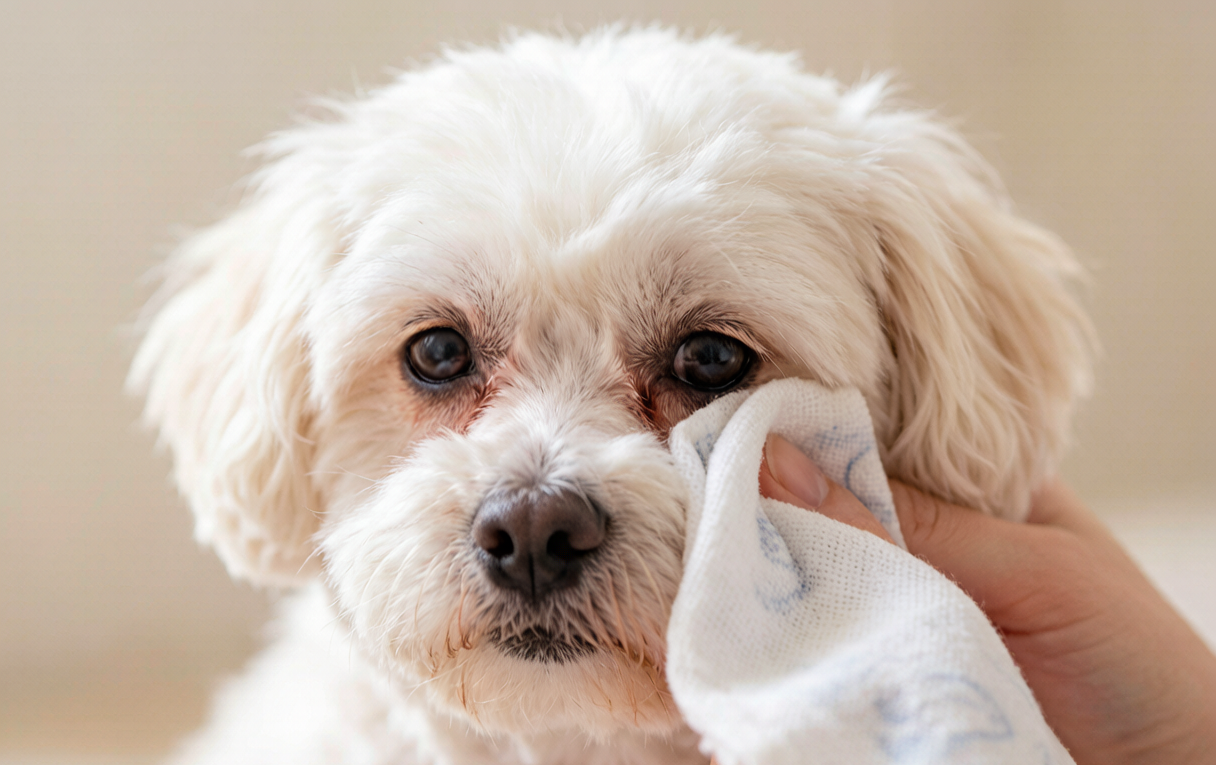
Wipe daily with a warm, damp cloth. A soft, clean cloth with warm water is the safest thing you can use. Gently wipe the fur under the eyes each day to remove tears before they sit and oxidize. Wipe away from the eye, not toward it, and use a fresh part of the cloth for each eye so you do not move anything from one eye to the other.
Keep the fur short under the eyes. Long hairs wick tears onto the face and hold moisture against the skin. Trimming the hair under and around the eyes, done carefully with blunt-nosed scissors or by a groomer, can visibly reduce staining because there is less fur for the tears to cling to.
Dry the area after wiping. Moisture is what lets the stains set and lets yeast thrive. After cleaning, pat the area dry with a clean cloth. Some owners use a tiny amount of cornstarch to keep the area dry, but keep it well away from the eye and check with your groomer first.
Beware of anything that promises fast whitening. The stain-removal market is full of products that promise dramatic results. Many of them rely on ingredients that are worth a careful look. Hydrogen peroxide can lighten fur but also irritates skin and can bleach the coat unevenly. Some formulations contain antibiotics like tylosin, which should never be used casually, and using them routinely for cosmetics is exactly the kind of thing a vet will warn against. “Brightening” is not the same as healthy. If a product list makes you pause, trust the pause.
Address the cause, not just the stain. The single most reliable way to reduce tear stains is to figure out why the dog is tearing. If it is allergies, managing the allergen helps. If it is a blocked duct, only a vet can address that. If it is just your dog’s face shape, the honest answer is that some staining is normal and the priority shifts to keeping it clean and comfortable rather than eliminating it.
—
When to See a Vet
Cleaning handles the cosmetic side. The vet handles the questions cleaning cannot answer. Make the call in these situations.
The eye itself looks abnormal. Redness in the white of the eye, swelling, squinting, pawing at the eye, or sensitivity to light all point to an eye problem, not a staining problem.
The discharge is colored or thick. Green or yellow discharge, or anything resembling pus, is a red flag.
The staining appeared suddenly or changed character. A sudden onset of heavy tearing in an adult dog, especially in one eye, is different from lifelong mild staining.
There are signs of pain. A dog that is holding one eye shut, rubbing its face on the floor, or flinching when you touch near the eye is in discomfort and needs attention.
The tear duct may be blocked. If one side constantly overflows while the other drains normally, or if cleaning never seems to reduce the moisture, a vet can check the duct.
Any change in vision, appetite, or energy that comes with the eye symptoms.
For many dogs, especially flat-faced breeds, a vet may simply confirm that the staining is cosmetic and reassure you. That confirmation is useful on its own, because it lets you stop worrying and focus on maintenance.
—
Supporting Eye and Skin Health from the Inside
Because so much of tear staining comes down to inflammation, allergies, and the health of the skin and tear film, everyday nutrition plays a supporting role. This is where supplements enter the picture, honestly.
Essential fatty acids, especially omega-3s, are the nutrients most often discussed for eye and skin health. The EPA and DHA in omega-3s support a normal inflammatory response and healthy skin, which is relevant because both eye irritation and allergic skin reactions are inflammatory processes. Supporting the skin barrier and a normal inflammatory balance is a reasonable part of everyday care for a dog that tears a lot, especially if allergies are part of the picture. You can read more about skin allergies and what helps in our skin allergies guide.
If you want to add this kind of support, our Omega 3-6-9 Complete Fatty Acid Complex is a chewable option with omega-3s, zinc, and vitamin E, ingredients that support skin, coat, and normal immune function as part of a healthy baseline. It is everyday wellness support, not a treatment for eye problems or tear stains, and it works best alongside good hygiene and your vet’s guidance. No supplement is a substitute for figuring out why the eye is tearing, and none of them are a treatment for an active eye condition.
—
Frequently Asked Questions
Do dog tear stains mean my dog is sick?
Not by themselves. In most dogs, tear stains are a cosmetic result of normal tears oxidizing on light fur, especially in flat-faced breeds. They become more of a concern when the eye itself looks red, swollen, or painful, when there is colored or thick discharge, or when the tearing suddenly appears in an adult dog. Those are the situations where a vet check is warranted.
What is the fastest way to remove dog tear stains?
There is no safe overnight fix. The fastest reliable approach is consistent daily wiping with a warm, damp cloth, keeping the fur trimmed and dry under the eyes, and addressing the underlying cause of the tearing. Products that promise dramatic whitening often rely on irritating ingredients, so they are not worth the risk to the skin around the eye.
Are tear stain removers safe for dogs?
Some are, and some are not. The safest options are gentle wipes and washes meant for the eye area. Products containing hydrogen peroxide can irritate skin, and some contain antibiotics that should not be used routinely for cosmetics. If you are unsure about an ingredient, ask your vet or groomer before using it near the eye.
Why does my white dog get tear stains but my dark dog does not?
Both dogs may tear the same amount. The difference is visibility. The stain comes from porphyrin in tears oxidizing on contact with air and light, and that reddish-brown color simply shows up clearly on white or cream fur while blending into dark coats. A dark-coated dog can have the exact same tearing with no visible stain.
Can food allergies cause tear stains?
They can contribute. Allergies, including food allergies, can cause watery, itchy eyes that lead to excess tearing and more staining. If you suspect a food allergy, work with your vet to evaluate the diet and rule out other causes before assuming the stains are purely dietary. —
Bottom Line
Tear stains are common, mostly cosmetic, and rarely an emergency. They happen when tears high in porphyrin sit on light fur and oxidize, and they show up far more on white and cream coats than on dark ones. The real work is not chasing the stain, it is understanding why the dog tears, whether that is face shape, allergies, a blocked duct, or something else. Keep the area clean and dry with gentle daily wiping and trimmed fur, treat the underlying cause, and let a vet weigh in when the eye itself looks red, painful, or has colored discharge. For most dogs, especially the flat-faced breeds where some staining is simply part of the look, a calm, consistent hygiene routine is worth more than any product. And if you want to support skin and eye health from the inside, omega-3s are a reasonable everyday addition, used as wellness support rather than as a fix for the stains themselves.
—
References
- Cornell University College of Veterinary Medicine — Eye conditions and tear film health resources. vet.cornell.edu
- American College of Veterinary Ophthalmologists — When to seek veterinary eye care. acvo.org
- Merck Veterinary Manual — Epiphora and tear drainage in dogs. merckvetmanual.com
—
Disclaimer: This article is for informational purposes only and is not a substitute for professional veterinary advice, diagnosis, or treatment. These statements have not been evaluated by the FDA. This product is not intended to diagnose, treat, cure, or prevent any disease. Always consult a licensed veterinarian for any health concern regarding your pet.