Essential Facts About Feline Nutrition
- Cats are obligate carnivores — biologically incapable of surviving on plant-based diets. Unlike dogs or humans, cats lack the enzymes to convert plant carotenoids to vitamin A, synthesize taurine from cysteine, or produce arachidonic acid from linoleic acid. Every one of these nutrients must come from animal tissue.
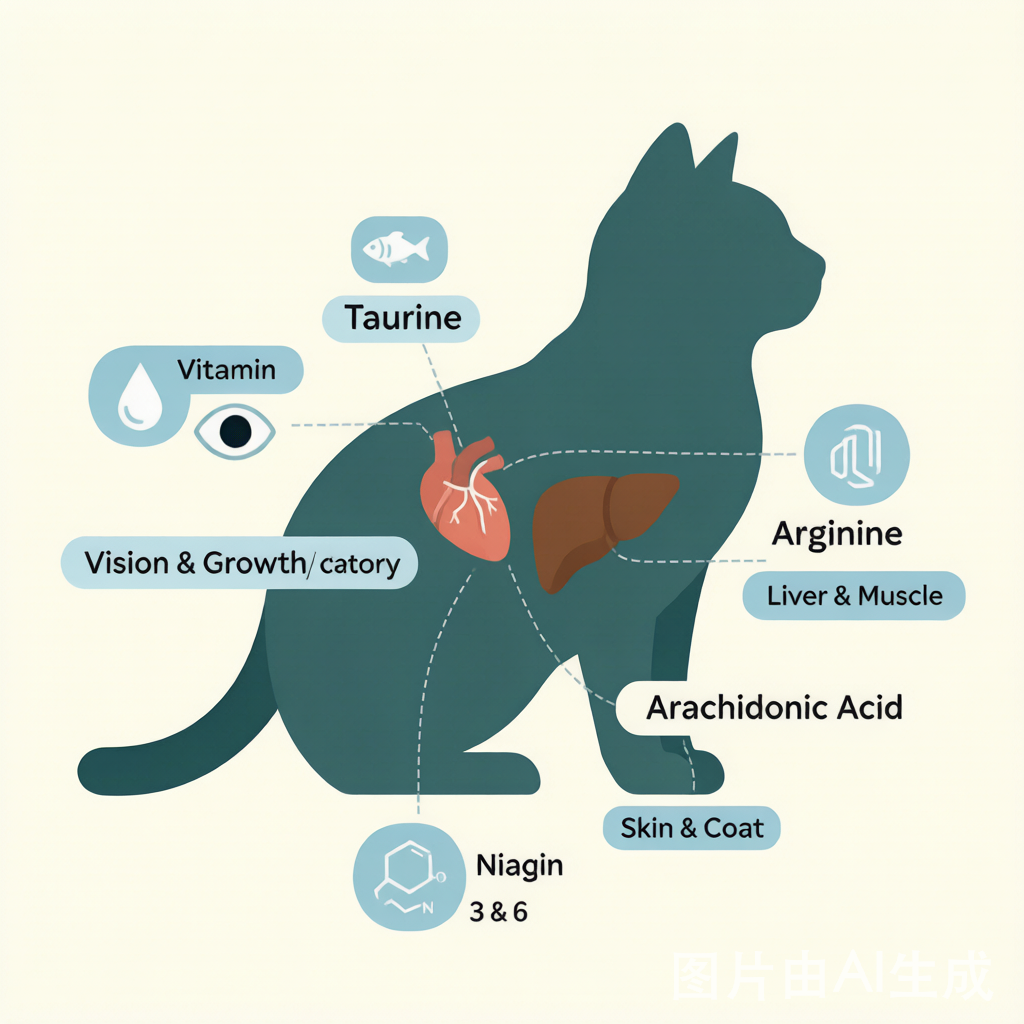
- Five essential nutrients define feline nutrition. Taurine, arginine, vitamin A (preformed retinol), arachidonic acid, and niacin are the five nutrients cats cannot synthesize in adequate amounts. A deficiency in any one triggers specific and serious disease — from taurine-deficiency dilated cardiomyopathy to arginine-depletion hyperammonemia within hours of a deficient meal.
- Commercial cat food does not guarantee nutrient adequacy. Heat processing degrades taurine by 20–70%. Storage time and conditions reduce bioavailability further. Senior cats absorb less, picky eaters eat less, and therapeutic diets trade one nutrient priority against another. Supplementation bridges these real-world gaps.
- Common feline nutrient deficiencies are predictable and preventable. Taurine deficiency causes blindness and heart failure. Vitamin A deficiency causes night blindness and skin lesions. Arginine deficiency can be fatal within hours. Omega-3 and probiotic gaps underlie chronic inflammation and gastrointestinal disorders. A quality cat supplement bridges the gap between what commercial food provides and what your individual cat actually needs. Knowing the signs and risk factors lets owners intervene before clinical disease develops.
Why Feline Nutrition Is Fundamentally Different
If you’ve ever fed your cat and your dog from the same bag of food, this section is for you.
Cats are obligate carnivores. That’s not a marketing term — it’s a biological classification that means their metabolism is hardwired to extract nutrients from animal tissue and animal tissue alone. Unlike dogs (facultative carnivores that can survive on a more varied diet) and humans (omnivores), cats lack the enzymatic machinery to synthesize several nutrients that are abundant in meat but absent from plants.
This isn’t a preference. It’s an evolutionary trade-off. Over millions of years, cats’ ancestors hunted prey that provided every nutrient they needed — so their bodies stopped investing energy in making those nutrients from scratch. The result is a metabolism that’s ruthlessly efficient on a meat-based diet and dangerously fragile on anything else.
Here at PurePalsLab, we formulate differently for cats than for dogs — because their biology demands it. Understanding those differences is the first step to keeping your cat healthy for the long haul.
The Five Nutrients Cats Cannot Live Without (and Cannot Make)
Every species has nutritional quirks, but cats have five that are clinically significant enough to cause disease when missing. These are the non-negotiables of feline nutrition.
| Nutrient | Why Cats Can’t Make It | Deficiency Consequence | Dietary Source |
|---|---|---|---|
| Taurine | Low activity of cysteine dioxygenase — the rate-limiting enzyme for taurine synthesis | Dilated cardiomyopathy (heart failure), retinal degeneration (blindness), reproductive failure, impaired immune function | Muscle meat (dark meat poultry highest), heart, fish |
| Arginine | Inability to synthesize ornithine from glutamate in the intestinal mucosa — cats rely entirely on dietary arginine for the urea cycle | Hyperammonemia within hours of a single arginine-free meal — ammonia builds to toxic levels causing vomiting, ataxia, seizures, and death if untreated | All animal proteins; particularly abundant in poultry and fish |
| Vitamin A (Retinol) | Lack of the intestinal enzyme β-carotene 15,15′-dioxygenase — cats cannot convert plant beta-carotene to active vitamin A | Night blindness, corneal degeneration, skin lesions, increased infection susceptibility, reproductive failure | Liver, fish oils, egg yolk (must be preformed retinol, not plant carotenoids) |
| Arachidonic Acid | Low or absent Δ6-desaturase activity — cats cannot convert linoleic acid (plant omega-6) to arachidonic acid | Impaired platelet aggregation (bleeding disorders), poor skin and coat condition, reproductive failure, inflammatory dysregulation | Animal fats, organ meats, egg yolk |
| Niacin (Vitamin B3) | Extremely high activity of picolinic carboxylase — diverts tryptophan away from niacin synthesis toward acetyl-CoA production | Weight loss, anorexia, inflamed gums, hemorrhagic diarrhea, “pellagra-like” syndrome | Meat, poultry, fish; particularly abundant in liver |
Two of these deserve special attention because of how quickly deficiency can become dangerous.
Taurine deficiency is insidious. Unlike arginine deficiency (which causes acute symptoms), taurine depletion happens over months. A cat eating a taurine-deficient diet may appear healthy until cardiac changes are already advanced. The 1987 discovery that linked low plasma taurine to dilated cardiomyopathy in cats led to mandatory taurine supplementation in all commercial cat foods — a regulation that remains one of the most impactful public health interventions in veterinary history.
Arginine deficiency is terrifyingly fast. A single arginine-free meal can cause hyperammonemia in cats within 2–5 hours. The urea cycle — which converts toxic ammonia to harmless urea — depends on arginine-derived ornithine. Without it, ammonia accumulates in the bloodstream and crosses the blood-brain barrier. The clinical signs (vomiting, hypersalivation, ataxia) appear rapidly, and without intervention, the cat can die within hours. No other domestic species is this sensitive to arginine deprivation.
When Cat Food Alone Isn’t Enough: The Case for Supplementation
A quality commercial cat food that meets AAFCO standards should theoretically provide all essential nutrients. In practice, several factors can create gaps that supplementation fills.
1. Heat Processing Degrades Taurine
Taurine is heat-sensitive. The high-temperature extrusion process used to make dry kibble can reduce bioavailable taurine by 20–50% depending on processing conditions. While manufacturers compensate by adding extra taurine, the final amount reaching your cat depends on storage conditions, bag age, and how much the food has been exposed to heat and moisture. A 2006 study in the Journal of Animal Physiology and Animal Nutrition documented that cooking alone can reduce taurine content in animal feed ingredients by 50–70%.
2. Senior Cats Absorb Less
Aging cats experience reduced intestinal absorption efficiency across multiple nutrient classes. Protein digestibility declines. B-vitamin absorption drops. Renal function changes affect electrolyte balance. A cat at 12 years old may need 30–50% more dietary input to achieve the same circulating nutrient levels as a 3-year-old — yet senior cats often eat less due to decreased appetite, dental issues, or concurrent disease.
3. Picky Eating Creates Real Deficits
Any cat owner knows the experience: you buy a premium food, and your cat refuses to touch it. A cat that skips meals — or eats only enough to stave off hunger — may meet calorie requirements while falling short on micronutrients. This is especially common in multi-cat households where food competition or stress suppresses intake in more timid cats.
4. Therapeutic Diets Have Trade-offs
Prescription diets for kidney disease, urinary crystals, or food allergies are formulated to manage specific conditions — sometimes at the expense of other nutrients. A renal diet that restricts phosphorus and protein may inadvertently reduce taurine and B-vitamin intake. A hydrolyzed protein diet for allergies may alter gut microbiota in ways that affect nutrient synthesis. Targeted supplementation alongside these diets, coordinated with your veterinarian, can bridge the gap.
The Supplement Categories That Actually Matter for Cats
Not all supplements are created equal, and cats don’t need every product on the pet store shelf. Here’s what the data supports.
| Supplement Category | Evidence Level | Best For | What to Look For |
|---|---|---|---|
| Probiotics | Strong — multiple RCTs in cats | Diarrhea, IBD, post-antibiotic recovery, stress-induced GI upset | Strain-specific labeling (e.g., Enterococcus faecium SF68, Lactobacillus acidophilus); CFU count at expiry, not at manufacture |
| Omega-3 (Fish Oil) | Strong for skin/coat and inflammation; moderate for kidney disease | Skin allergies, inflammatory conditions, CKD support, cognitive aging | EPA + DHA content (not total oil); molecularly distilled for purity; third-party tested for heavy metals |
| Joint Support (Glucosamine + Chondroitin) | Moderate — more evidence in dogs than cats, but feline osteoarthritis is underdiagnosed | Senior cats, breeds prone to OA (Maine Coon, Persian, Siamese), post-injury recovery | Glucosamine HCl (not sulfate) for cats; combined with chondroitin; allow 6–8 weeks for effect |
| L-Lysine | Mixed — widely used for feline herpesvirus but recent RCTs question efficacy | Chronic FHV-1 (cat flu) management; may reduce viral shedding and symptom severity | Pure L-lysine HCl; avoid formulations with propylene glycol (toxic to cats); 250–500 mg BID |
| Taurine | Strong for deficiency; preventive for at-risk cats | Cats on homemade/raw diets, senior cats, cats with cardiac history | Free-form taurine powder; 250–500 mg daily for prevention; therapeutic doses under vet supervision |
| Multivitamin | Supportive — fills micronutrient gaps | Picky eaters, seniors, cats on restricted diets, multi-cat households | Complete B-complex, vitamin A (retinyl palmitate, not beta-carotene), vitamin D3, zinc, iron |
A word about the market context: the global cat supplement market reached $1.15 billion in 2025 and is projected to hit $1.95 billion by 2031, growing at 9.3% CAGR. Probiotics are the fastest-growing segment — Google Trends data shows search interest for “cat probiotics supplements” spiked 13-fold in late 2025 alone. Cat owners are increasingly proactive about preventive health, and the supplement aisle reflects that shift.
Frequently Asked Questions About Feline Nutrition
Cats are classified as obligate carnivores because their metabolism is evolutionarily adapted to a diet consisting almost exclusively of animal tissue. Unlike omnivores (humans) or facultative carnivores (dogs), cats lack several key enzymes — including β-carotene 15,15′-dioxygenase for vitamin A conversion, cysteine dioxygenase for taurine synthesis, and Δ6-desaturase for arachidonic acid production — that would allow them to obtain essential nutrients from plant sources. Their ancestors hunted prey that provided every necessary nutrient, so cats lost the metabolic machinery to synthesize these compounds endogenously. As a result, cats must consume preformed taurine, arginine, vitamin A, arachidonic acid, and niacin directly from animal tissue. A diet lacking animal-derived nutrients inevitably leads to deficiency disease and, in some cases, death.
The most clinically significant nutrient deficiencies in domestic cats are: (1) Taurine deficiency — causes dilated cardiomyopathy, retinal degeneration, and reproductive failure; risk increases with homemade diets, dog food fed to cats, and poorly stored dry food where heat has degraded taurine. (2) Arginine deficiency — causes hyperammonemia within hours of an arginine-free meal, with vomiting, ataxia, and potentially fatal ammonia toxicity. (3) Vitamin A deficiency — produces night blindness, corneal degeneration, skin lesions, and increased infection susceptibility in cats fed plant-based or liver-free diets. (4) Arachidonic acid deficiency — leads to impaired platelet function, poor coat quality, and reproductive failure in cats fed low-fat or plant-oil-based diets. (5) Omega-3 fatty acid deficiency — contributes to chronic inflammatory skin conditions, cognitive decline in seniors, and suboptimal renal function. Blood work (whole-blood taurine, serum vitamin A, fatty acid profile) can definitively diagnose deficiencies when clinical signs are present.
No. Cats cannot survive on a vegetarian or vegan diet without developing life-threatening nutritional deficiencies. Their obligate carnivore biology requires preformed taurine, arachidonic acid, and retinol (vitamin A) — nutrients found exclusively in animal tissue. While synthetic forms of taurine and vitamin A exist as supplements, a cat’s digestive tract is anatomically and physiologically adapted to process meat, not high volumes of plant material. Cats have a short gastrointestinal tract, limited capacity for carbohydrate digestion (low salivary and pancreatic amylase), and no nutritional requirement for dietary carbohydrates. Furthermore, plant-based diets create an alkaline urinary pH that predisposes cats to struvite crystal formation and urinary tract disease. Feeding a cat a vegan diet, even with synthetic supplementation, constitutes a welfare concern that most veterinary organizations — including the American Veterinary Medical Association and the British Veterinary Association — explicitly advise against. A cat’s biology does not offer a plant-based option.
Supplementation should be considered when specific risk factors are present: Age — senior cats (10+ years) have reduced intestinal absorption and may need 30–50% more dietary input to maintain circulating nutrient levels. Diet type — cats on homemade, raw, or restricted-ingredient diets are at higher risk of micronutrient gaps. Appetite — picky eaters or cats in multi-cat households where food competition suppresses intake may meet calorie needs while falling short on micronutrients. Medical conditions — cats with chronic kidney disease, inflammatory bowel disease, feline herpesvirus, or osteoarthritis may benefit from targeted supplementation (omega-3s, probiotics, lysine, joint support respectively). Physical signs — dull coat, flaky skin, lethargy, weight loss, or recurrent infections can signal underlying deficiencies. The decision to supplement should be guided by a veterinarian familiar with your cat’s complete health picture. Blood work is the definitive diagnostic tool — don’t guess when a simple test can confirm. A healthy young cat eating a complete AAFCO-approved commercial diet with normal appetite likely does not need routine supplementation.
Generally no. Human supplements often contain ingredients toxic to cats: xylitol (common sweetener in gummies), garlic or onion extracts, propylene glycol, and certain herbal additives. Dosing is also radically different — a human fish oil capsule may provide 10× the appropriate EPA/DHA for a cat. Always use cat-specific formulations or consult your veterinarian before using any human product.
Early signs are often subtle: dull coat, flaky skin, lethargy, decreased appetite, or weight loss. More specific signs depend on the missing nutrient — night blindness suggests vitamin A deficiency; exercise intolerance or coughing may indicate taurine-deficiency heart disease. Blood work (whole blood taurine, vitamin levels, complete blood count) is the definitive diagnostic tool. If your cat shows any persistent change in energy, appetite, or appearance, a veterinary exam is the right first step.
If your cat is young, healthy, eating a complete-and-balanced AAFCO-approved diet with good appetite, and has no specific health concerns — probably not. Supplementation makes the most sense for cats with identified risk factors: seniors, picky eaters, cats on restricted/therapeutic diets, indoor-only cats with limited sun exposure (vitamin D), or cats with chronic conditions. Think of supplements as targeted tools, not daily defaults. When in doubt, ask your vet.