
# Why Is My Dog Limping? A Load-Bearing Guide to Finding the Cause and Knowing When It Can Wait
Limping is one of the most common reasons a dog ends up at a veterinary clinic, and one of the hardest to triage over the phone. That is because “limping” covers everything from a thorn in a pad that resolves by morning to a cranial cruciate ligament rupture that needs surgery, and both dogs may walk into the clinic on three legs with the same worried expression. The difference is in details that owners can actually collect: which leg, how the weight is being carried, whether it started suddenly or crept in, and what changed in the last week.
This guide turns those details into a sequence. You will grade the limp, check the paw, match the pattern to the likely causes, and end up in one of three places: watch and rest with a recheck plan, a routine appointment this week, or an emergency visit tonight. The treatment side of the major joint disease is covered separately in our guide to arthritis medication for dogs; this article is about finding the cause and grading the urgency.
The Short Answer
Start by grading the limp: a dog that still puts partial weight on the leg is different from one that holds it completely off the ground, and that difference drives the timeline. Next, check the paw itself, because roughly half of sudden limping in an otherwise sound dog is something visible in the pad, between the toes, or on a nail. Then match the pattern: a large young dog with a sudden hind-leg limp is a cruciate case until proven otherwise, a slow-worsening front-leg limp in a senior is arthritis or a shoulder problem, and an intermittent limp that is worst when the dog first stands up but loosens with movement is classic osteoarthritis. Any non-weight-bearing limp, any limp with swelling, heat, or a dragging leg, and any limp that lasts more than a few days of strict rest needs an examination, because most limps cannot be diagnosed without a hands-on orthopedic exam and, often, imaging.
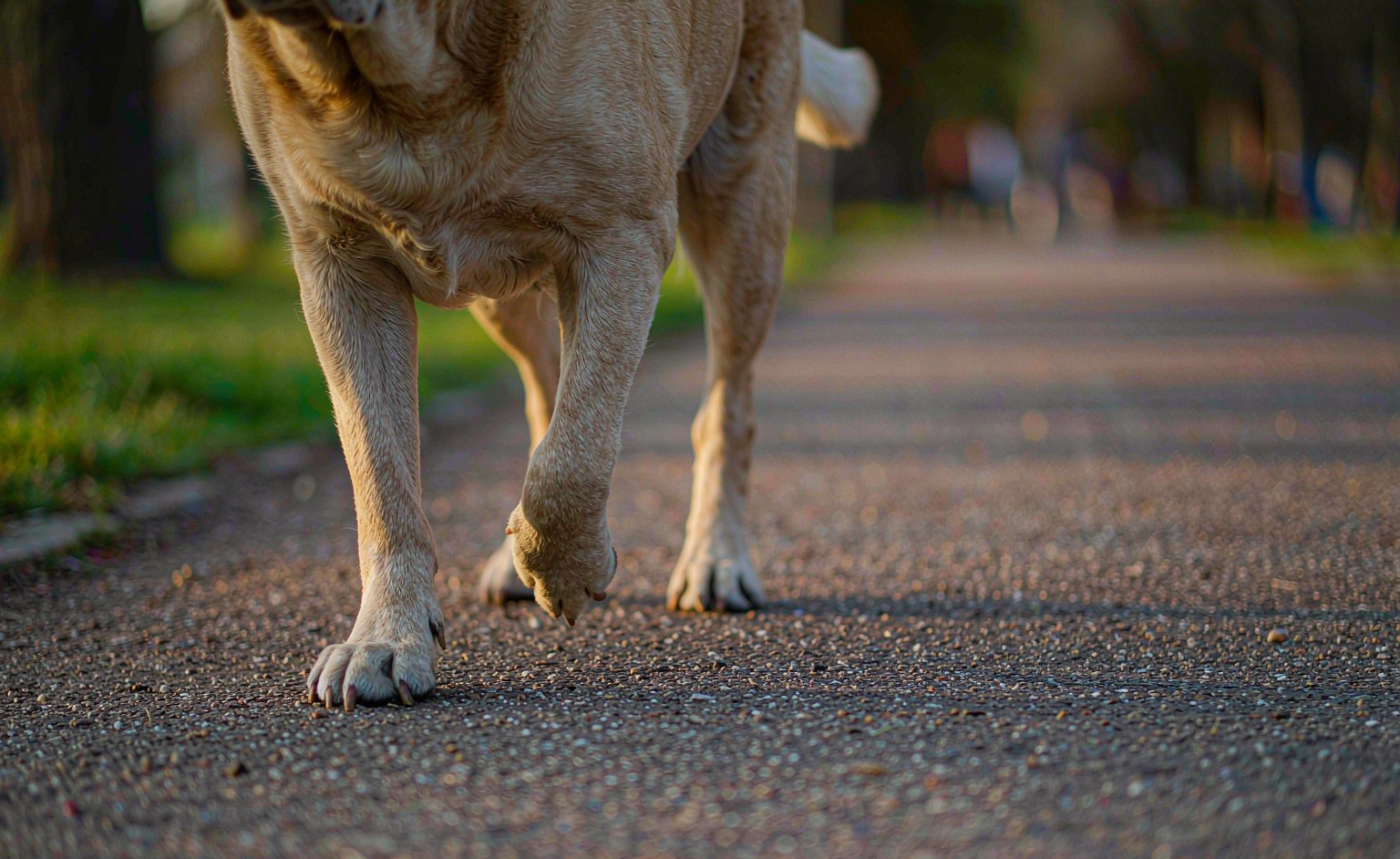
Step One: Grade the Limp Before Anything Else
Weight-bearing status is the single most informative observation, and it is worth getting right before you touch the dog.
Grade 1, intermittent. The limp comes and goes. The dog walks normally most of the time, with occasional skips or brief head bobs. Typically arthritis flare-ups, mild soft tissue strain, or patella luxation in small breeds.
Grade 2, consistent partial weight-bearing. The dog uses the leg every step but favors it: a shortened stride, a head bob (up on the sound leg, down on the painful one), or a visible hesitation. This is the most common presentation and the hardest to triage, because it spans a thorn pad to a partial cruciate tear.
Grade 3, toe-touching. The leg reaches toward the ground but the dog barely loads it, resting the toes down while keeping the heel up. This is a genuinely painful leg, and the causes tend to be significant: cruciate rupture, severe soft tissue injury, fracture.
Grade 4, non-weight-bearing. The dog carries the leg. This is a same-day or next-morning examination, always. The classic teaching is that a non-weight-bearing limp is a fracture, a full cruciate rupture, a dislocation, or a severe pad injury until imaging proves otherwise, and none of those improve with watching.
Two additional observations refine the grade. Which leg matters because the causes cluster differently: front-limb limps point to shoulder, elbow, and paw; hind-limb limps point to stifle (knee), hip, and paw. And the timing within each stride matters: limping that is worst when the dog rises from rest and improves with movement suggests joint disease, while a limp that worsens the longer the dog moves suggests soft tissue or muscle problems.
Step Two: Examine the Paw, Slowly
A surprising share of sudden limps end at the paw, and this is the part you can fully check at home. Do it gently, and stop if the dog snaps; pain-related biting is a real risk with a sore dog.
Work through this list in order:
- Nails. Look for a broken or split nail, especially the dewclaw, which catches on things because it never touches the ground. A nail that fractured into the quick bleeds, hurts, and sometimes needs surgical removal of the remnant. A torn nail is one of the most common causes of a sudden grade 2 to 3 limp.
- Between the toes. Spread each toe space. Look for grass awns, thorns, splinters, caked ice or mud, and swellings. A grass seed that has burrowed in produces a draining tract and persistent licking. Interdigital cysts and foreign bodies live here.
- Pads. Check for cuts, abrasions, burns (pavement in summer is a real hazard), peeling, and embedded objects. A pad laceration may be nearly invisible until you spread the toes and look at the underside.
- The webbing and fold. Redness, swelling, or a moist odor between toes suggests interdigital dermatitis or a focal infection, which produce limping without any visible wound.
If you find and remove a visible thorn or splinter and the limp resolves within a day, that was the whole problem. If you find a torn nail, broken skin, swelling, or nothing at all, the next step depends on the grade.
Step Three: Match the Pattern to the Likely Causes
The history narrows the field more than any single finding. Match your dog’s story to one of these patterns.
Pattern A: Large-breed young adult, sudden hind-leg limp
This is the cranial cruciate ligament (CCL) profile until an examination says otherwise. The CCL is the knee’s main stabilizer, and it fails in a characteristic way in dogs: partial tears that produce intermittent limping over weeks, then either sudden worsening or a rupture during ordinary activity. Labrador Retrievers, Rottweilers, Newfoundlands, and Boxers are heavily overrepresented, and the failure is partly degenerative rather than purely traumatic, which is why it can happen during nothing more dramatic than stepping off a curb.
The classic findings are a grade 2 to 4 hind-leg limp, muscle atrophy on the affected thigh developing within weeks, and a sitting posture where the affected leg sticks out sideways rather than tucking under (“sit test”). A partial tear that gets strict rest and still limps after three to four weeks is a surgical conversation. The reason urgency matters is compounding: when one knee fails, the opposite knee takes the extra load, and dogs with one CCL rupture have a substantially elevated risk of rupturing the other one, often within a year. Weight management is the one modifiable factor with real evidence behind it, and our joint supplements guide covers what the glucosamine and chondroitin evidence actually supports for the degenerative side.
Pattern B: Senior dog, slowly worsening limp, worst on rising
Osteoarthritis is the most common joint disease in dogs and the most under-recognized, because dogs express chronic pain as slowness rather than vocalizing. The profile: a middle-aged or senior dog, often large breed, whose limp has crept in over months, is worst after rest, and loosens with gentle movement. Stiffness on cold mornings, hesitation before jumping into the car, and shorter walks are the early markers, and owners routinely attribute all of it to “just aging.”
Arthritis limps are grade 1 to 2 by definition; a dog with arthritis who suddenly stops weight-bearing has something else happening on top of it, usually a cruciate tear or an inflammatory flare. The management ladder, from weight control through exercise modification to anti-inflammatory medication and joint injections, is laid out in our arthritis medication guide, and the evidence for the supplement tier is reviewed in our senior dog glucosamine analysis.
Pattern C: Small breed, intermittent skipping on a hind leg
Medial patella luxation is the small-dog signature. The kneecap slides out of its groove, the dog skips for a stride or two, kicks the leg out, and walks normally again. Poodles, Chihuahuas, Yorkshire Terriers, and Pomeranians are the classic breeds, and the condition is often present in both knees at different grades. Intermittent skipping without persistent limping is typically grade 1 to 2 luxation, which often needs no surgery, but the grading requires an orthopedic examination because the grade determines the plan.
Pattern D: The limp that follows unusual exercise
A dog that ran hard on Sunday and limps on Monday has, most commonly, a soft tissue strain: a muscle, tendon, or ligament overloaded past its conditioning. Iliopsoas strains (the deep hip flexor) are the classic sporting-dog injury and produce a front-reaching, shortened hind stride. These respond to genuine rest, meaning leash-only toileting for two to three weeks, not “a few quiet days,” and they relapse predictably when rest is cut short.
Pattern E: The limp with no trauma and no joint story, in a licking dog
When the limp is accompanied by licking at the paw, think about what the paw is telling you: interdigital foreign bodies, focal infections, and immune-mediated pododermatitis all produce limping through inflammation rather than structural injury. A persistent licking focus with a draining tract is a grass-awn signature, common in summer and fall in grassy areas.
Pattern F: The limp that is not a leg problem at all
Two mimics are worth knowing. Lyme disease and other tick-borne infections cause shifting leg lameness that moves from leg to leg, sometimes with fever and lethargy, in tick-exposed dogs. Immune-mediated polyarthritis, more common in younger dogs, produces multiple-limb stiffness and fever and is a diagnosis that requires joint taps. The clue in both is that the limp is not reliably in one leg.
Step Four: The Rest Protocol, Done Properly
For a grade 1 to 2 limp with no swelling, no non-weight-bearing episodes, and a dog that is otherwise well, a short course of strict rest is a reasonable first move, and doing it properly matters more than most owners expect.
The protocol: leash-only, toileting only, for 14 days. No running, no stairs, no jumping on or off furniture, no playing with other dogs, no fetch. Confinement to a small room or crate when unsupervised is the honest version; the loose version, where the dog has house access and the family forgets on day three, is why so many strains become chronic.
The decision point: if the limp has not clearly improved by 72 hours, or has not resolved by the end of 14 days, the dog needs an orthopedic examination. Continuing to rest a leg that does not respond is not cautious; it delays diagnosis of cruciate disease, osteochondrosis, elbow dysplasia, and bone problems, all of which are easier to manage early.
Never give human anti-inflammatories during the rest period. Ibuprofen, naproxen, and acetaminophen are toxic to dogs, and masking the pain changes nothing about the underlying tissue.
When It Cannot Wait
Go the same day, or to an emergency clinic if it is after hours, for any of these:
- Non-weight-bearing for more than a few hours
- Visible deformity, an angulated leg, or a limb that dangles
- Dragging of the paw, which shifts concern from joints to the spinal cord
- Swelling, heat, or severe pain on gentle palpation of a limb
- A limp with fever, lethargy, or appetite loss
- A suspected snake bite, puncture, or bleeding wound
- Any limp in a puppy under 6 months with swelling near a joint, because juvenile bone and joint infections are painful and fast-moving
- Sudden inability to rise, which in a large deep-chested dog raises the question of conditions far beyond the leg, and our bloat timeline guide covers that separate emergency
What the Veterinary Workup Looks Like
Knowing the sequence helps you budget time and money. The orthopedic exam comes first: the veterinarian palpates each joint, checks range of motion, performs the specific maneuvers for cruciate stability and patella position, and watches the dog walk and turn. A large fraction of diagnoses are made here, without imaging.
Radiographs come next for anything structural: fractures, arthritis grading, cruciate-associated joint changes, and bone lesions. Some diagnoses need more: a cruciate partial tear is best confirmed by arthroscopy or advanced imaging, elbow dysplasia may need CT, and joint taps distinguish infection and immune-mediated disease from mechanical problems. Referral to a surgeon is the norm for cruciate repairs, complex fractures, and anything the first-pass films cannot explain.
One practical note: dogs limp for orthopedic reasons far more often than for neurological ones, but the distinction matters, and a dog whose limp comes with knuckling, dragging, or incoordination is in the neurological workup pathway, where the spine rather than the limb is the suspect.
Bottom Line
Grade the limp by weight-bearing, check the paw thoroughly, and match the story to the pattern: sudden hind-leg limp in a large young dog is a cruciate question, creeping stiffness in a senior is arthritis, skipping in a small breed is patella, and post-exercise limping is a strain that needs real rest. Half of sudden limps are paw problems you can find yourself, and most of the rest need a hands-on orthopedic exam to diagnose. A grade 1 to 2 limp with none of the red flags gets 14 days of strict leash rest with a 72-hour improvement checkpoint; anything non-weight-bearing, swollen, or dragging gets seen now. The limp itself is a symptom; the diagnosis is the thing that decides the outcome.
Frequently Asked Questions
When should I take a limping dog to the vet?
Same day for any non-weight-bearing limp, visible deformity, dragging paw, severe swelling or heat, fever, or a limp in a puppy with joint swelling. Within a day or two for a limp with a torn nail or an obvious wound. After 72 hours of home rest without improvement, or at 14 days without full resolution, for a mild partial weight-bearing limp with no other signs.
Can a dog’s limp go away on its own?
Some do. Limping from a minor pad irritation, a thorn, or a mild strain often resolves with a day or two of reduced activity. But a limp that persists beyond 72 hours, keeps returning, or worsens is not self-resolving; it is pointing at cruciate disease, arthritis, patella luxation, or another structural cause that needs diagnosis. Resting a dog indefinitely without a diagnosis delays treatment of conditions that are easier to manage early.
How can I tell which leg is making my dog limp?
Watch from the side at a walk. The head bobs up as the painful leg hits the ground and down when the sound leg bears weight, so the dog “steps up” onto the good leg. For hind legs, the tail and hips may rise unevenly. Filming a short video of the dog walking toward you, away from you, and from the side gives your veterinarian more information than a description does.
What is the most common cause of limping in dogs?
For sudden limps, paw problems lead the list: torn nails, foreign bodies, cuts, and interdigital infections. For persistent or recurring limps, cranial cruciate ligament injury and osteoarthritis dominate, with patella luxation common in small breeds. Soft tissue strains from unaccustomed exercise account for most of the rest.
Can I give my dog anything for limping pain at home?
No human pain medication is safe. Ibuprofen and naproxen cause gastrointestinal ulcers and kidney damage in dogs, and acetaminophen damages the liver and red blood cells. Rest, restricted activity, and cold compresses on a swollen area in the first 48 hours are the safe home measures. Pain control that actually helps requires veterinary prescription drugs dosed for the specific dog.
Why is my dog limping but acting normal otherwise?
Dogs routinely mask pain, so a normal appetite and happy demeanor do not rule out a significant injury. Cruciate partial tears, early arthritis, and patella luxation all produce limping in dogs that still eat, play, and greet normally. The limp is the reliable signal; the mood is not.
Should I wrap or bandage a limping leg?
No, not without veterinary instruction. A poorly placed wrap restricts circulation, causes swelling below the bandage, and can do real damage in hours. The only home measures for a limp are rest, cold compresses on an obviously swollen area for the first day or two, and checking the paw for something visible and removable.
References
- Wucherer KL, Wilke V. Evaluation of causes of pelvic limb lameness in dogs. Veterinary and Comparative Orthopaedics and Traumatology. 2010. https://pubmed.ncbi.nlm.nih.gov/20140728/
- Muir P, Johnson AL. Fractures of the patella and comparative aspects of ligamentous injury. Veterinary Clinics of North America: Small Animal Practice. (cruciate and stifle injury diagnosis) https://pubmed.ncbi.nlm.nih.gov/7990304/
- Harasen G. Patellar luxation. The Canadian Veterinary Journal. 2006. https://pmc.ncbi.nlm.nih.gov/articles/PMC1475908/
- Wills A, Higginson C. Diagnosis and treatment of cranial cruciate ligament disease in dogs. In Practice. 2019. https://inpractice.bmj.com/content/41/7/291
- Kealy RD, Olsson SE, Monti KL, et al. Effects of dietary restriction on the occurrence of hip osteoarthritis in dogs. Journal of the American Veterinary Medical Association. 1992. https://pubmed.ncbi.nlm.nih.gov/1345160/
- Littman MP. Lyme disease in dogs. Today’s Veterinary Practice / Merck Veterinary Manual. https://www.merckvetmanual.com/dog-owners/bone,-joint,-and-muscle-disorders-of-dogs/lyme-disease-lyme-borreliosis-in-dogs
- jaeger G, et al. (iliopsoas myopathy in dogs) Veterinary Radiology and Ultrasound. 2007. https://pubmed.ncbi.nlm.nih.gov/17708128/
- American College of Veterinary Surgeons. Cranial Cruciate Ligament Disease. https://www.acvs.org/small-animal/cranial-cruciate-ligament-disease
Disclaimer
This article is educational and is not veterinary advice. Limping requires hands-on examination to diagnose, and imaging is often necessary. Pain medication for dogs is prescription-only; never give a dog ibuprofen, naproxen, acetaminophen, or any human medication. If your dog is non-weight-bearing, has a deformed or dragging leg, or is limping with fever or lethargy, seek veterinary care immediately.