
# Brewers Yeast for Dogs: The Name Confusion Costing Dogs Their Skin
Search for brewers yeast and you will find it sold two ways, as a flea repellent and as a coat and B vitamin supplement. Search for yeast infections in dogs and you will find a skin condition that makes dogs miserable. Both contain the word yeast, and a surprising number of owners, and more than a few forum threads, put those two facts together and reach a conclusion that is exactly backwards.
Here is the distinction that settles it. Brewers yeast is Saccharomyces cerevisiae, the same species used to brew beer and bake bread, sold as a dried nutritional supplement. The organism behind canine yeast dermatitis is Malassezia pachydermatis, a completely different fungus that lives on dog skin as part of the normal flora and overgrows when something else goes wrong. They are not related in any way that matters to your dog, giving brewers yeast does not cause or cure a Malassezia infection, and a dog with an active yeast skin infection is not helped by adding more yeast to its diet.
What brewers yeast may actually do, and the flea claim in particular, is a separate and less flattering story. This article separates the two organisms, then looks honestly at what the flea evidence supports, what the nutrition case is, and where the real risks sit, because brewers yeast is not useless but it is also not what the label implies.
—
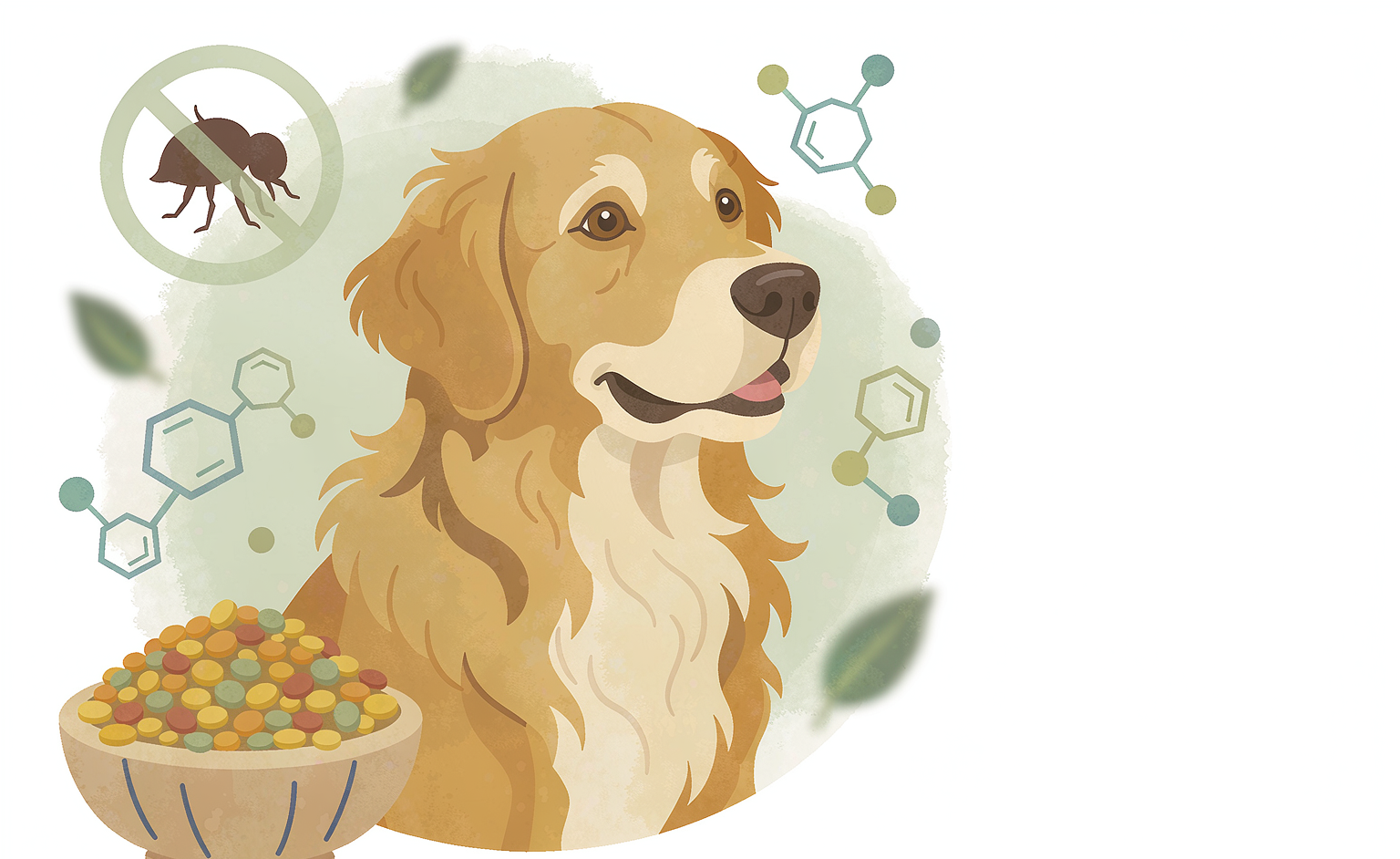
The Short Answer
Brewers yeast for dogs is a dried Saccharomyces cerevisiae supplement sold for flea control and as a source of B vitamins, chromium, and protein. It is not the same organism as the Malassezia yeast that causes canine skin and ear infections, and giving it does not cause or treat those infections. The flea-repellent claim rests on old and largely uncontrolled studies, and the effect sizes reported are far weaker than modern preventives. Brewers yeast is nutritionally useful and generally safe in moderation, but it can cause gas and bloating, it is high in purines, and it should be avoided in dogs prone to yeast overgrowth until that problem is sorted out.
—
Two Organisms, One Word
The confusion is understandable because English uses one word for a whole kingdom of fungi, and the two species that matter to dog owners could not be less alike.
Brewers yeast is Saccharomyces cerevisiae, a domesticated single-celled fungus that humans have used for millennia. As a supplement it is usually a dried, debittered byproduct of brewing, sold as powder, flakes, or tablets. It is nutritionally dense: B vitamins including thiamine, riboflavin, niacin, and B6, a meaningful protein content, minerals including selenium and chromium, and beta-glucans from the cell wall.
The yeast that causes skin problems is Malassezia pachydermatis, a lipophilic fungus that is normal flora on canine skin and in ear canals. Every dog carries some. It becomes a problem when the skin environment changes, usually because of allergy, moisture, or a change in the skin’s defenses, and the organism overgrows into a itchy, greasy, often malodorous dermatitis or otitis. Our guide to yeast infections in dogs covers that condition in detail, and the treatments for it are antifungal drugs and management of the underlying cause.
These are different organisms from different genera, with different metabolisms and different relationships to the dog. Brewers yeast passes through the gut as food. Malassezia lives on the skin. Eating one does not seed the other.
There is, however, one place where the confusion has a sliver of legitimate grounding, and it is worth being precise about it. Saccharomyces species are sometimes used as probiotics in dogs, and some studies of oral Saccharomyces boulardii have looked at gut health and, in a few reports, at markers related to Malassezia populations on the skin. That line of research is about a live probiotic organism and its interaction with the gut and immune system, not about dried brewers yeast as a flea powder, and the results are not strong enough to justify the sweeping claims made for brewers yeast supplements.
What the Flea Claim Actually Rests On
The flea-repellent reputation of brewers yeast is old, widely repeated, and much weaker than its confidence level suggests.
The claims trace back to studies, several decades old, in which dogs and cats fed brewers yeast were reported to have fewer fleas than controls. Even taking those studies at face value, the reductions reported were modest, typically in the range of a partial reduction rather than elimination, and the study designs would not meet the standard applied to modern parasiticides. Later work has not reproduced a clear effect, and reviews of flea control generally do not list oral yeast among effective options.
There is a plausible mechanism, which is part of why the idea persists. The theory is that metabolites from the yeast are excreted through the skin and make the dog less attractive or less hospitable to fleas, presumably via odor or skin chemistry. It is not absurd, and it is also not demonstrated.
The honest comparison is with what else is available. Modern flea control, the isoxazolines and other prescription and over-the-counter parasiticides, achieve very high kill rates within hours, break the flea life cycle, and are tested in large controlled trials before approval. A supplement that might reduce flea numbers by some uncertain fraction is not in the same category, and for a dog with a genuine flea infestation, or with flea allergy dermatitis where a single bite triggers days of misery, relying on brewers yeast is how infestations become household-wide problems. A flea allergy dog needs the flea gone, not reduced.
Worth stating plainly: brewers yeast does not kill fleas on contact, does not reliably prevent infestation, and is not an adequate substitute for a preventive in any home with an active flea problem.
Where It Does Have a Real Case
Strip away the flea marketing and brewers yeast is a reasonable nutritional supplement, and that is where its honest value sits.
B vitamins. The B complex in brewers yeast is bioavailable and includes thiamine, which some owners use deliberately for the separate and interesting reason that thiamine has been studied as a flea repellent in its own right. B vitamins support energy metabolism, nervous system function, and skin and coat maintenance, and dogs on a poor quality or heavily processed diet may be running short.
Chromium and glucose tolerance. Brewers yeast is one of the better natural sources of chromium, a trace mineral involved in insulin signaling and glucose metabolism. This is why it turns up in discussions of blood sugar support, and it is one of the more interesting nutritional arguments for the supplement, though the canine-specific evidence is thin.
Protein and amino acids. Dried brewers yeast is roughly 45 to 50 percent protein and contributes a decent amino acid profile, which is why it shows up as a feed ingredient as well as a supplement.
Beta-glucans and gut immune interaction. The cell wall contains beta-glucans, which are investigated for immune-modulating effects. This is the same family of compounds studied in medicinal mushrooms, and the research is interesting and far from settled.
Palatability. Many dogs find the flavor attractive, which makes it a practical way to get a supplement into a fussy eater’s bowl.
So the honest pitch is this: brewers yeast is a nutrient-dense, generally safe food supplement with plausible benefits for coat and general nutrition, sold with a flea claim that the evidence does not support at anywhere near the strength the marketing implies.
The Real Risks, Ranked
Gas, bloating, and digestive upset. By far the most common problem. Yeast is fermentable, and a generous scoop in a dog’s bowl produces exactly what you would expect: gas, abdominal discomfort, loose stool, or in unlucky cases, a distended, uncomfortable dog. Start at a fraction of the label dose and increase slowly. This risk is also the reason to be cautious in deep-chested breeds where bloat is a concern, since anything that increases gas production is worth weighing carefully in those dogs.
Purine content. Yeast is high in purines, which metabolize to uric acid. Dogs prone to urate stones, notably some Dalmatians and a few other breeds with urate metabolism quirks, have a specific reason to avoid a high-purine supplement. Ask your vet if your dog has a history of urinary stones.
Dogs with active Malassezia problems. Even though brewers yeast does not cause the infection, many dermatologists prefer to remove all yeast sources from the diet of a dog being treated for yeast dermatitis or otitis, on the conservative principle of not adding antigenic or fermentable material while the skin is being brought back under control. It is not a proven harm, but it is a defensible reason to pause the supplement, and it costs you nothing to wait until the skin is clear. If your dog is scratching and you are not sure which kind of yeast you are dealing with, our dog itching guide walks through the diagnostic path.
Interactions and special cases. Brewers yeast contains tyramine, which is why it is generally avoided in dogs on monoamine oxidase inhibitor medications, and it should be used cautiously in dogs on other psychiatric medications. Diabetic dogs and dogs on insulin warrant a conversation with your vet, because of the chromium effect on glucose. Pregnant dogs, and dogs with confirmed yeast allergies, are also cases where you ask first.
Quality and dosage. Supplements are not dosed by eye. Typical label guidance runs roughly a teaspoon per 20 to 25 pounds of body weight daily, but products vary in concentration, and a brewers yeast product formulated for dogs is safer than a bulk human product because the dosing and any added ingredients are designed for dogs. Some garlic-containing brewers yeast flea powders exist, and garlic is toxic to dogs in cumulative doses, so read the ingredient panel with care.
Reading This Against the Rest of the Supplement Shelf
Brewers yeast is a single-ingredient product doing a narrow job, and most dogs whose owners are shopping for it actually want one of two things: fewer fleas, or a better coat. For the first, the answer is a modern preventive, not a supplement. For the second, the honest answer is usually broader than one ingredient.
Coat quality comes from a cluster of things working together: adequate dietary protein and fat, omega-3 fatty acids, micronutrients including zinc and biotin, a gut that absorbs them, and no underlying allergy or parasite dragging the skin down. A single B vitamin and chromium source will not carry that load on its own, which is why a comprehensive daily formula tends to outperform single-ingredient approaches for skin and coat complaints.
Our multivitamin soft chews combine omega-3 with a broad base of vitamins, minerals, and cofactors including the B complex and biotin, in a chicken-flavored chew, which lines up with the coat and skin support picture and covers the nutritional ground brewers yeast only partly reaches. It is daily nutritional support, not a treatment for flea infestation, yeast dermatitis, or any diagnosed skin condition, and a dog with active fleas, an active infection, or persistent itching needs a diagnosis and a targeted treatment plan from your veterinarian.
Frequently Asked Questions
Does brewers yeast cause yeast infections in dogs?
No. Brewers yeast is *Saccharomyces cerevisiae*, a nutritional supplement that passes through the gut, while canine yeast infections are caused by *Malassezia pachydermatis*, a different fungus that lives on the skin. Eating one does not seed the other. Some dermatologists still suggest pausing yeast supplements while treating an active yeast dermatitis, as a conservative measure rather than a proven risk.
Does brewers yeast actually repel fleas?
The evidence is weak. The claim traces to decades-old studies reporting modest reductions, with designs that would not meet modern standards, and later work has not reproduced a clear effect. Brewers yeast does not kill fleas on contact and is not an adequate substitute for a modern preventive, especially for a dog with flea allergy, where a single bite triggers days of itching.
How much brewers yeast should I give my dog?
Follow the product label, because concentrations vary. A common range is roughly one teaspoon per 20 to 25 pounds of body weight daily, but start at a fraction of that for the first week to let the gut adjust, since gas and bloating are the most common side effects. Err on the low side for deep-chested breeds prone to bloat.
Can brewers yeast help my dog’s coat?
It can contribute, mainly through B vitamins and protein, and many dogs do look better on it. Coat quality depends on more than one ingredient though, including dietary fat, omega-3 fatty acids, zinc, and biotin, and on ruling out allergies and parasites. If the coat does not improve, look for an underlying cause rather than adding more of the same supplement.
Why does brewers yeast cause gas?
Because it is fermentable. Gut bacteria ferment the yeast and produce gas as a byproduct, which shows up as flatulence, abdominal discomfort, and sometimes loose stool. Introducing it gradually over a week or two lets the gut adapt, and if gas persists, the dose is too high for that dog.
Is brewers yeast safe for every dog?
Not quite. Avoid it in dogs prone to urate bladder stones, because it is high in purines. Use caution in dogs on MAO inhibitor or certain behavior medications, because of tyramine content. Check with your vet for diabetic dogs, pregnant dogs, and dogs with a confirmed yeast allergy, and avoid any product that adds garlic.
Should I give brewers yeast to a dog with a yeast ear infection?
Ask your vet, and expect a cautious answer. It does not cause the infection, but many clinicians prefer to remove yeast sources from the diet while bringing an active *Malassezia* dermatitis or otitis under control. The infection itself is treated with antifungal medication and management of the underlying cause, usually allergies, not with dietary manipulation.
Bottom Line
Brewers yeast is a good supplement wearing a bad claim. Nutritionally it is genuinely useful, a dense source of B vitamins, chromium, protein, and beta-glucans that many dogs tolerate well and some visibly benefit from, and it is cheap and easy to feed. The flea reputation it is most often bought for is the weakest part of its case, resting on old studies with modest results and no modern confirmation, and no dog with a real flea problem should be relying on it. The other thing worth carrying away is the name: this yeast and the yeast that causes your dog’s itchy skin are not the same organism, and confusing them leads owners to withhold a harmless supplement from healthy dogs and to feed it hopefully to dogs who need antifungals instead. Dose it low, build up slowly, watch for gas, and let a preventive handle the fleas.
Disclaimer
This article is for general education only and is not veterinary advice. Brewers yeast is not appropriate for every dog, including dogs prone to urate stones, dogs on certain medications, and dogs with diabetes or confirmed yeast allergy, without veterinary direction. Flea infestation and yeast dermatitis require diagnosis and targeted treatment from a veterinarian. Dietary supplements are not intended to diagnose, treat, cure, or prevent any disease, and you should consult your veterinarian before starting any supplement.
References
- Merck Veterinary Manual. “Flea Allergy Dermatitis” and “Malassezia Dermatitis in Dogs.”
- Companion Animal Parasite Council. “Flea Control Recommendations for Dogs and Cats.”
- VCA Animal Hospitals. “Yeast Dermatitis in Dogs” and “Flea Control in Dogs.”
- Cornell University College of Veterinary Medicine. “Malassezia (Yeast) Infections in Dogs.”
- Beale KM. “Flea allergy dermatitis: the diagnostics and therapeutics of a common feline and canine dermatologic condition.” Compendium on Continuing Education for the Practicing Veterinarian.