
# What to Give a Dog for Upset Stomach: A Home Remedy Decision Tree
Most dog stomach upsets are not emergencies. A dog eats something he should not have, has one loose stool, looks slightly sorry for himself, and is fine by the next morning. In that situation, doing something sensible at home is better than doing nothing, and far better than a panicked trip to the clinic.
The problem is that “something sensible” is hard to pin down when you are standing in your kitchen at eleven at night with a dog who just vomited on the rug. The internet offers an enormous list of remedies, some of which are helpful, some useless, and a few actively dangerous. Baking soda, human anti-diarrheal drugs, hydrogen peroxide to induce vomiting, and fasting a puppy for two days are all common pieces of advice, and all of them can cause real harm.
What follows is a decision tree rather than a list. The first decision is whether this is a home-care situation at all, because a surprising share of the dogs whose owners are searching for remedies need a vet instead. Once that is settled, the question becomes what to actually give, in what amount, and what to expect over the next twenty-four hours, because knowing what a normal recovery looks like is how you know when it has stopped being normal.
—
The Short Answer
For a bright, alert adult dog with one or two episodes of vomiting or diarrhea and no red-flag signs, the standard home approach is a short fast of six to twelve hours for vomiting (not for puppies or small dogs), then a bland diet of plain boiled chicken and rice in small frequent meals for two to three days, with free access to water. Canned pumpkin can help with loose stool, and a canine-specific probiotic supports recovery. Do not give human anti-diarrheal medications, ibuprofen or other painkillers, hydrogen peroxide, or baking soda. See a vet immediately if there is blood, repeated vomiting, a swollen or painful belly, lethargy, a puppy under six months, or no improvement within 24 hours.
Step One: Is This Actually a Home-Care Case?
Before any remedy, run this screen. Any single item on it moves you from kitchen to clinic, and the list is not negotiable for the sake of convenience.
Vomiting more than two or three times in a few hours, or unproductive retching. Repeated vomiting prevents oral fluids from staying down and risks dehydration, and unproductive retching in a deep-chested breed is the hallmark of bloat, which is fatal within hours without surgery.
A belly that looks distended or feels hard and painful. Abdominal swelling with discomfort is a surgical emergency until proven otherwise.
Blood. Bright red blood in vomit or stool, or black tarry stool that looks like coffee grounds, means bleeding somewhere in the gut and needs a vet.
Lethargy, weakness, collapse, or a dog who will not respond normally. A dog who is dull and quiet alongside vomiting is sicker than one who vomits and then goes back to being interested in the room.
A puppy under six months, a toy breed, or an elderly or chronically ill dog. These dogs dehydrate and decompensate fast. There is no safe fasting window to manage at home.
Any suspicion of a swallowed object, a toxic food, or a toxic plant. Chocolate, grapes and raisins, xylitol, onions, and hundreds of other items warrant immediate advice, and the remedy may be induced vomiting under veterinary direction, not at home.
Suspected parvovirus. An unvaccinated or incompletely vaccinated puppy with vomiting and bloody diarrhea is a medical emergency with a real mortality risk.
No improvement after 24 hours. A stomach upset that is genuinely minor starts turning the corner within a day. One that does not is a diagnostic question.
Step Two: The Fasting Question, Answered Properly
Fasting is the oldest home remedy for vomiting and it is legitimate, but the details have narrowed over the years.
For an adult dog with vomiting, a short fast of six to twelve hours gives the gut a rest. Nothing by mouth except water, and plenty of it, offered in small amounts frequently rather than a big bowl at once. The purpose is not to starve the dog into health but to let an irritated stomach settle.
Fasting is not appropriate for puppies, toy breeds, or small dogs under about 5 kg. Their glycogen reserves are small and hypoglycemia is a real risk within a day. For these dogs, skip the fast and go to small amounts of a bland diet, or to the vet.
Fasting is not appropriate for diarrhea alone. A dog with loose stool but no vomiting does not need to fast, and withholding food deprives the gut of the nutrients it needs to recover. Bland diet straight away is the better move.
Long fasts are a mistake. Fasting beyond about 24 hours has no added benefit and can worsen the situation, and multi-day fasting advice that circulates online is outdated and can be harmful.
Step Three: The Bland Diet, With Actual Amounts
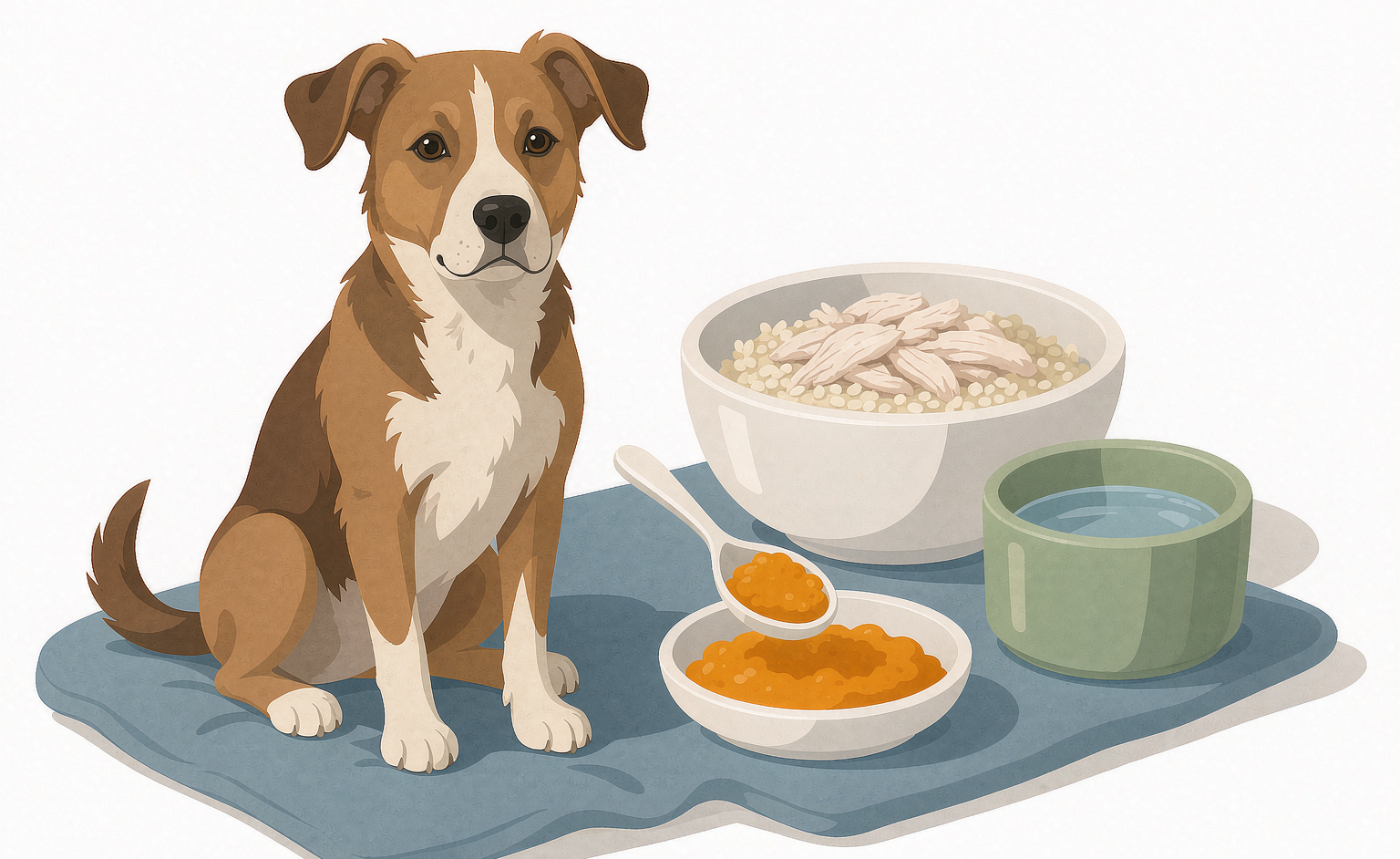
The bland diet is not really a remedy, it is a way to feed a recovering gut something it can handle. The standard is plain boiled chicken or turkey with white rice, roughly one part lean meat to two parts cooked rice, both unseasoned. No salt, no butter, no garlic, no onion, nothing else in the pot.
How much and how often. Offer small meals, roughly a quarter of the dog’s normal meal volume, every four to six hours. A dog who keeps a small meal down gets another one a few hours later. This matters more than the total daily amount, because a large meal on an irritated stomach is what triggers another episode.
How long. Two to three days on the bland diet, then transition back to normal food by mixing increasing proportions of the regular diet into the bland diet over another two or three days. Going straight back to regular food after one good day is a common cause of relapse.
The boiled-chicken caveat. Chicken and rice is not nutritionally complete, which is fine for a few days and not fine beyond that. The other thing worth knowing is that chicken is a common allergen, so a dog with a suspected food allergy may do better with a novel protein such as boiled whitefish or turkey. And for a dog with a history of pancreatitis, the fat content of any home diet matters, so lean is not a preference, it is a requirement.
Ground pumpkin as a stool-firming agent. Plain canned pumpkin, not pie filling, contains soluble fiber that helps firm loose stool and is one of the few widely recommended home remedies with a sensible mechanism. A typical serving is one to two teaspoons for small dogs, a tablespoon for medium, and up to two tablespoons for large dogs, mixed into food once or twice daily. Our pumpkin guide covers the amounts and the fiber reasoning.
Rice water is an old remedy with mild merit: the starchy water from cooking rice contains some soluble fiber and is bland and hydrating. It is not a treatment, but it does no harm and a dog who will not eat may accept it.
Step Four: What Not to Give, and Why
This section matters more than any of the recommendations above, because these are the items that turn a manageable upset into a hospital visit.
Human anti-diarrheal medications. Loperamide and similar drugs are sometimes used in dogs under veterinary direction, but they are not safe to give on a guess. In dogs they can cause serious problems, and certain collie-type breeds carry a genetic mutation that makes standard doses toxic. Bismuth subsalicylate products contain salicylates that are risky in dogs with bleeding or kidney concerns. Nothing from the human diarrhea aisle belongs in a dog’s bowl without a vet’s instruction.
Human painkillers. Ibuprofen, naproxen, and acetaminophen are all toxic to dogs and cause gastrointestinal ulceration and kidney injury at doses an owner might reasonably guess at. A dog with a painful belly needs a diagnosis, not a painkiller from the cabinet.
Hydrogen peroxide to induce vomiting. This is one of the most dangerous pieces of internet advice in pet care. It causes severe stomach irritation, can produce blood-tinged vomiting, and in sufficient quantity causes gastritis and even esophageal damage. Inducing vomiting is sometimes appropriate after a toxin ingestion, but it is a veterinary decision with a proper emetic, not something to do with a kitchen bottle.
Baking soda. Sometimes recommended for upset stomach, and it can cause metabolic alkalosis and sodium overload in dogs. Do not.
Milk and dairy. A common instinct, and a poor one, since most dogs are lactose intolerant to some degree and dairy often worsens diarrhea. Our yogurt guide explains why the cultures in yogurt do not solve this either.
Raw eggs, garlic, and various kitchen folklore. Raw eggs carry bacterial risk and biotin-binding concerns, garlic is toxic to dogs in cumulative doses, and neither addresses the problem.
Withholding water. Never restrict water in a vomiting dog. Small frequent amounts, but always available, unless a vet has specifically instructed otherwise in preparation for surgery.
Step Five: The Probiotic Layer
There is a real evidence base for probiotics in acute canine gastroenteritis, and it is one of the few supplement categories where the recommendation is not just plausible but studied. Certain strains have been shown to shorten the duration of acute diarrhea in dogs, and the mechanism is straightforward: a disrupted gut gets help re-establishing a normal bacterial population, which supports the mucosal barrier and normal water absorption.
The details matter. Strain matters, dose matters, and colony count at the time of feeding matters, because many products do not deliver what the label claims by the time they reach your dog. A canine-specific product with named strains and a stated CFU count is the relevant comparison, not a human capsule or a spoonful of yogurt.
Our 12 Billion CFU Multi-Strain Probiotic Soft Chews combine eight probiotic strains, four prebiotics including inulin and FOS, five digestive enzymes, and a pumpkin and flaxseed fiber blend, which puts the fiber and the probiotic in the same daily dose. It is formulated for dogs but the feeding guide includes cats. This is daily gut support and recovery support, not a treatment for gastroenteritis, parvovirus, pancreatitis, or any diagnosed condition, and a dog who is vomiting repeatedly, lethargic, or passing blood needs veterinary care rather than a supplement.
Step Six: What Recovery Should Look Like
Knowing the expected trajectory is how you judge whether home care is working.
Within 6 to 12 hours: vomiting should be settling, or stopping altogether. The dog should be drinking and interested in the room.
Within 24 hours: appetite returning, first small meals staying down, energy improving. Stool may still be loose if diarrhea was part of the picture.
Within 48 to 72 hours: near-normal energy and appetite, stool firming up, gradual return to regular food.
What should make you stop and call: vomiting that resumes after a period of settling, a dog who refuses all food past 24 hours, worsening lethargy, blood appearing where there was none, a belly that becomes distended, or a dog who seems to improve and then worsens again, which can indicate an obstruction that briefly passed material and then blocked.
Preventing the Next Episode
Most recurrent stomach upsets have an identifiable cause, and the list is short.
Dietary indiscretion is the most common: garbage, table scraps, rich treats, sudden food changes. Managing access and transitioning foods over seven to ten days prevents a large share of episodes.
Food intolerance and allergies show up as intermittent loose stool and gas rather than dramatic vomiting. A dietary trial with a vet identifies these.
Scavenging and eating too fast cause gas and bloat risk. Slow feeders and supervised outdoor time help, and our guide to dog gas covers the flatulence side.
Stress, including boarding, travel, and household change, reliably affects some dogs’ guts, which is where a daily probiotic earns its place as prevention rather than rescue.
Underlying disease, particularly in older dogs, where chronic or intermittent vomiting can be the first sign of something that needs diagnosis rather than management.

Frequently Asked Questions
What can I give my dog for an upset stomach right away?
For a bright, alert adult dog, offer small amounts of water frequently and consider a short six to twelve hour fast if there is vomiting. Then start small frequent meals of plain boiled chicken and white rice. Canned pumpkin can help if the stool is loose. Do not reach for human medications of any kind.
Should I fast my dog with an upset stomach?
A short fast of six to twelve hours is reasonable for an adult dog with vomiting, with water always available. Do not fast puppies, toy breeds, or dogs under about 5 kg, because of hypoglycemia risk, and do not fast a dog with diarrhea alone. Fasts longer than 24 hours have no benefit.
How much boiled chicken and rice should I give my dog?
Roughly one part lean boiled meat to two parts cooked white rice, fed in small meals about a quarter of the dog’s normal meal size every four to six hours. Keep it unseasoned. Use it for two to three days, then transition back to regular food over another two to three days.
Can I give my dog Pepto-Bismol or Imodium?
No, not without veterinary direction. Loperamide and bismuth products are sometimes used in dogs at specific doses, but they carry real risks, including toxicity in collie-type breeds with a particular genetic mutation. Human anti-diarrheal medications are not safe to give on a guess.
Is pumpkin good for a dog’s upset stomach?
For loose stool, yes. Plain canned pumpkin, not pie filling, provides soluble fiber that helps firm stool and support normal colonic function. Typical amounts are one to two teaspoons for small dogs up to two tablespoons for large dogs, once or twice daily. It does not help vomiting and is not a treatment for any underlying disease.
When should I take my dog to the vet instead of treating at home?
Immediately if there is blood in vomit or stool, repeated vomiting, a distended or painful belly, unproductive retching, lethargy, a puppy under six months, or any suspicion of swallowing a foreign object or toxin. Also see a vet if there is no improvement within 24 hours, or if the dog improves and then worsens.
How long does a dog stomach upset usually last?
A mild dietary upset typically settles within 24 to 48 hours with supportive care, with stool normalizing over two to three days. Anything persisting beyond 48 hours, or accompanied by lethargy or weight loss, needs investigation rather than more home treatment.
Bottom Line
The useful thing to have before your dog gets sick is not a list of remedies but a rule for when remedies do not apply. Most mild stomach upsets in healthy adult dogs resolve with water, a short rest for the gut, and a few days of small bland meals, and the probiotics and pumpkin earn their place by supporting recovery rather than overriding it. The dangerous ground is the human medicine cabinet and the folklore, hydrogen peroxide and anti-diarrheal pills and baking soda, all of which turn a manageable evening into a hospital visit. The other thing worth committing to memory is the red-flag list, because the dogs who do badly are almost never the ones whose owners did too little at home, they are the ones whose owners waited on a dog that had already told them it was time to go in.
Disclaimer
This article is for general education only and is not veterinary advice. Vomiting and diarrhea in dogs can indicate serious conditions including obstruction, parvovirus, pancreatitis, and toxicity that require prompt veterinary care. Puppies, toy breeds, elderly dogs, and dogs with chronic illness should be evaluated by a veterinarian rather than treated at home. Never give a dog human medications, hydrogen peroxide, or baking soda without veterinary direction. Dietary supplements are not intended to diagnose, treat, cure, or prevent any disease, and you should consult your veterinarian before starting any supplement.
References
- Merck Veterinary Manual. “Vomiting in Dogs” and “Acute Gastroenteritis in Dogs.”
- VCA Animal Hospitals. “Gastroenteritis in Dogs” and “Bland Diet for Dogs.”
- Veterinary Partner (VIN). “Vomiting in Dogs” and “Diarrhea in Dogs.”
- American Kennel Club. “Dog Upset Stomach: What to Do.”
- Herstad HK, et al. “Effects of a probiotic intervention in acute canine gastroenteritis: a controlled clinical trial.” Journal of Veterinary Internal Medicine. 2010.