
# Cat Constipation: What the Litter Box Is Telling You Before It Gets Serious
The litter box is the most honest medical record a cat keeps. Cats hide illness as a survival instinct, and they are good at it, but stool is hard to disguise. The owner who notices that the box needs scooping less often, or that the deposits have shrunk into small hard pebbles sitting in the corner, has caught something a cat would never volunteer. Constipation in cats is common, and unlike many feline problems, it announces itself early in a place you already look every day.
What makes it worth taking seriously is that cat constipation is not a single condition but a slope. At the top is a mild, reversible slowdown that responds to water and fiber. At the bottom is a colon that has stretched past the point of working, a state called megacolon that may require surgery. The distance between the two is measured in months of small, manageable steps, and most cats never have to travel far down the slope if the early signs get treated. This article maps the slope, the causes that push cats down it, and the line where home care stops and the clinic starts.
—
The Short Answer
Constipation means a cat is passing hard, dry stool less often than normal, and most cats normally go about once a day. The leading drivers are dehydration, a dry-food-only diet, hairballs, obesity, and underlying disease. Mild cases respond to water, moisture-rich food, and vet-guided fiber, but severe or repeated constipation can progress to obstipation and megacolon, where the colon loses function permanently. Take your cat to the vet the same day if there is straining with nothing produced, blood, vomiting, appetite loss, or no stool for two days.
—
First, What Normal Looks Like
Before you can spot constipation, you need a baseline, and every cat’s baseline is a little different. Diet matters: a cat eating dry food only tends to have slower, drier digestion than a cat on wet food. Energy level matters: a sedentary cat’s gut moves more slowly than an active prowler’s. Health status matters: an older cat with kidney disease or arthritis is working against both dehydration and pain.
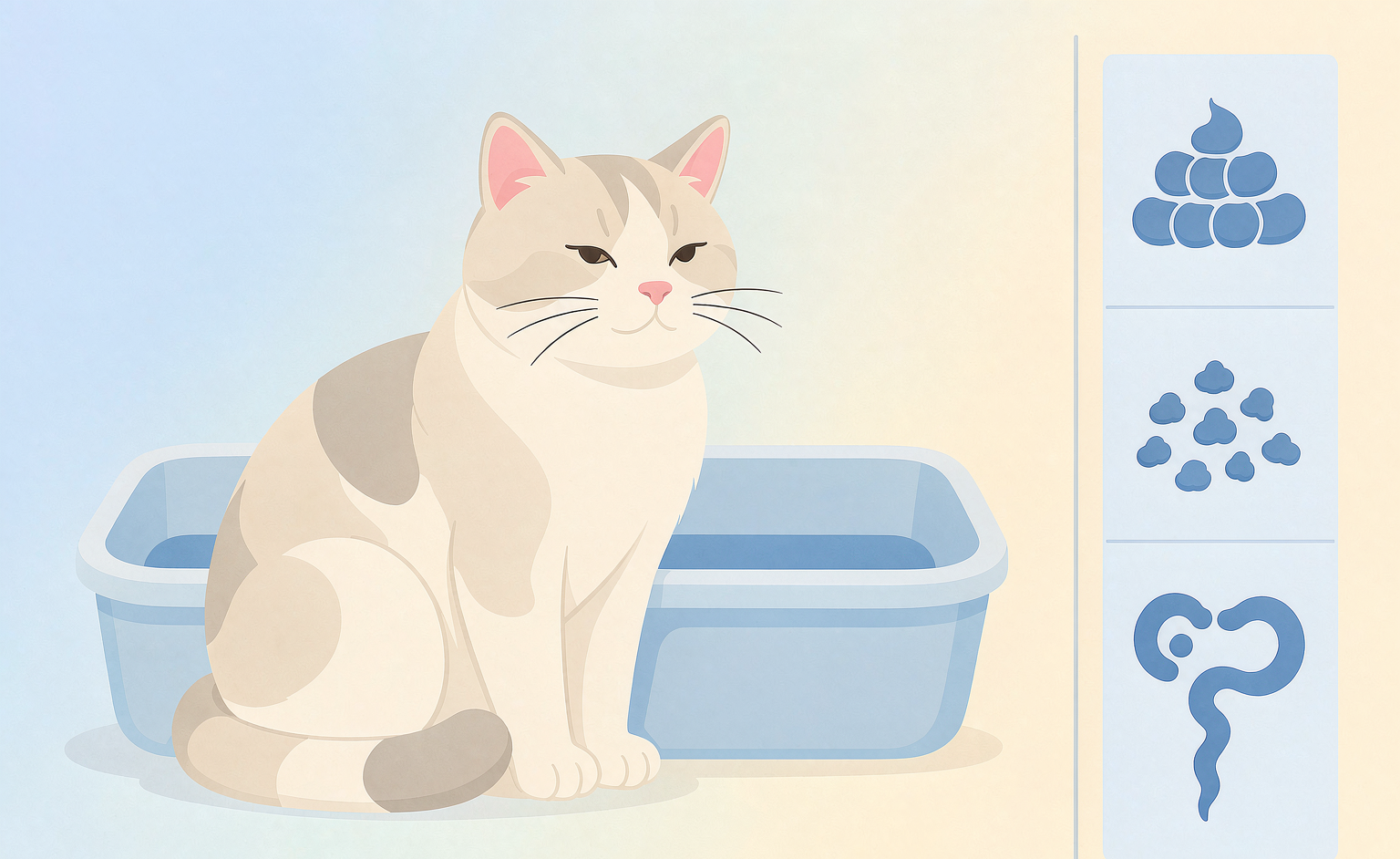
Most cats poop about once a day, and the stool itself is the tell. Normal cat stool is dark brown, firm but not hard, formed into log-shaped segments, and comes away from the scoop cleanly. It should not smell overwhelming. Here is where the early signal lives: when the stool turns into small hard balls instead of logs, when the litter box shows fewer deposits than usual, or when you hear your cat straining in the box, constipation has already started. A cat who normally goes twice a day and has skipped a full day is already a concern. The litter box is not just a chore, it is a daily reading of the gut, and the habit of actually looking at what you scoop is the cheapest diagnostic tool a cat owner has.
Why Cats Get Constipated More Than You Would Expect
Cats are built for desert survival, and one legacy of that ancestry is a weak thirst drive. A cat who evolved to extract water from prey does not drink the way a dog does, which makes cats chronically prone to mild dehydration, especially on dry food. That single trait sits underneath several of the most common constipation drivers.
Dehydration. The foundational cause. Dry food contains roughly 10 percent water; a mouse, the ancestral meal, is close to 70 percent. A cat eating kibble only has to drink a great deal to compensate and often does not, leaving stool drier and harder to pass. This is why the first lever in almost every constipation plan is moisture.
Hairballs and ingested fur. Cats groom constantly and swallow the loose fur, most of which passes through. When it does not, it can form a mass that slows or blocks the colon. This is the constipation mechanism that overlaps with the cat hairball problem, and long-haired cats and heavy shedders are the ones most prone to it.
Obesity and inactivity. Fat around the abdomen and an inactive lifestyle both slow gut motility. An overweight cat is at higher risk on two counts at once, and the fix is the same lever that helps everything else: gradual weight reduction and more movement.
Pain and arthritis. This one hides. A cat whose hips hurt from arthritis may start holding stool because passing it is uncomfortable, and delaying makes it harder, which makes it more painful. Older cats with arthritis and constipation are often two symptoms of one problem.
Underlying disease. Kidney disease, diabetes, hyperthyroidism, and electrolyte disturbances all shift the body’s water handling and can leave stool dry. In many cats the cause of constipation is never identified, and the case is called idiopathic, which is honest medicine rather than a missing answer. The practical point is that persistent constipation in an older cat deserves bloodwork, because treating the constipation alone can miss the disease driving it.
The Slope: Constipation, Obstipation, Megacolon
This is the part worth remembering, because the three words describe one problem at three depths, and depth determines treatment.
Constipation is the productive stage. Stool is hard and dry, the cat strains, output drops, but the colon can still push stool out. This is the stage where water, diet change, and vet-guided fiber work best, and where aggressive early treatment prevents everything below it.
Obstipation is when stool has become so hard and dry that the cat cannot pass it at all without veterinary help. This is the stage that requires enemas or, in a painful cat, sedation for manual removal. Cornell’s feline specialists are blunt about the strategy here: constipation should be treated fairly aggressively, precisely to keep cats out of obstipation.
Megacolon is the end of the slope. Prolonged stretching of the colon damages the nerves and muscles that make it contract, and the colon dilates into a flabby bag that no longer moves stool on its own. At this point, medical management may still help, but some cats need surgical removal of the affected colon, a procedure done to prevent bacteria from translocating from the gut into the bloodstream, which can be life-threatening. Megacolon is most common in middle-aged cats, with a marked skew toward males.
The reason to lead with this progression is motivation. A cat showing early hard stool looks like a minor annoyance, the kind of thing an owner can put off. The same cat months later, with a stretched colon, is a different prognosis entirely. The slope is the argument for acting early on a symptom that seems small.
Reading the Signs at Home
Cats rarely limp into the room and announce a gastrointestinal problem, so the signs are behavioral, and they live in and around the box.
- Straining that produces nothing. This is the single most important sign, and it has a dangerous twin: straining to urinate. Cats with a urinary blockage from crystals or stones strain in the box in a way that looks identical to constipation, and that condition is a same-hour emergency, especially in male cats. If you cannot tell which it is, treat it as a urinary concern and call the vet now.
- Small, hard, ball-shaped stool. The classic constipation signature, contrasted with the normal segmented log.
- Fewer pills, less scooping. A drop in output you notice before any other sign.
- Blood on the stool or in the box. Hard stool can abrade the colon lining, or it can signal something else entirely. Either way, it is a vet visit.
- Vomiting, appetite loss, lethargy. When constipation progresses, these systemic signs appear, and they turn a home-care situation into a same-day appointment.
- Crying out or hiding while defecating. Pain, communicated the way a cat communicates it.
The threshold for calling the vet is not complicated. If you have seen repeated straining, blood, vomiting, appetite loss, or lethargy, or if it has been two days or more without a bowel movement, that is a visit today, not a wait-and-see.
What Actually Helps, and What Makes It Worse
Home care has a real role in mild constipation, but it also has traps, and knowing which is which matters.
Fluid first. The most reliable home move is increasing water intake. Add wet food to the diet, put out multiple water sources, try a pet fountain, and offer a bowl of the water from a can of tuna packed in water as a palatable one-off. Every step that raises a cat’s water intake makes stool easier to pass.
Fiber, used in the right form. Here the detail matters, and Cornell’s guidance explains why. Soluble fiber, such as canned pumpkin or psyllium, is fermented in the colon into short-chain fatty acids that can promote colonic contraction, and it helps stool hold water. Insoluble fiber, such as cellulose, bulks stool and stimulates the colon by distending it, but it also lowers fecal water content, which is the opposite of what a dehydrated constipated cat needs. In practice, many cats do better with soluble fiber, and a vet can tailor the type and amount. Overdoing soluble fiber swings the problem the other way into diarrhea and can interfere with nutrient absorption, so this is a measured adjustment, not a free-for-all.
The traps. Never give a cat an over-the-counter human laxative or enema without veterinary direction. Human products contain ingredients and doses that are harmful to cats, and the stimulant laxatives and saline enemas designed for people have caused real harm in cats. This is a firm rule, and it is where well-meaning home management most often goes wrong.
Vet-guided tools. When home care is not enough, veterinarians reach for laxatives that increase stool water content or lubricate the stool, oral or trained-at-home enemas, drugs that increase intestinal motility, and prescription high-fiber or hydrolyzed diets. The tools exist and work; the point is that they are selected and dosed by a vet for the specific cat and cause.
Why a Probiotic Belongs in the Support Conversation
There is one layer of cat constipation that fiber and water do not fully address, and it is the gut environment itself. The colon is where soluble fiber gets fermented, and fermentation depends on the bacteria doing the work. A cat with a long, dry-food, low-moisture history may have both a hydration problem and a gut-flora problem, and supporting the second can help the first behave better.
This is the legitimate role of a daily probiotic, and it is a support role rather than a treatment. Our probiotic soft chews combine 12 billion CFU across eight strains, four prebiotics including inulin and FOS, five digestive enzymes, and a pumpkin and flaxseed fiber blend in a chicken-flavored chew, with a feeding guide that includes cats. The prebiotic fibers feed the beneficial bacteria that ferment stool-softening soluble fiber, and the enzymes support normal digestion. It is a daily gut-support layer, not a treatment for constipation or for the conditions behind it, which need diagnosis and veterinary management. Used that way, alongside moisture and a vet-guided plan, it earns its place.
Getting Ahead of It
Prevention for cat constipation is mostly a moisture project, and it is easier to keep a cat off the slope than to pull one back up.
Wet food as a routine rather than a treat is the single highest-value change. Free water in multiple locations, ideally a fountain for cats who prefer running water. Regular grooming for long-haired cats, to reduce swallowed fur. Weight management and daily play to keep the gut moving. Litter box attention, so early hard stool is noticed in week one rather than month three. And for older cats, routine checkups with bloodwork, because the constipation may be the visible end of a kidney, thyroid, or pain problem that deserves its own treatment.
For a cat with a history of hard stool or repeat episodes, the cat diarrhea guide covers the opposite problem and its own warning signs, because the two often trade places in cats with a sensitive gut, and knowing both ends of the spectrum helps you read the box accurately. When constipation is paired with a cat who has stopped eating, the not eating guide explains why appetite loss in a cat is a fast-moving concern worth a vet call.
Frequently Asked Questions
How often should a cat poop?
Most cats poop about once a day, though diet and activity shift the normal range, and some healthy cats go twice daily while others go every other day. What matters more than the exact number is your cat’s own pattern. If a cat who reliably goes daily has not produced stool in 24 to 48 hours, or is straining, that counts as constipation even if the calendar number seems close to normal.
What are the signs of constipation in cats?
Hard, dry, ball-shaped stool instead of the usual segmented logs, straining in the litter box, fewer deposits, and less frequent scooping. As it progresses, you may see blood, appetite loss, vomiting, weight loss, or lethargy. Straining that produces nothing is the most important sign, and it can also mean a urinary blockage, which is a same-day emergency, so have it checked rather than assumed.
Can I give my constipated cat a human laxative or enema?
No. Over-the-counter human laxatives and enemas contain ingredients and doses that can seriously harm cats, and this is one of the most common home-care mistakes. Safe options exist, including laxatives and motility drugs, but they are selected and dosed by a veterinarian for the individual cat and cause. If your cat is constipated, the right first move is a vet call, not the medicine cabinet.
Will canned pumpkin help my constipated cat?
It can, in moderation, and the mechanism is specific. Pumpkin is a soluble fiber source, which is fermented in the colon into short-chain fatty acids that help promote colonic contraction and helps stool hold water. It is not a guaranteed fix and not appropriate in unlimited amounts, since too much soluble fiber can tip a cat toward diarrhea. A small amount, cleared with your vet, is a reasonable trial in a mild case.
When is cat constipation an emergency?
Go to the vet the same day if your cat is straining with little or nothing produced, if there is blood in the stool or box, if the cat is vomiting or has stopped eating, or if it has been two days or more without a bowel movement. Straining with no output can also signal a urinary blockage in a male cat, which is life-threatening within hours. The two look alike from the outside, so when in doubt, treat it as urgent.
Bottom Line
Cat constipation looks like a small problem in a litter box, and early on it is exactly that. The danger is not the hard stool you find this week, it is the colon it belongs to if the problem keeps returning untreated, stretching a little further each time toward obstipation and megacolon. The levers that keep a cat high on the slope are unglamorous and mostly about water: wet food, free-flowing water, grooming, weight, and a scoop that you actually look at. Handle the early signs, keep human laxatives and enemas away from a cat entirely, and let your vet handle the diagnosis when the box stops lying about normal. The most useful thing you own in feline medicine is the daily habit of noticing.
Disclaimer
This article is for general education only and is not veterinary advice. If your cat is straining without producing stool or urine, has blood in the stool, is vomiting, or has stopped eating or passed no stool for two days, contact a veterinarian immediately. Never give a cat human laxatives, enemas, or medications without veterinary direction. Dietary supplements are not intended to diagnose, treat, cure, or prevent any disease, and you should consult your veterinarian before starting any supplement.
References
- Cornell Feline Health Center, Cornell University College of Veterinary Medicine. “Constipation.” 2021.
- VCA Animal Hospitals. “Megacolon in Cats.”
- Preventive Vet. “Feline Constipation: What to Do For Your Cat or Kitten.” September 2024.
- Washabau RJ, et al. “Constipation, obstipation, and megacolon.” In: Small Animal Gastroenterology.