
# Stool Softener for Dogs: Which Ones Work, Which Ones Are Dangerous, and What to Use First
“Stool softener” is one of those phrases that sounds like a single thing and turns out to be a shelf of very different products with very different risk profiles. The aisle holds lubricants, surfactants, osmotic salts, bulk fibers, and stimulant laxatives, and they are not interchangeable, not equally safe in dogs, and not all appropriate for the same underlying problem.
The decision that matters most is not which brand to buy. It is whether your dog’s hard stool is a hydration and fiber problem, which responds to gentle measures, or a motility or obstruction problem, where softening the stool does nothing useful and can cost you time. This article sorts the products by mechanism, gives the actual numbers where they exist, and marks the two categories you should never give a dog without a veterinarian.
—
The Short Answer
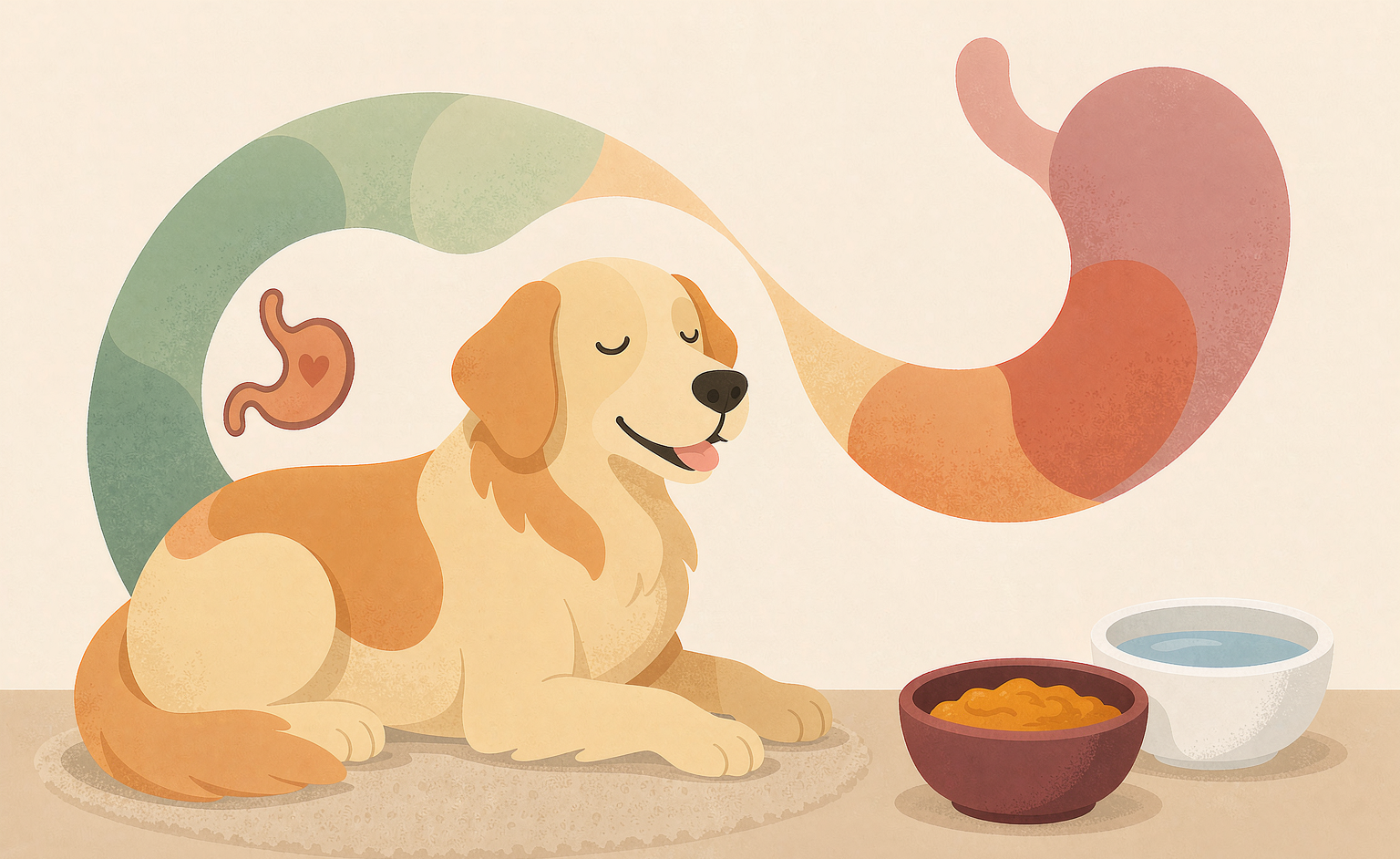
The safest first-line stool softener for a dog is usually water plus a measured fiber source, most commonly plain canned pumpkin, and a lubricant such as a small amount of mineral oil or a veterinary product like lactulose when a vet has prescribed it. Docusate sodium is the classic human stool softener and is sometimes used in dogs at a veterinary dose. Never give a dog a human stimulant laxative or a human enema. No bowel movement for 48 to 72 hours, straining with nothing produced, vomiting, a painful or bloated belly, or blood in the stool are all reasons for a same-day vet call rather than a home remedy.
—
First, Sort the Problem Before You Shop
Hard stool is a symptom, and the products on the shelf only fit some of its causes. Working through these four questions first will save you from the wrong purchase and, occasionally, from a missed emergency.
Is there actually stool to soften? A dog posturing repeatedly with nothing coming out is not necessarily constipated in the ordinary sense. Two conditions mimic it and both are urgent. The first is a urethral obstruction in a male dog, where the dog hunches and strains to urinate. The second is obstipation, where the colon is packed with a mass of dry stool the dog cannot move. In the second case, softening agents alone rarely solve it, because the stool is already too far along to respond.
Is there a foreign body? A swallowed toy, bone fragment, or cloth can sit in the bowel and produce exactly the signs of constipation. Softening the stool does nothing for a mechanical blockage and delays the imaging that would find it. If you suspect ingestion, call rather than treat.
Is the stool problem actually the whole problem? Not always. A dog with chronic digestive disease, inflammation of the colon, or a parasitic burden can present with altered stool long before anyone notices anything else, and our colitis in dogs guide walks through the inflammatory picture that sits behind a lot of treatment-resistant constipation. If the problem runs the other way instead, the dog diarrhea home remedy guide covers that end of the spectrum. And if your dog has stopped eating alongside the bowel change, the dog not eating guide explains why appetite loss changes the urgency.
How long has it been? A healthy adult dog generally produces stool one to two times a day, and missing a single day is not a medical event. A change in the dog’s own routine matters more than any absolute number, but the practical line most veterinarians use is 48 to 72 hours without a bowel movement, with urgency rising the moment straining, vomiting, or appetite loss joins the picture.
What changed recently? A food switch without a transition, a new treat, a decreased water intake in hot weather, a course of antibiotics, less exercise after an injury, an anal gland problem making defecation painful, or a new medication can all be the actual cause, and each has a specific fix that is better than any product in the aisle. Anal gland disease deserves particular mention, because a dog whose glands are impacted or infected associates defecation with pain and will hold stool, which then dries out and compounds the problem. Our dog scooting guide covers the signs that point to the glands rather than the gut.
The Categories, Sorted by Mechanism
Stool softeners are grouped by how they work, and the grouping is what tells you whether the product is appropriate.
| Category | How it works | Examples | Use in dogs |
|---|---|---|---|
| **Bulk-forming fiber** | Absorbs water, increases stool volume, stimulates the colon by distending it | Psyllium, pumpkin, wheat bran, methylcellulose | Reasonable first line for simple dry stool, needs plenty of water alongside |
| **Osmotic agents** | Draws water into the colon | Lactulose, polyethylene glycol, lactitol | Lactulose is a common veterinary prescription, effective and generally well tolerated |
| **Emollient / surfactant** | Lets water penetrate and soften the stool mass | Docusate sodium, docusate calcium | Sometimes used in dogs at a veterinary dose, weak on its own |
| **Lubricants** | Coats the stool and eases passage | Mineral oil, white petrolatum | Short-term veterinary use only, carries a real aspiration hazard |
| **Stimulant laxatives** | Directly stimulates bowel contractions | Senna, bisacodyl, cascara, castor oil | Not for dogs without direct veterinary direction |
| **Enemas** | Fluid instilled into the rectum | Human phosphate enema, soap suds enema | Never at home in a dog |
Where Pumpkin Fits, and Where It Does Not
Plain canned pumpkin is the near-universal first suggestion, and it earns that position for sensible reasons. It is cheap, familiar, and mostly water, and its fiber is largely soluble, which means it is fermented in the colon into short-chain fatty acids that support normal colonic function and help stool retain moisture. A typical starting amount for a medium dog is one to two tablespoons mixed into food, adjusted by body size, with the important qualifier that pumpkin is a fiber source, not a laxative. It supports a normally functioning gut. It does not force a bowel movement in a dog that is obstipated or blocked.
Two related cautions. Use plain canned pumpkin, not pumpkin pie filling, which carries added sugar and spices. And keep the amount measured rather than generous, because a large soluble fiber load in a dog that is already dehydrated can make the stool bulkier without making it softer, which is the opposite of the goal.
There is also a fiber nuance most guides skip. Soluble fiber holds water and supports fermentation. Insoluble fiber, such as cellulose and bran, adds bulk and stimulates the colon wall, but it also lowers the water content of the stool. In a dog whose problem is genuinely dry stool, piling on insoluble fiber can backfire. This is one of the reasons a diet change or a vet-selected fiber type beats a generic bran sprinkle.
The Products You Should Not Give
Human stimulant laxatives. Senna, bisacodyl, cascara sagrada, and castor oil are designed to force contractions in a human colon and are dosed for human body weight and human physiology. In dogs they can cause severe cramping, profuse diarrhea, dehydration, and electrolyte loss, and some ingredients carry additional toxicity concerns. There is no safe home dose to guess at.
Human enemas. This is the most dangerous item on the list, and it deserves its own line. Ready-to-use human enema solutions are frequently phosphate-based, and phosphate is absorbed through the colonic wall. In dogs, and especially in small dogs, that absorption can produce severe hyperphosphatemia and acute kidney injury, which is a well-documented veterinary emergency and can be fatal. Soap suds enemas prepared at home carry their own risk of mucosal damage and electrolyte problems. If a dog needs an enema, it is a veterinary procedure performed with the right solution and usually with sedation.
Mineral oil given carelessly. Mineral oil is a legitimate short-term lubricant in veterinary hands, but it has a specific and serious hazard: if it is squirted into the mouth and the dog inhales even a small amount, it causes aspiration pneumonia, because oil in the airway cannot be coughed out. Given by mouth it should be mixed into food rather than syringed, it should not be given to a dog who is vomiting or has any swallow difficulty, and it should not be used long term, because it can interfere with absorption of fat-soluble vitamins.
Docusate in the wrong hands. Docusate sodium is the closest thing to a true stool softener, and a veterinarian may well prescribe it. Two cautions apply. The dose is weight-based and much lower than a human adult dose, and docusate calcium should not be substituted for docusate sodium by assumption, since they are not equivalent in use. Ask before you guess.
Lactulose is the exception worth understanding. Lactulose is a synthetic sugar that draws water into the colon osmotically, and it is genuinely useful in dogs, which is why veterinarians reach for it. It is a prescription item precisely because the dose has to be titrated to the individual dog: too little and nothing happens, too much and you trade constipation for a very messy diarrhea. If a vet prescribes it, follow the titration schedule rather than improvising.
What a Veterinarian Actually Does
If home measures do not work within about a day, or if any red flag is present, the veterinary visit follows a predictable and useful shape.
The history and physical exam come first, including an abdominal palpation and a rectal exam, which can identify hard stool in the rectum, a mass, a stricture, or an anal gland problem. Bloodwork checks for the metabolic drivers worth ruling out, particularly dehydration, kidney values, calcium, and thyroid. Imaging, usually radiographs and sometimes ultrasound, is what separates simple constipation from a mechanical obstruction or a colon packed past the point of responding.
Treatment then scales with the finding. Mild cases get hydration, a diet or fiber adjustment, and a prescribed osmotic agent. More advanced cases get fluid therapy and manual evacuation under sedation. Genuine obstipation or megacolon may need a repeated evacuation protocol and a long-term management plan. A mechanical obstruction is surgical. In every one of those branches, the thing that determined the outcome was the diagnosis, not the brand of softener, which is the reason self-treatment has such a short runway.
Preventing the Next Episode
Once a dog has been cleared, the boring measures do most of the work.
- Water intake, always. Wet food, multiple bowls, and a splash of water in the bowl all help. A dog who is not drinking enough will produce hard stool regardless of what else you change.
- Fiber consistency rather than fiber spikes. Drastic swings in either direction are what trigger episodes. Change the amount gradually over a week.
- Steady exercise. Movement stimulates gut motility. Short walks after meals are more useful than one big weekend outing, and they matter most for older dogs and dogs recovering from injury.
- Attention to pain. Anal gland disease and arthritis can make defecation painful, and a dog who associates the act with pain will hold stool, which makes the stool harder. Treating the pain treats the constipation.
- Routine and privacy. Some dogs will not defecate on an unfamiliar surface or in an interrupted walk. That is a schedule problem with a schedule fix.
- Diet transitions done properly. Switch foods across seven to ten days rather than overnight.
Where Gut Support Fits
Simple constipation in dogs is often a story about a slow or unbalanced gut environment rather than a dramatic disease, and that is the narrow place where daily nutritional support is reasonable to consider. A stable microbiome supports normal fermentation of soluble fiber and normal motility, and fiber fermentation is the mechanism that makes pumpkin work in the first place.
Our 12 Billion CFU Multi-Strain Probiotic Soft Chews combine eight probiotic strains with four prebiotics and five digestive enzymes, plus a pumpkin, flaxseed, and apple powder blend as fiber sources. The prebiotic fibers feed the bacteria responsible for fermenting the soluble fiber in the diet, and the enzymes support normal digestion, so the formula lines up with the maintenance side of the picture rather than the acute side. It is a daily gut-support layer, not a stool softener, not a laxative, and not a treatment for constipation or for any condition behind it. A dog who is blocked, obstipated, or unwell needs veterinary diagnosis and management, and no supplement substitutes for that. Pairing it with a complete daily formula such as our dog multivitamin soft chews covers the baseline nutrients that a dog on a restricted or bland diet may be missing while the gut settles.
Frequently Asked Questions
What is the safest stool softener for dogs?
For a bright, eating, drinking dog with mildly hard stool, the safest first step is water plus a measured soluble fiber source such as plain canned pumpkin, and more exercise. If a softer stool is genuinely needed, the products a veterinarian is most likely to reach for are lactulose and, less often, docusate sodium at a weight-based dose. Never use a human stimulant laxative or a human enema at home.
Can I give my dog docusate sodium?
Sometimes, and only at a veterinary dose. Docusate sodium is a surfactant that helps water penetrate the stool, and it is used in dogs, but the canine dose is much lower than a human adult dose and is based on body weight. Do not substitute docusate calcium by assumption, and do not give it to a dog who has not been evaluated if the constipation is severe or long-standing.
Is pumpkin a stool softener?
It is a soluble fiber source, which is not the same thing. Pumpkin helps a normally functioning colon hold water in the stool and supports the fermentation that keeps things moving, and it works well in mild cases with adequate water intake. It does not force a bowel movement, and it will not resolve obstipation or a mechanical obstruction. Use plain canned pumpkin, not pie filling.
Why can I not give my dog a human enema?
Because many ready-to-use human enemas are phosphate-based, and phosphate is absorbed through the colonic wall. In dogs that absorption can cause severe hyperphosphatemia and acute kidney injury, which is a documented veterinary emergency and can be fatal, especially in small dogs. Home-prepared soap suds enemas carry their own risk of mucosal damage. Enemas in dogs are veterinary procedures.
How long can a dog go without pooping?
A missed day is usually not concerning in a healthy adult dog. Reach out to your veterinarian if there is no bowel movement for 48 to 72 hours, and seek care the same day if there is repeated straining with nothing produced, vomiting, a bloated or painful abdomen, loss of appetite, or blood in the stool.
Are stimulant laxatives safe for dogs?
Not on a home-guess basis. Senna, bisacodyl, cascara, and castor oil are formulated and dosed for human physiology and can cause severe cramping, profuse diarrhea, and dehydration in dogs, with additional toxicity concerns for some ingredients. If a stimulant is ever appropriate, it is a decision and dose made by a veterinarian.
What if nothing works and my dog is still straining?
That is the signal to stop home treatment and get a diagnosis. Straining with no result can mean obstipation, a foreign body obstruction, a mass, or a urethral blockage in a male dog, and those need imaging rather than another day of fiber. Repeating home remedies past the 24-hour mark mostly costs time.
Bottom Line
Stool softener is a category, not a product, and the category that fits a dog depends entirely on what is causing the hard stool. For ordinary mild constipation, water, measured soluble fiber, and movement do the work, and they do it gently. For persistent or painful cases, lactulose and docusate sodium are real tools, but they are veterinary-scale tools. What should never enter the picture is a human stimulant laxative or a human enema, because the phosphate load in the latter can cause kidney injury in a dog. And underneath all of it sits the rule that matters more than any product: no stool for 48 to 72 hours, straining with nothing produced, vomiting, or a painful belly means the next step is a vet, not the medicine cabinet.
Disclaimer
This article is for general education only and is not veterinary advice. Never give a dog human laxatives, enemas, or medications without veterinary direction, as some carry serious toxicity risks including acute kidney injury. Seek prompt veterinary care if your dog has not passed stool for 48 to 72 hours, is straining without producing stool, is vomiting, has a painful or bloated abdomen, or has blood in the stool. Dietary supplements are not intended to diagnose, treat, cure, or prevent any disease, and you should consult your veterinarian before starting any supplement.
References
- VCA Animal Hospitals. “Constipation in Dogs.”
- Merck Veterinary Manual. “Disorders of Defecation and the Rectum and Anus in Dogs.”
- Veterinary Partner (VIN). “Constipation and Obstipation in Dogs.”
- American Kennel Club. “Dog Constipation: Causes, Symptoms, and Treatment.”
- Cornell University College of Veterinary Medicine. “Fiber in Pet Diets.”
- Washabau RJ, et al. “Constipation, obstipation, and megacolon.” In: Small Animal Gastroenterology.